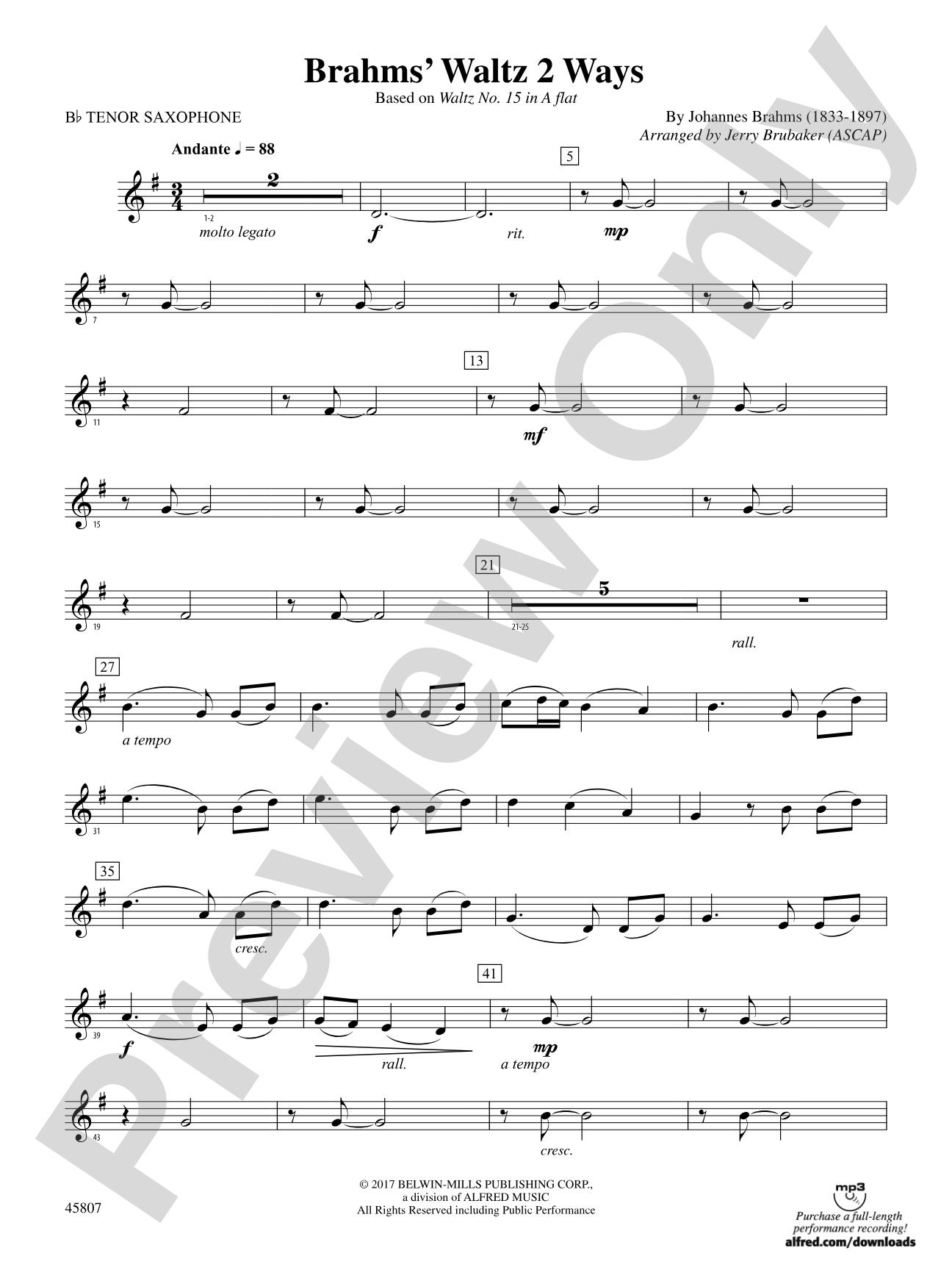
Brahms' Waltz 2 Ways: B-flat Tenor Saxophone Sheet Music Preview

Brahms' Waltz 2 Ways: B-flat Tenor Saxophone

Based on Waltz No. 15 in A-flat

By Johannes Brahms / arr. Jerry Brubaker

Grade: 3 (Medium Easy)

Item: 00-PC-0017613_TX1

Digital Download
$3.00
Description
Chocked full of special ingredients, here are two contrasting settings of a lovely Brahm's waltz; first a lush traditional setting, then an upbeat jazz-waltz treatment. A tasty choice that is sure to be savored by audiences and students alike! (3:15)

Don't just read it, hear it, play along with it, and watch your students grow with it. In MakeMusic Cloud, Brahms' Waltz 2 Ways: B-flat Tenor Saxophone comes alive with professional accompaniment, adjustable tempo, and built-in practice tools that turn solo practice into real progress.

Sample Audio
0:00
0:00
Sample Video
Additional Details
Series: Belwin Concert Band
Publisher: Alfred Music
Page Count: 230
SKU: 00-PC-0017613_TX1

More about this title

About the Composer: Johannes Brahms

Johannes Brahms (1833-1897) composed during the Romantic era and remains one of classical music's most performed and celebrated composers. His mastery of melody, harmonic sophistication, and structural clarity shaped the concert music repertoire that still defines our concert halls today. Brahms wrote across all genres—symphonies, concertos, chamber works, and songs—and his music balances emotional depth with rigorous compositional craft.

Why we love this

Jerry Brubaker's dual arrangement gives you two entirely different concert experiences from a single beautiful waltz melody. The traditional setting honors Brahms' romantic sensibilities, while the jazz-waltz treatment brings contemporary energy and style to a Romantic masterwork, making this ideal for mixed-level audiences and programming that bridges classical and popular tastes.

What to expect

The first setting blooms with the warmth and elegance of a Vienna ballroom, its lush harmonies and gentle sway inviting the listener to waltz along. The second shifts gear entirely, trading romance for sophistication and swing, infusing the familiar melody with jazz vocabulary and rhythmic snap that feels both playful and polished.

Who it's for

This arrangement works for concert bands at the Grade 3 level seeking repertoire that challenges without overwhelming. Directors programming mixed-age or mixed-skill ensembles will appreciate how the accessible difficulty doesn't compromise musical sophistication, and audiences respond enthusiastically to the contrast between the two treatments.

How to get the most out of it

  • Shape the phrasing in the traditional setting with long, singing lines; resist the urge to rush the romantic rubato—let the band breathe with the music.
  • In the jazz-waltz section, establish a clear triplet feel and lock the rhythm section to anchor the swing interpretation across the ensemble.
  • Balance the two contrasting styles during rehearsal by treating them as distinct pieces with separate musical personalities rather than variations of the same idea.
  • Use the score's 230 pages as a road map for dynamic shaping and sectional balance; the detail Brubaker includes rewards careful attention to the conductor's markings.

How to use it

Program this as a centerpiece in a concert celebrating arranging or genre fusion, or use it as a bridge between classical and jazz repertoire in a season that spans styles. The 3:15 duration fits comfortably into a concert pacing, and audiences particularly enjoy the surprise transition that makes this feel fresh each time they hear it.

Skills your students will build

  • Contrast in style and interpretation (Romantic lyricism versus jazz vocabulary)
  • Balancing multiple dynamic levels and textures within a single ensemble
  • Listening to sectional independence while maintaining ensemble cohesion across genre changes
  • Reading and executing triplet-feel rhythms and swing articulation in a concert band context

You May Also Like