

Brahms: Piano Works (Volume II: Op. 76-119 & 5 Etudes)
By Johannes Brahms / ed. E. V. Sauer
Item: 00-PC-0005674
$0.99
Pickup currently not available
Description
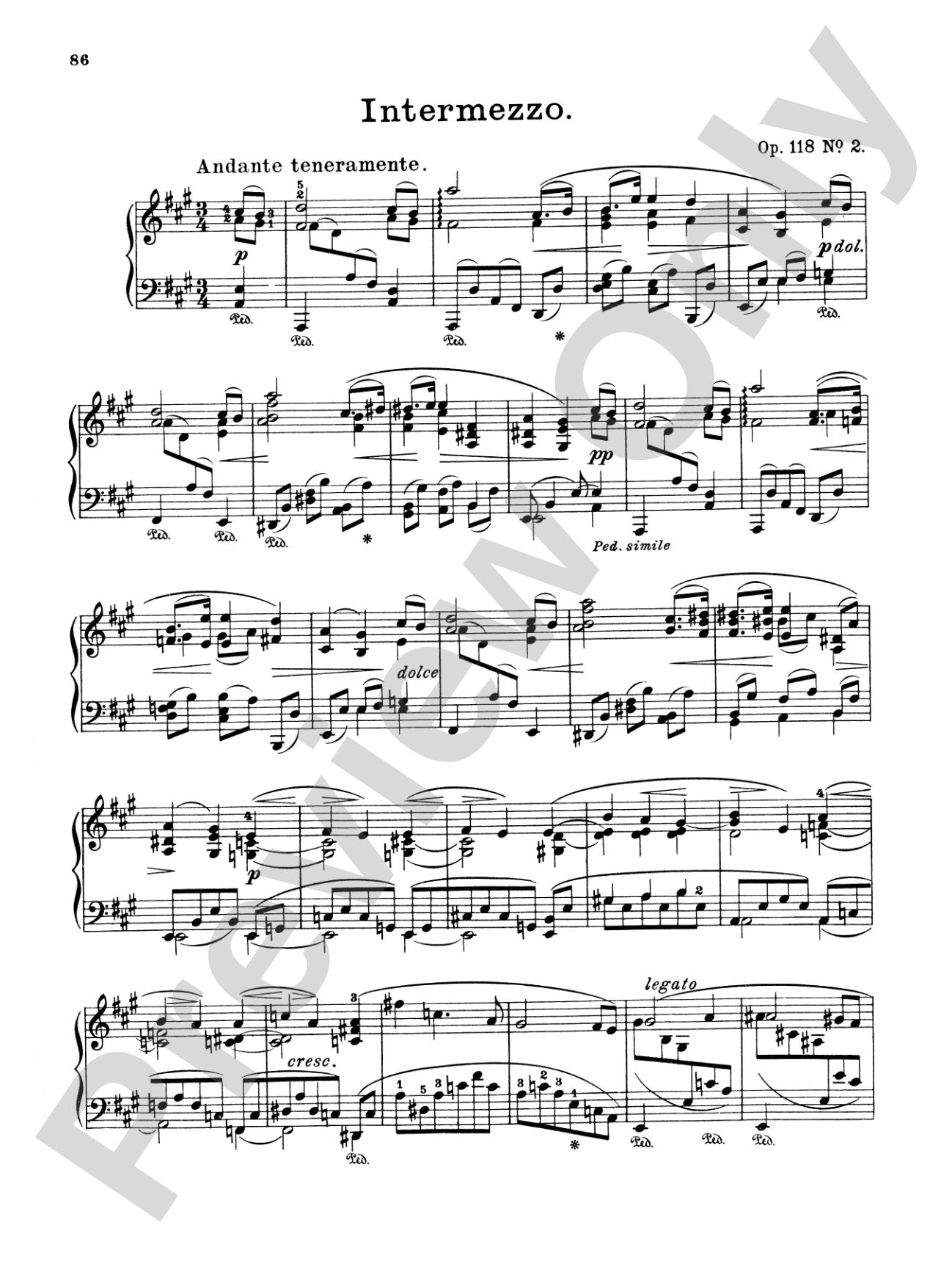
This volume includes the Opus 76 Piano Pieces, Opus 79 Two Rhapsodies, Opus 116 Fantasies, Opus 117 Intermezzi, Opus 118 Piano Pieces, Opus 119 Piano Pieces, and Five Studies.


Don't just read it, hear it, play along with it, and watch your students grow with it. In MakeMusic Cloud, Brahms: Piano Works (Volume II: Op. 76-119 & 5 Etudes) comes alive with professional accompaniment, adjustable tempo, and built-in practice tools that turn solo practice into real progress.
Open in the Player
Jump straight in and assign it today.
Start Your Free Trial
Open this title and explore the full library in minutes.
Sample Audio
No sample audio found.
Sample Video
No sample videos found.
Additional Details
Series:
Kalmus Edition
Publisher:
Alfred Music
Page Count:
160
SKU:
00-PC-0005674
More about this title
About the Composer: Johannes Brahms
Johannes Brahms (1833-1897) stands as one of the towering figures of Romantic music, a composer equally comfortable with intimate chamber works and grand symphonic statements. His late piano works represent the culmination of a lifetime spent exploring the instrument's expressive range, synthesizing Baroque contrapuntal mastery with Romantic harmonic innovation. Brahms arrived in Vienna in 1862 and remained there for the rest of his life, gradually establishing himself as a major force in European concert halls. His deep engagement with the music of Bach and Beethoven shaped his compositional voice, informing works that balance structural rigor with emotional depth.
The pieces in this volume span Brahms's mature and late periods, written between 1877 and 1893, when he had achieved complete artistic confidence. Rather than pursuing virtuosic display, Brahms crafted these works as vehicles for introspection, lyrical beauty, and sophisticated formal thinking. They reveal a composer uninterested in following fashion, instead creating music of enduring substance that rewards careful study and repeated listening.
Why we love this
This collection gathers the later Brahms piano works that pianists return to throughout their careers, and for good reason. The balance of technical accessibility and interpretive depth makes these pieces ideal for students ready to engage with serious repertoire, while the emotional range across eight opus numbers gives teachers real flexibility in programming. Unlike the early Brahms virtuoso works, these pieces invite slow exploration of harmony and color rather than speed, making them perfect entry points into Late Romantic piano literature.
What to expect
These works inhabit a world of introspection and emotional restraint, far removed from the virtuosic pyrotechnics of earlier Romantic writing. The Intermezzos and Fantasies offer moments of profound lyricism alongside harmonically daring passages that feel both intimate and immense. Throughout the volume, Brahms uses the full range of the piano to create rich textural variety, from spun-out melodies over rolling accompaniments to stark, almost stark harmonic progressions that feel modern in their austerity.
Who it's for
Advanced pianists and serious students with solid Romantic-era technique and the ability to hear multi-voice counterpoint will find this collection essential. Teachers preparing students for competitions, conservatory auditions, or advanced recital work benefit from having all these major later works in one volume. This is repertoire for pianists who have moved beyond showpieces and are ready to engage with music of structural and emotional complexity.
How to get the most out of it
- Honor the voice leading across registers; Brahms often suspends melodic lines that aren't in the soprano voice, and students easily miss the architectural integrity if they play mechanically. Listen for inner voices and shape them with the same care you give the melody.
- The Intermezzos and Fantasies contain subtle rhythmic elasticity despite their surface regularity. Avoid metronomic rigidity, especially in slow sections where Brahms's harmonic movement should breathe naturally.
- Pedal changes must be frequent and precise in these works. Brahms's harmonic language often creates subtle overlaps, and unclear pedaling will blur his carefully voiced chords. Experiment with half-pedal and rapid changes rather than holding the pedal through entire phrases.
- The Rhapsodies demand structural clarity. Mark the large formal divisions and ensure listeners can hear the architecture of each piece. These aren't rhapsodies in the improvisatory sense; they're tightly organized despite their dramatic surface.
How to use it
These works anchor a recital program or serve as the centerpiece of a Brahms evening devoted to his late style. Pair individual pieces (an Intermezzo, a Rhapsody, or a Fantasia) with earlier Romantics or Baroque selections to highlight how Brahms synthesizes musical history. The shorter pieces work well in chamber music contexts with string players, creating natural pairing opportunities with Brahms's sonatas and other works from the same period.
Skills your students will build
- Identifying and voicing hidden melodic lines within dense harmonic textures
- Sustaining interpretive control across extended harmonic progressions without tonal anchors
- Precise pedal work and harmonic clarity in music with sophisticated voice leading
- Structural analysis and formal understanding of non-traditional piano forms (fantasy, rhapsody, intermezzo)
- Subtle rhythmic flexibility and rubato within metrically regular frameworks
- Color and texture differentiation across the full range of the keyboard