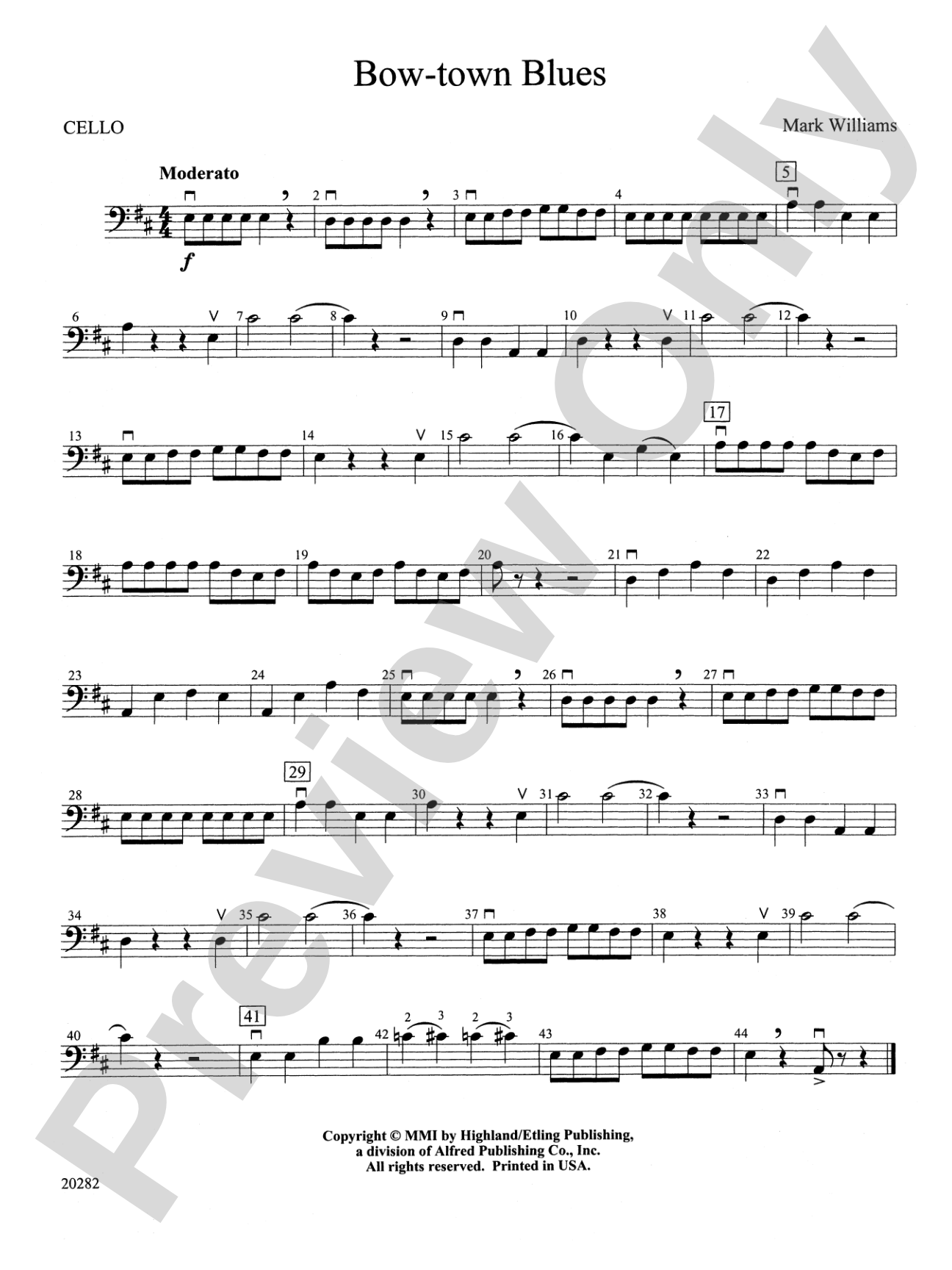
Bow-town Blues: Cello Sheet Music Preview

Bow-town Blues: Cello

By Mark Williams

Grade: 2

Item: 00-PC-0000376_VC1

Digital Download
$5.99
Description
A knowledge of the 12-bar blues form is essential for understanding the roots of American jazz and popular music. Bow-town Blues provides an excellent introduction to this uniquely American art form with substantial opportunity for practicing C-natural and C-sharp on the A string. Let your students experience the blues with this fun and engaging composition by Mark Williams. Correlated with Strictly Strings, Book 1, page 30.

Don't just read it, hear it, play along with it, and watch your students grow with it. In MakeMusic Cloud, Bow-town Blues: Cello comes alive with professional accompaniment, adjustable tempo, and built-in practice tools that turn solo practice into real progress.

Sample Audio
0:00
0:00
Sample Video
Additional Details
Series: Highland/Etling Strictly Strings
Publisher: Alfred Music
Page Count: 72
SKU: 00-PC-0000376_VC1

More about this title

About the Composer: Mark Williams

Mark Williams

Mark Williams built a prolific career writing for young ensembles, with over 200 compositions for band, orchestra, and choir to his name. A co-author of the Accent on Achievement Band Method and a seasoned clinician, he conducted and adjudicated across 34 states, five Canadian provinces, and Australia, bringing his educational philosophy directly to school programs nationwide.

Williams earned degrees from Eastern Washington University and spent his teaching career in Washington schools with a focus on elementary band instruction. Beyond composing, he performed bassoon professionally with the 560th Air Force Band and later served as Conductor and Artistic Director for the Spokane British Brass Band. His contributions to music education were recognized through awards including the Western International Band Clinic's Gralia Competition and multiple ASCAP Special Awards.

Why we love this

Williams grounded this piece in genuine pedagogical purpose: students learn the 12-bar blues form by playing it, not by studying it in isolation. The specific focus on C-natural and C-sharp fingerings on the A string transforms what could feel like a technical exercise into musicmaking that feels purposeful and rooted in real American musical tradition.

What to expect

Accessible and inviting, with the rhythmic swagger of a classic 12-bar blues translated into string textures. Students experience the satisfaction of playing something recognizable and culturally significant, even at grade 2, with enough harmonic movement to keep the ear engaged across the form's repetitions.

Who it's for

String orchestras at the early-intermediate level, particularly those just beginning to explore jazz and blues repertoire. This works well for ensembles using Strictly Strings Book 1 who need repertoire that reinforces specific technical skills while introducing historical musical context.

How to get the most out of it

  • Establish the swing feel early in rehearsal by having students listen to recordings of authentic blues before playing. The groove matters as much as the notes.
  • Balance the ensemble so the blues changes are clearly audible. Layer sections through the form so students can hear how the 12 bars cycle and repeat.
  • Encourage vibrato on sustained tones, especially from the section carrying the melody. It adds color and authenticity to the blues idiom.
  • Keep the tempo comfortable enough that intonation stays solid through the key changes, particularly during the C-sharp passages.

How to use it

Pair this with a short unit on the history of blues in American music, using it as a bridge between classical technique and jazz idioms. It works especially well in a concert that explores American musical traditions, or as a festival piece that showcases ensemble cohesion and rhythmic maturity.

Skills your students will build

  • Intonation of C-natural and C-sharp on the A string
  • Understanding of 12-bar blues form and harmonic structure
  • Ensemble swing and rhythmic flexibility
  • Reading and playing through key changes
  • Stylistic awareness of blues idiom and phrasing

You May Also Like