Bourrée from Terpsichore: 1st B-flat Clarinet Sheet Music Preview

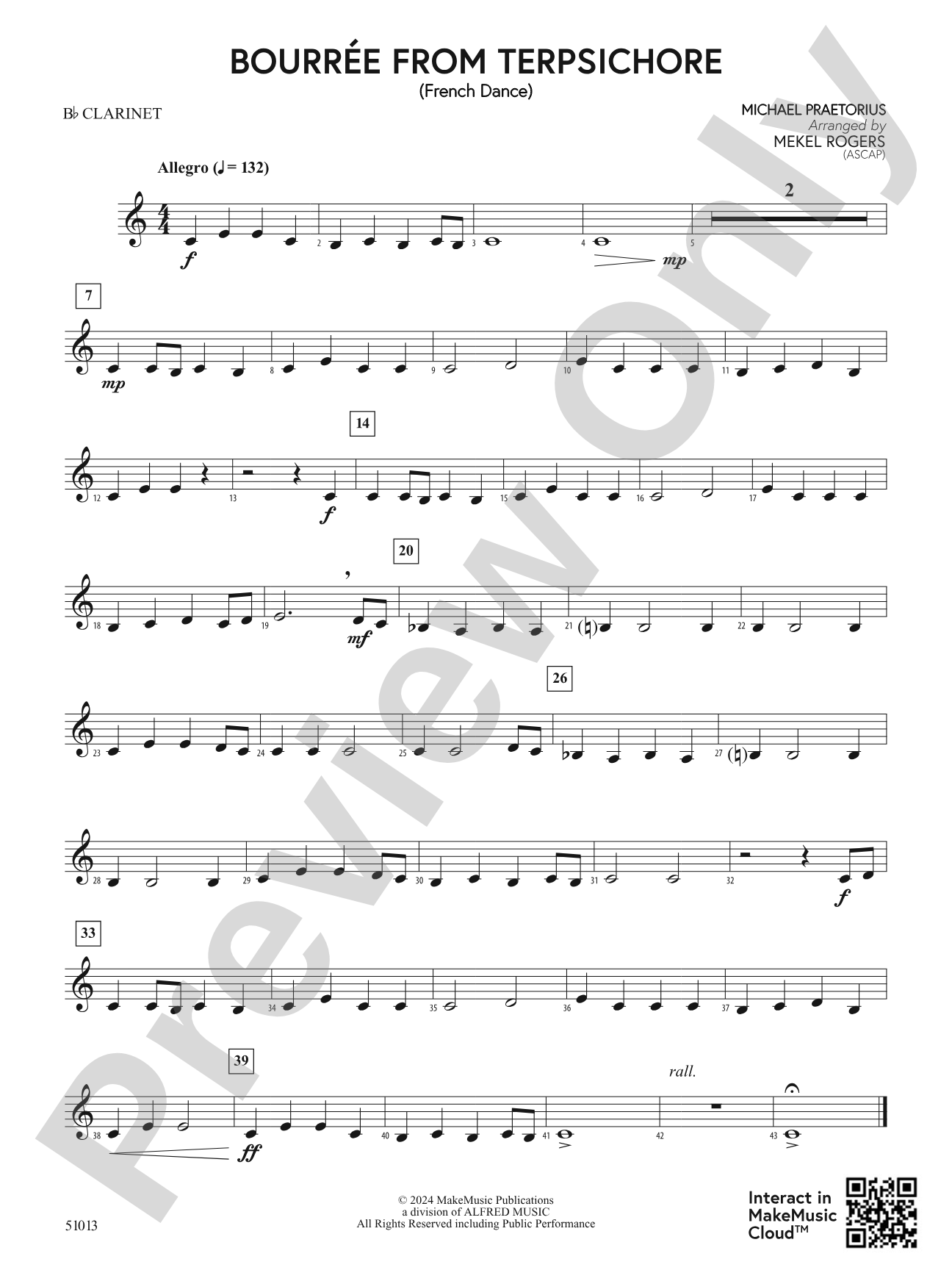
Bourrée from Terpsichore: 1st B-flat Clarinet

(French Dance)

By Michael Praetorius / arr. Mekel Rogers

Grade: 0.5

Item: 00-PC-0019226_C1

Digital Download
$3.00
Description
This spirited and authentic arrangement of Michael Praetorius's Bourrée from Terpsichore is stunningly accessible to young players as early as their first year of study. Arranger Mekel Rogers has made this an excellent way to explore Renaissance music in a highly engaging and fun work for all players! (1:30)

Don't just read it, hear it, play along with it, and watch your students grow with it. In MakeMusic Cloud, Bourrée from Terpsichore: 1st B-flat Clarinet comes alive with professional accompaniment, adjustable tempo, and built-in practice tools that turn solo practice into real progress.

Sample Audio
0:00
0:00
Sample Video
Additional Details
Series: MakeMusic First Performance Band
Publisher: MakeMusic Publications
SKU: 00-PC-0019226_C1

More about this title

About the Composer: Michael Praetorius

Michael Praetorius (1571-1621) was a German composer, theorist, and music director whose output shaped early Baroque practice across Europe. His vast catalog included sacred vocal works, instrumental dances, and theoretical writings that documented Renaissance performance practice in meticulous detail.

Terpsichore, published in 1612, stands as one of his most enduring legacies: a collection of over 300 dance tunes drawn from French sources and original compositions. These dances were designed for courtly entertainment and remain foundational repertoire for understanding Renaissance dance music and instrumental color.

Why we love this

This arrangement drops a masterwork directly into the hands of first-year players without sacrificing authenticity or musical substance. Rogers's scoring captures the spirited character of Renaissance dance while respecting the learning stage, making it possible for young musicians to perform genuine concert repertoire rather than simplified exercises.

What to expect

Buoyant and courtly, with the forward momentum of a Renaissance dance floor. The familiar melody sits comfortably in young instruments while the harmonies suggest the richness of period ensemble color, creating a performance that feels both accessible and genuinely musical.

Who it's for

First-year band students and early concert ensembles seeking material that builds musicianship without condescending to the player. Conductors building programs that introduce Renaissance music alongside standard wind band repertoire will find a work that engages and educates simultaneously.

How to get the most out of it

  • Bring out the rhythmic clarity of the bourrée's characteristic dotted-note figures; even at a relaxed tempo, these articulations define the dance's character.
  • Balance the melodic line across your winds without drowning the lower voices that anchor the harmonic foundation.
  • Shape the piece's natural phrasing in four- or eight-bar units rather than letting it drift; Renaissance dance forms reward clear structural breathing.
  • Check your ensemble's intonation on sustained notes; young players often flatten on half notes and whole notes, which muddies the transparent texture Praetorius wrote for.

How to use it

Program this early in a concert to establish an energetic tone, or pair it with other Renaissance or Baroque works to build thematic programming around historical periods. Its brevity (1:30) and appeal to young audiences make it ideal for educational concerts, festivals, and demonstrations of what first-year players can achieve.

Skills your students will build

  • Dotted rhythms and articulation in period style
  • Reading and balancing transparent ensemble textures
  • Sustaining intonation across whole notes and half notes
  • Phrasing according to dance form structure
  • Familiarity with Renaissance instrumentation and melodic writing

You May Also Like