Bourrée (Encore Plus, Book 2) Sheet Music Preview

Bourrée (Encore Plus, Book 2): Piano Solo

By Gottfried Heinrich Stölzel

Grade: 4

Item: 35-DS01989423

Digital Download
$3.99
Description

Discover MakeMusic Cloud: thousands of interactive titles your students can play along with today.

Sample Audio
No sample audio found.
Sample Video
Additional Details
Publisher: Hal Leonard
Page Count: 1
SKU: 35-DS01989423

More about this title

About the Composer: Gottfried Heinrich Stölzel

Gottfried Heinrich Stölzel (1690–1749) was a prolific German Baroque composer whose output spanned sacred music, opera, and instrumental works. Working primarily in Dresden and Gotha, he composed over 100 cantatas alongside countless chamber and keyboard pieces, establishing himself as a significant figure in the transition between late Baroque and early Classical styles.

Stölzel's keyboard music remains a teaching staple because it balances formal clarity with genuine melodic charm. His pieces demonstrate the characteristics of the galant style while maintaining the contrapuntal thinking of the Baroque, making them ideal for students developing both technique and musical sensitivity.

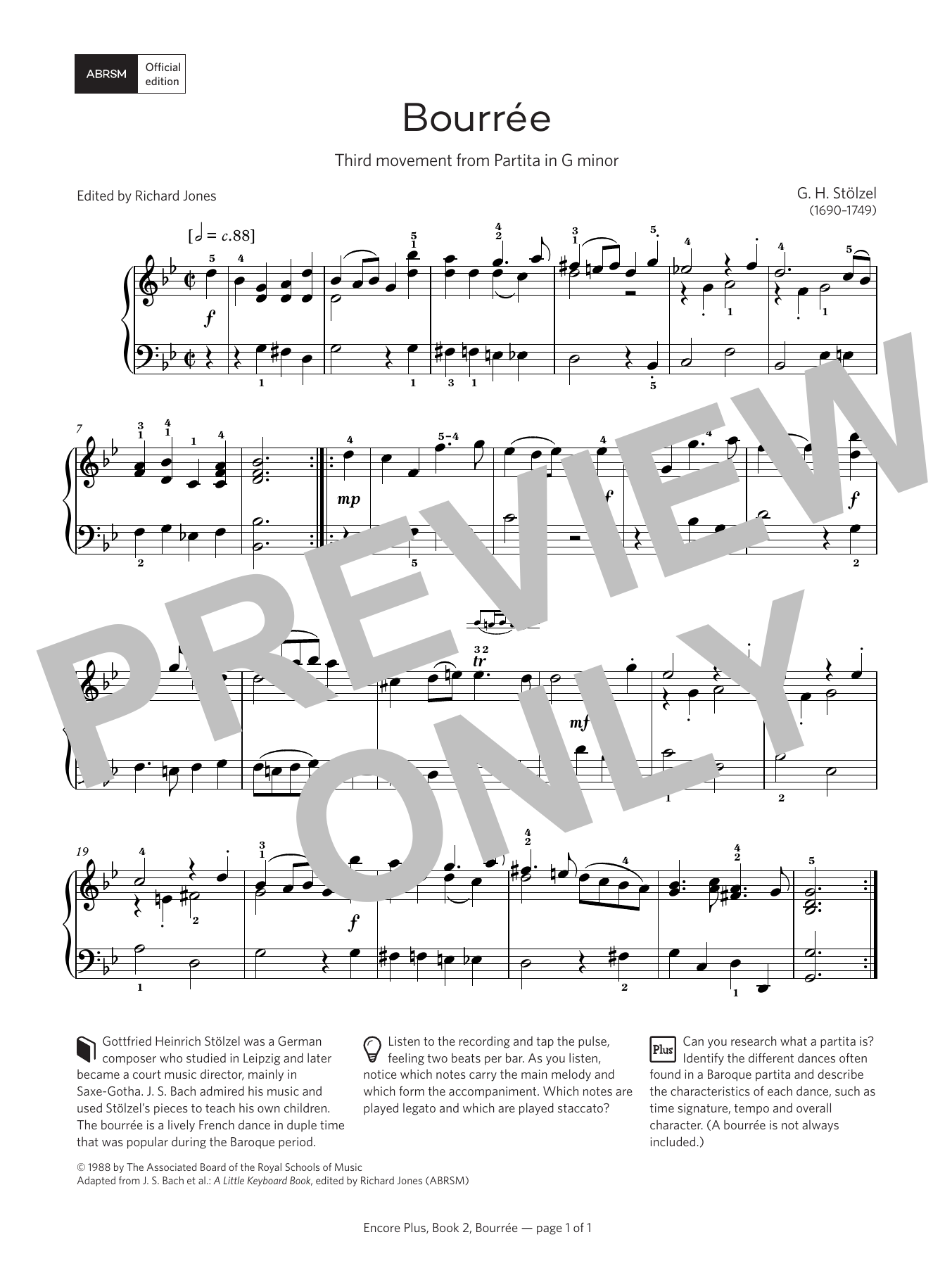
Why we love this

This bourrée sits at a sweet spot for intermediate pianists: it demands secure rhythmic clarity and articulation without requiring advanced hand spans or complex passagework. The courtly character feels immediately rewarding to perform, giving students a genuine sense of elegant musicianship at Grade 4.

What to expect

A courtly dance captured in miniature, where politeness and grace disguise genuine rhythmic vitality. The piece unfolds with the ease of conversation, never rushed, yet propelled by the steady pulse that defines the bourrée's character.

Who it's for

Grade 4 pianists ready to explore Baroque dance forms with period-appropriate style. Students working through repertoire that bridges Baroque refinement and Classical clarity will find this piece both accessible and musically substantial.

How to get the most out of it

  • Shape the two-note opening motif with a slight lift, letting each phrase begin with gentle emphasis rather than mechanical repetition
  • Maintain a walking bass line that stays conversational, never allowing the left hand to overshadow the melody's forward motion
  • Observe the binary form's repeat structure carefully; the return to material should feel like recognition rather than redundancy

How to use it

Include this on a recital exploring Baroque keyboard literature, or pair it with other galant pieces to show students how composers bridged two eras. A single page makes it ideal for supplementing a lesson repertoire without demanding extensive practice time.

Skills your students will build

  • Articulating baroque dance rhythms with historical awareness
  • Maintaining rhythmic independence between hands in a structured binary form
  • Balancing melodic line with steady accompaniment patterns
  • Recognizing and performing baroque ornamentation with restraint

You May Also Like