
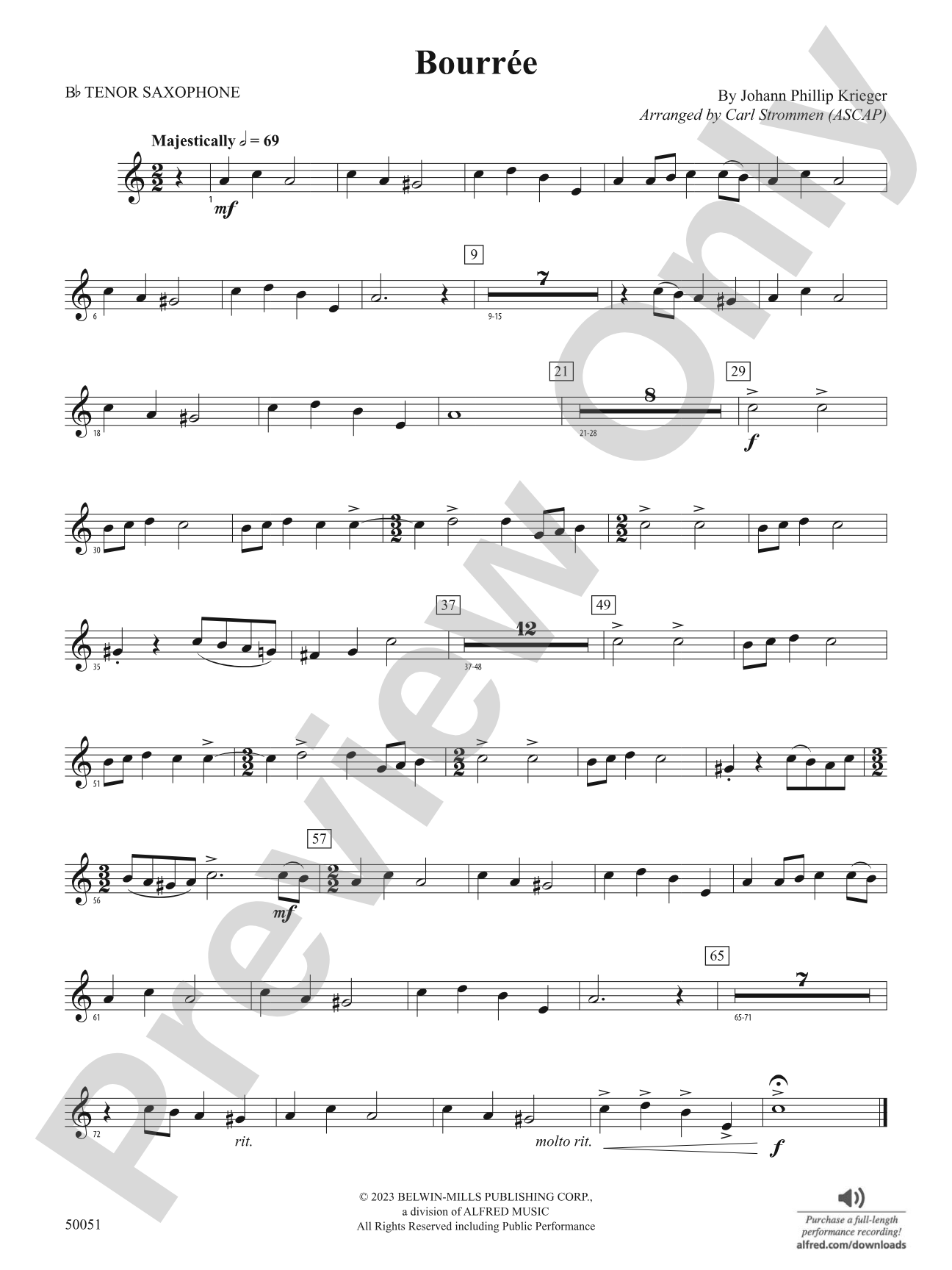

Bourrée: B-flat Tenor Saxophone
By Johann Philipp Krieger / arr. Carl Strommen
Grade: 3
Item: 00-PC-0019147_TX1
$3.00
Pickup currently not available
Description
This masterful arrangement by Carl Strommen will allow your ensemble to explore 17th- and 18th-century music. The Bourrée is a lively dance of French origin, characteristically played in cut time, with phrases often starting on the fourth beat of the measure. Bourrées often appear in the instrumental suites of Bach, Handel, and other giants of the Baroque era. Johann Philipp (von) Krieger (1649-1725) was the most notable of a family of distinguished German musicians. His oeuvre includes sacred and secular vocal music, solo and trio sonatas, partitas, and works in most of the idioms known during his time. (2:30)
The PerformancePlus+ series is an innovative addition to the ever-expanding MakeMusic Cloud interactive library. These engaging selections are presented with educational resources designed to enrich the rehearsal process and create outstanding performances. Including:


The PerformancePlus+ series is an innovative addition to the ever-expanding MakeMusic Cloud interactive library. These engaging selections are presented with educational resources designed to enrich the rehearsal process and create outstanding performances. Including:
- Assignment, recording, and assessment tools within MakeMusic Cloud
- Piece-specific exercises focused on skills and techniques
- Educational tips and suggestions to support learning
Available in print and digital formats.
Don't just read it, hear it, play along with it, and watch your students grow with it. In MakeMusic Cloud, Bourrée: B-flat Tenor Saxophone comes alive with professional accompaniment, adjustable tempo, and built-in practice tools that turn solo practice into real progress.
Open in the Player
Jump straight in and assign it today.
Start Your Free Trial
Open this title and explore the full library in minutes.
Sample Audio
1
Audio File
--:--
0:00
0:00
Sample Video
No sample videos found.
Additional Details
Series:
Belwin Concert Band - PerformancePlus+
Publisher:
Alfred Music
SKU:
00-PC-0019147_TX1
More about this title
About the Composer: Johann Phillip Krieger
Johann Philipp Krieger (1649-1725) was a central figure in German Baroque music, representing a generation of composers who synthesized Italian and German musical traditions. His prolific output spanned sacred cantatas, instrumental sonatas, partitas, and dance suites, making him a vital contributor to the expanding instrumental repertoire of the late 17th century.
Krieger's music reflects the craftsmanship and structural clarity that defined his era. His dance forms, including bourrées and other movement types, became models for later composers and remain essential documents of Baroque instrumental practice. His influence extended through his family; his brother Johann Krieger and his sons all pursued significant musical careers.
Why we love this
Strommen's arrangement captures the authentic spirit of Baroque dance music while making it accessible to intermediate ensembles. The piece delivers genuine musical substance in a compact format, giving students exposure to period-appropriate phrasing and articulation without overwhelming the band's technical capacity. At Grade 3, it serves as a genuine gateway to Baroque repertoire rather than a simplified substitute.
What to expect
Energetic and elegant, with the crisp precision of a French court dance. The characteristic cut-time pulse and quick-stepped character create momentum and lift, drawing performers and audiences into the refined world of Baroque instrumental music.
Who it's for
Concert bands at the Grade 3 level seeking authentic Baroque repertoire that challenges musicianship without demanding virtuosity. Directors programming festival contests or concert series will find a piece that balances historical substance with accessible arrangement.
How to get the most out of it
- Shape phrases to begin on the characteristic fourth beat of the measure, allowing the band to feel the natural lift and momentum that defines the bourrée's rhythmic character.
- Maintain the crisp, articulated style of Baroque dance music; avoid overblowing or sustaining notes beyond their written values, which will obscure the period's characteristic clarity.
- Coordinate the rhythm section and lower voices to establish a steady harmonic foundation that supports the melodic lines without dragging the tempo.
- Use the PerformancePlus+ recording as a reference for stylistic interpretation, but encourage ensemble members to listen actively rather than relying on it as a strict tempo click.
How to use it
Program this alongside other Baroque or early music selections to build a thematic concert unit, or position it as a contrasting opener that establishes the ensemble's stylistic versatility. Its 2:30 duration makes it an ideal festival selection or a compelling addition to a concert that surveys historical periods.
Skills your students will build
- Baroque phrasing and articulation in a dance context
- Cut-time meter and the rhythmic character of period-appropriate dance forms
- Ensemble balance and clarity in lighter, more transparent textures
- Stylistic listening and interpretation using recorded reference materials
- Coordination of melodic and harmonic roles within a small ensemble setting