Bourree Sheet Music Preview

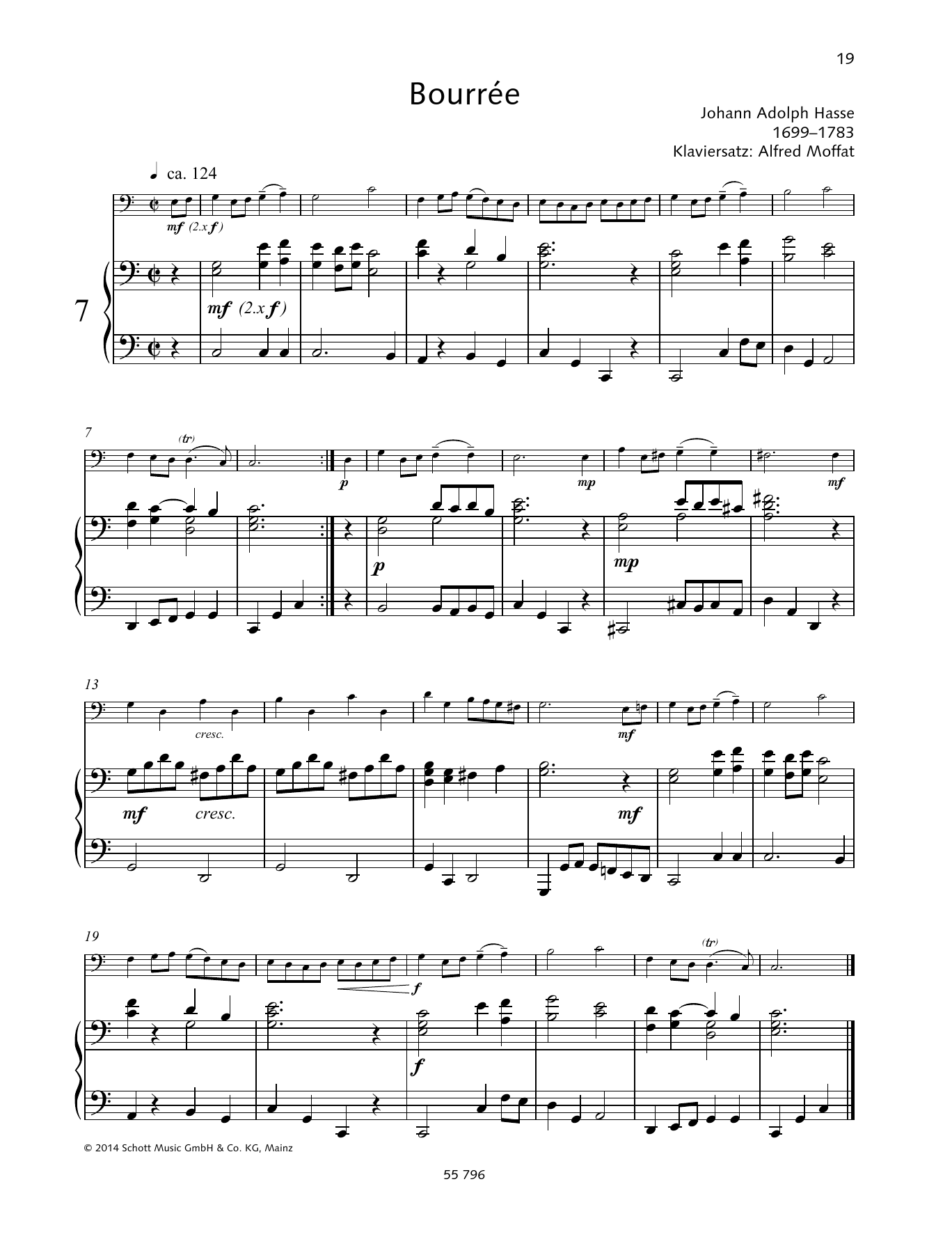
Bourree: Cello and Piano

By Johann Adolph Hasse / Edited by Rainer Mohrs

Item: 35-DS00371962

Digital Download
$1.99
Description

Discover MakeMusic Cloud: thousands of interactive titles your students can play along with today.

Sample Audio
No sample audio found.
Sample Video
Additional Details
Publisher: Hal Leonard
Page Count: 2
SKU: 35-DS00371962

More about this title

About the Composer: Johann Adolph Hasse

Johann Adolph Hasse (1699-1783) was one of the most prolific and celebrated composers of the 18th century, earning the nickname 'Il Sassone' (The Saxon) during his long career in Italy. His gift for vocal writing made him famous across Europe as an opera composer, but his instrumental works reveal the same elegance and structural clarity that defined the galant style.

Hasse's compositional output spanned nearly seventy years and multiple genres. His dance movements and character pieces for keyboard and strings remain valuable teaching tools, offering students access to authentic Classical-era music with straightforward harmonic language and graceful melodic lines.

Why we love this

This bourrée sits in that sweet spot where students encounter genuine historical material without getting tangled in technical excess. The writing is transparent enough that cellists can focus on musical phrasing and period-appropriate articulation rather than fighting the notes.

What to expect

Crisp and light, with the rhythmic buoyancy that defines the bourrée character. The piece moves with courtly confidence, never rushing, inviting the performer to shape each phrase with careful attention to the natural rise and fall of the melody.

Who it's for

Cellists in their second or third year of study will find this bourrée accessible in terms of range and left-hand position work while offering meaningful practice in baroque style. It works equally well for advancing high school players or young adult amateurs looking to build a small Classical chamber repertoire.

How to get the most out of it

  • Approach the articulation with restraint; a light, detached stroke serves the baroque aesthetic better than a heavy legato that might creep in from later repertoire.
  • Keep the accompaniment supportive and uncluttered. The piano part exists to frame the cello line, not compete with it.
  • Shape the phrases in two or four-bar units rather than playing through without punctuation. These shorter gestures are characteristic of the period.

How to use it

This pairs naturally with other Classical and baroque dance movements in a student or chamber recital. It also works as a palate cleanser between weightier contemporary works, or as an encore that reminds audiences of music's essential elegance.

Skills your students will build

  • Baroque articulation and stylistic phrasing
  • Chamber music balance between cello and piano
  • Period-appropriate ornamentation and expression
  • Rhythmic precision in dance forms
  • Sight-reading galant harmonic progressions

You May Also Like