
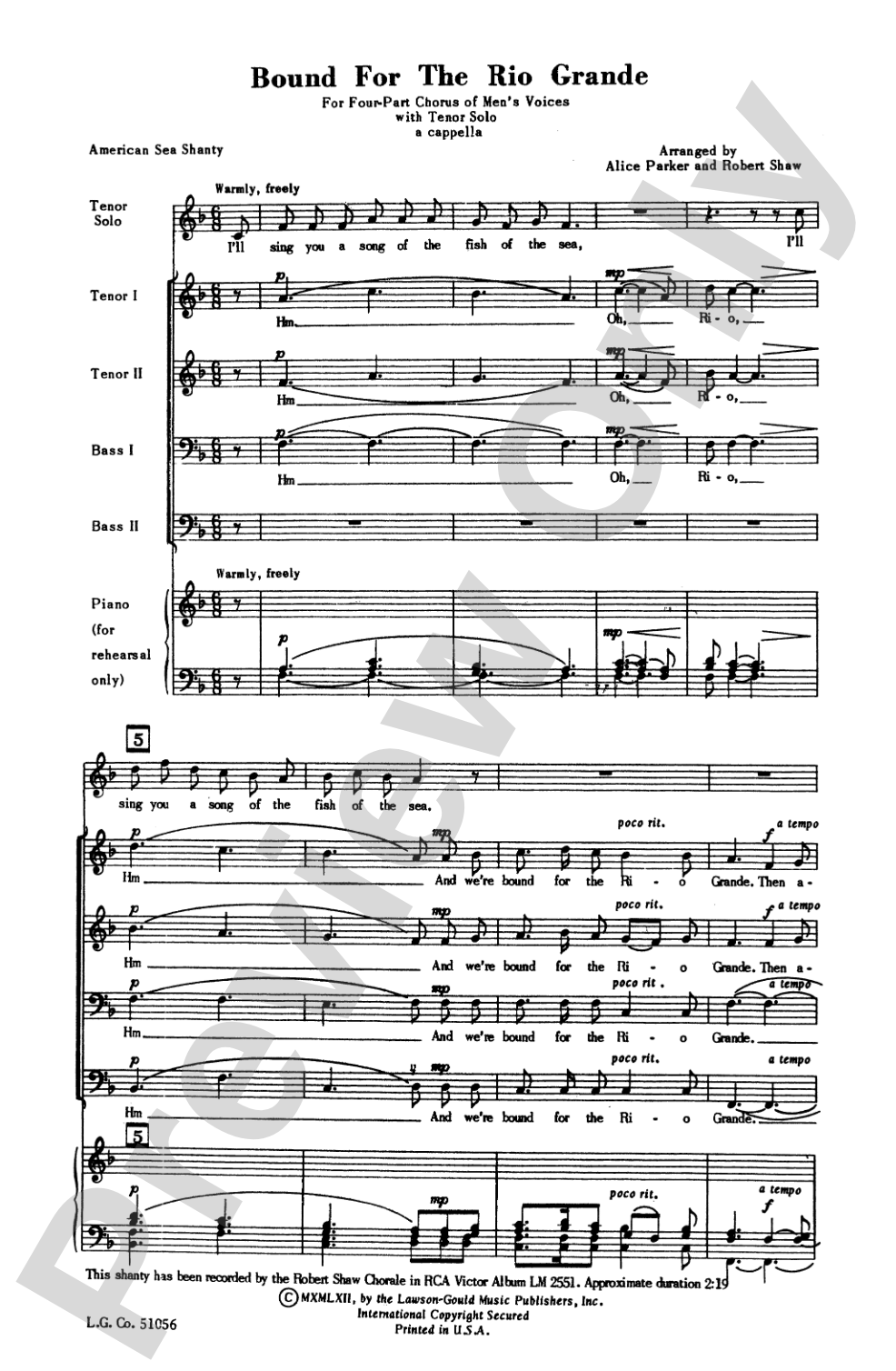
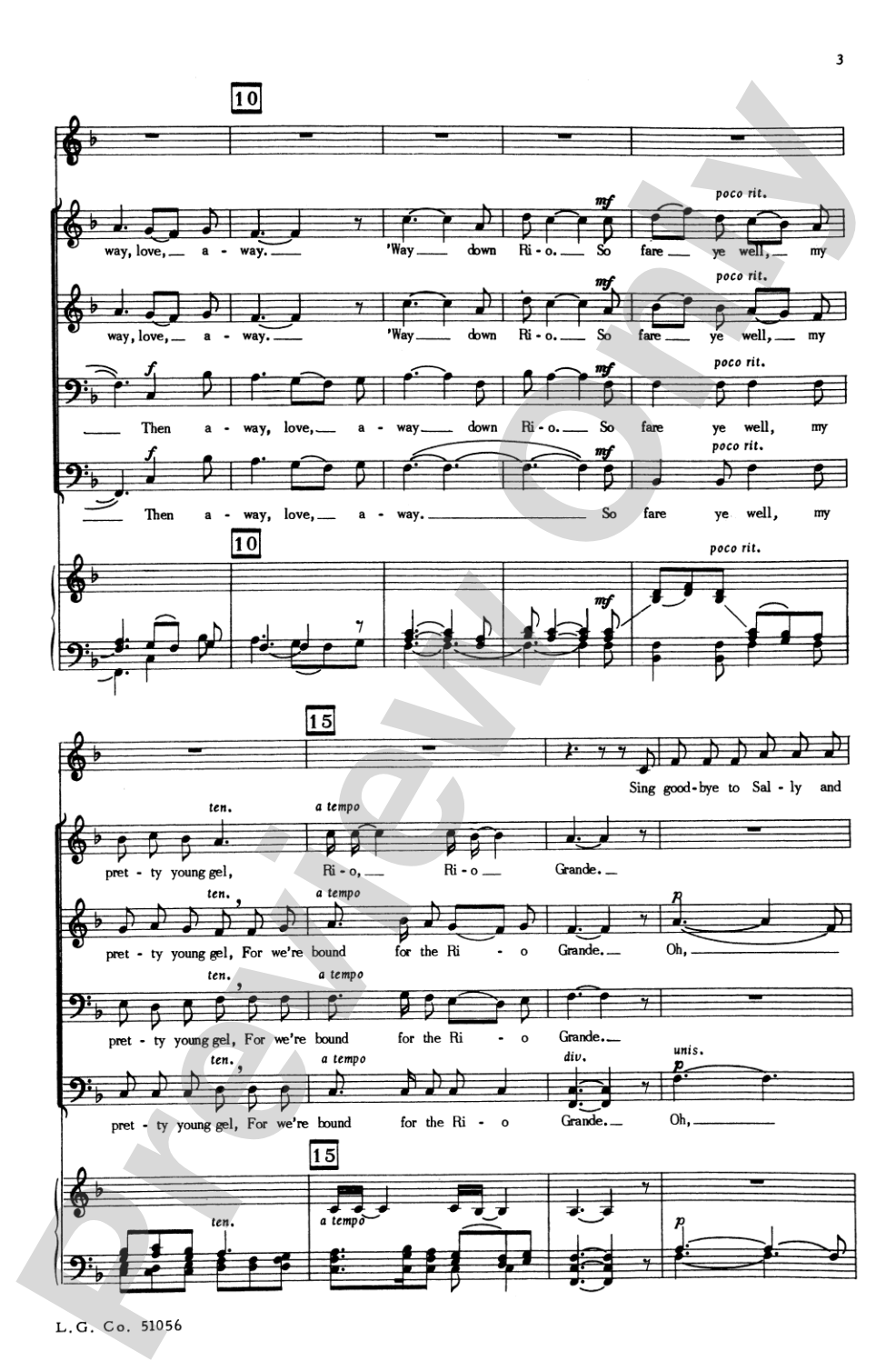

Bound for the Rio Grande: TTBB Choral Octavo
American Sea Shanty
Arr. Robert Shaw and Alice Parker
Item: 00-PO-0004967
$2.25
Minimum order quantity: 20 copies
Pickup currently not available
Related Items
Bound for the Rio Grande: TTBB Choral Octavo |
$2.25
|
View |
Description


Bound for the Rio Grande: TTBB Choral Octavo isn't in MakeMusic Cloud just yet...but it could be. Let us know you'd like to see it, and you'll help shape what comes next. In the meantime, start a free trial and dive into thousands of interactive titles your students can play along with today.
Request This Title
Tell us you want it.
Start Your Free Trial
Explore everything that's ready to play right now.
Sample Audio
No sample audio found.
Sample Video
No sample videos found.
Additional Details
Series:
Alfred Archive Edition: Lawson-Gould Music Publishers
Publisher:
Alfred Music
Page Count:
8
SKU:
00-PO-0004967
More about this title
About the Arranger: Robert Shaw
Robert Shaw was a visionary choral conductor and arranger whose influence on American choral music extended across five decades. He founded the Atlanta Symphony Orchestra Chorus and served as associate conductor of the Cleveland Orchestra, positions from which he championed both classical masterworks and American folk repertoire. Shaw's arrangements are distinguished by their respect for source material combined with sophisticated harmonic writing; he understood that folk music could withstand genuine compositional development without losing its essential character.
His collaborative work with Alice Parker produced some of the most enduring choral arrangements in the American canon. Together they created a body of folk arrangements that have become standards in school and community choirs, balancing accessibility with musical integrity. Shaw's legacy as both conductor and arranger demonstrates his belief that choral music should be simultaneously rewarding to sing and meaningful to perform.
Why we love this
Shaw and Parker's arrangement captures the narrative momentum and work-song energy of this Texas cowboy ballad without relying on gimmicks or oversimplification. The TTBB voicing sits naturally for male voices while the folk-derived melodic writing feels earned rather than imposed, giving singers something genuine to sink their teeth into. Repertoire this unpretentious and this musically sound rarely comes together.
What to expect
Dusty, purposeful, and alive with the momentum of migration and hard work. The piece carries the pragmatic spirit of a cowboy ballad, with harmonies that feel built from necessity rather than decoration. There's an understated dignity here, the kind that comes from singing about real labor and real travel.
Who it's for
TTBB choirs with singers who enjoy American folk material and aren't intimidated by part-singing that requires independence. Works equally well for high school men's choirs, community groups, and collegiate singers looking for concert repertoire that connects to vernacular traditions. The arrangement's accessibility makes it suitable for groups of moderate experience, but its musical sophistication rewards more advanced ensembles.
How to get the most out of it
- Approach the narrative arc of the text with the directness of someone actually heading somewhere. The rhythmic momentum should feel purposeful rather than rushed; let the story carry the tempo.
- Balance the harmonic color by bringing out inner voices where the arrangement shifts its support of the melody. These moments reveal Shaw and Parker's craftsmanship.
- Shape phrases around the natural cadences of speech rather than singing through to the barline. The folk idiom rewards articulation and breathing that respect the lyrical meaning.
- Record or listen to traditional versions of the song to anchor your interpretation in authentic folk style, then trust that the arrangement honors that foundation.
How to use it
Pair this with other American songs to explore folk traditions in concert, or use it as a lighter moment between heavier choral works to showcase your singers' ability to handle genuine storytelling. The 8-page length makes it practical for mixed concert programs. Consider programming it during a season focused on American music, where its direct approach and cultural authenticity feel intentional rather than filler.
Skills your students will build
- Sustaining character and narrative focus across a longer choral form
- Balancing part independence in TTBB writing without losing harmonic blend
- Singing with the rhythmic flexibility of folk idiom while maintaining ensemble precision
- Shaping vocal lines around speech patterns and textual meaning rather than musical phrase marks