
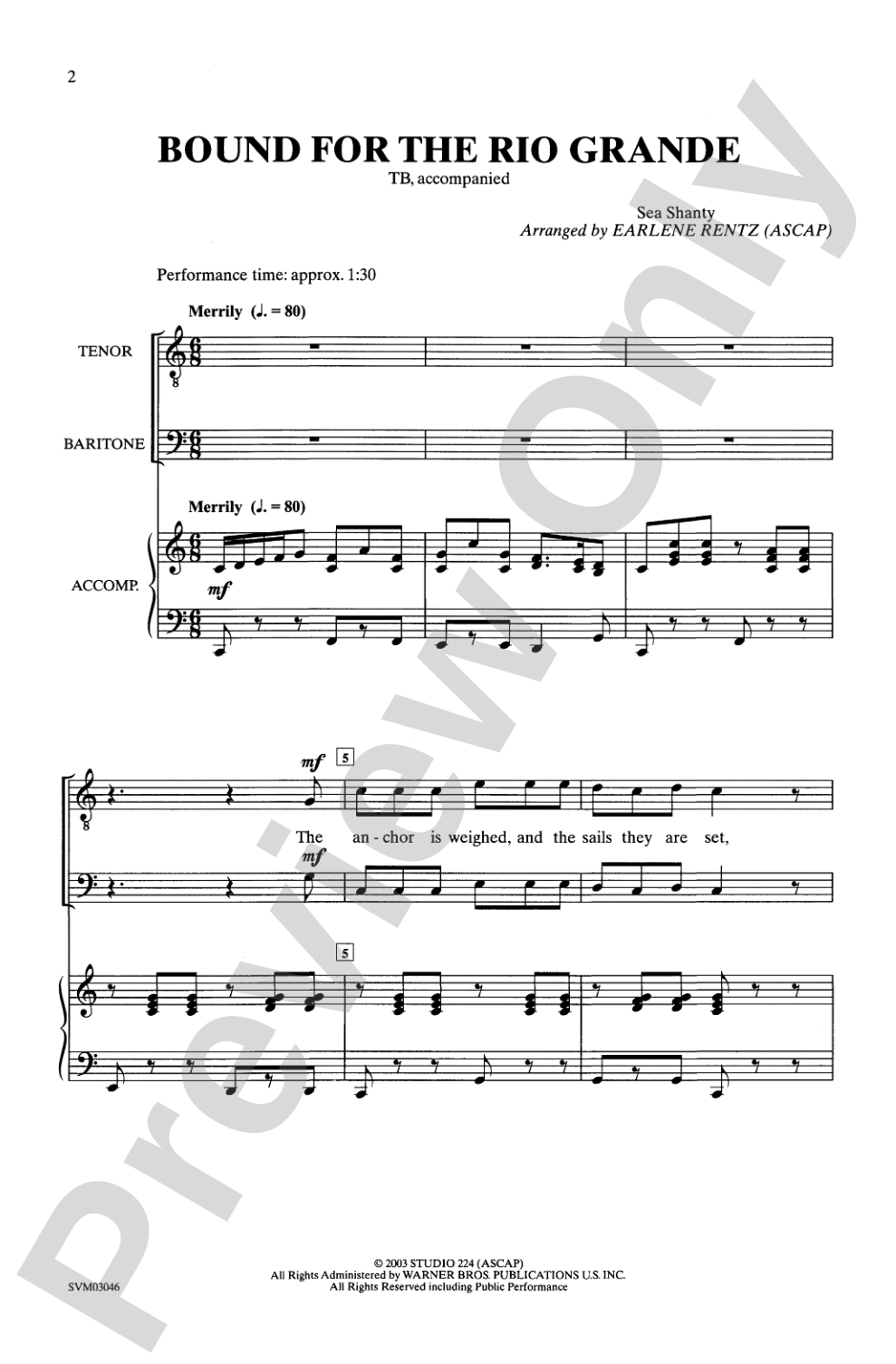
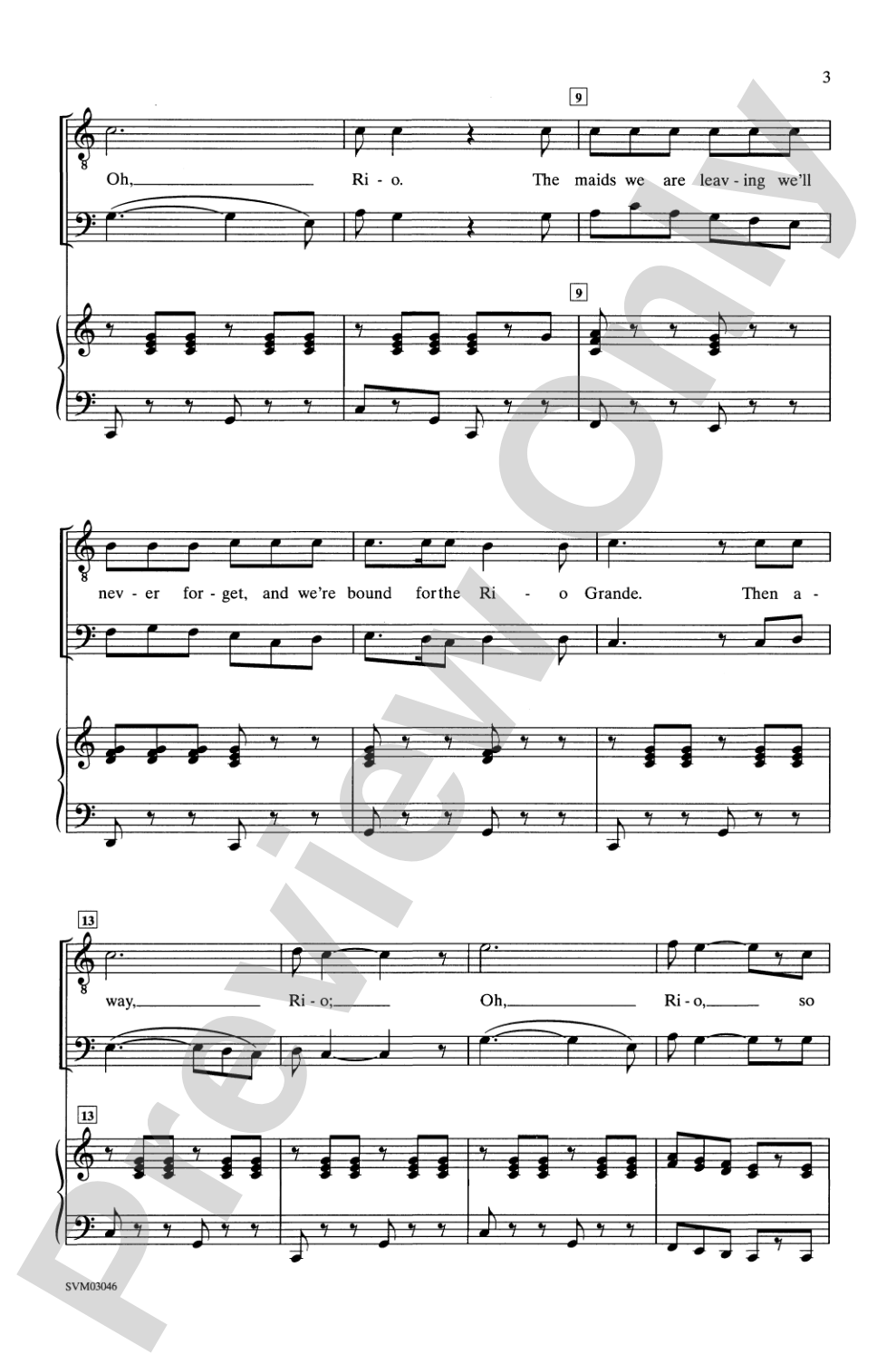

Bound for the Rio Grande: TB Choral Octavo
Sea Shanty / arr. Earlene Rentz
Item: 00-PO-0002791
$2.25
Minimum order quantity: 20 copies
Pickup currently not available
Related Items
Bound for the Rio Grande: TB Choral Octavo |
$2.25
|
View |
Description
This traditional sea shanty is arranged for your developing men's choirs by Earlene Rentz. It is easy-to-sing and fun to program for any concert or festival. It will make them sound great!


Bound for the Rio Grande: TB Choral Octavo isn't in MakeMusic Cloud just yet...but it could be. Let us know you'd like to see it, and you'll help shape what comes next. In the meantime, start a free trial and dive into thousands of interactive titles your students can play along with today.
Request This Title
Tell us you want it.
Start Your Free Trial
Explore everything that's ready to play right now.
Sample Audio
1
Audio File
--:--
0:00
0:00
Sample Video
No sample videos found.
Additional Details
Series:
Alfred Archive Edition: Studio PR Catalog
Publisher:
Alfred Music
Page Count:
8
SKU:
00-PO-0002791
More about this title
About the Arranger: Earlene Rentz

Earlene Rentz has shaped choral music from multiple angles throughout her career. She spent seven years teaching choral music across elementary, junior high, and high school levels in public schools, then devoted twelve years to training the next generation of choral educators in higher education settings. Her experience conducting All-State Choirs in Georgia, Florida, Kentucky, and Alabama gave her deep insight into what works with developing singers at every level.
Based in North Carolina, Rentz has become a prolific voice in choral publishing, with over 700 compositions and arrangements published across 17 different publishers. Her output reflects a practical understanding of what directors actually need: repertoire that sounds polished without being technically out of reach, material that engages singers, and pieces built on the musical foundations that matter most in a rehearsal room.
Why we love this
Rentz knows exactly what a developing men's choir needs to sound confident and engaged. This arrangement strips away complexity while keeping the robust character of the sea shanty intact, letting your singers feel the payoff without drowning in technical demands. It's the kind of piece that builds morale quickly and programs beautifully alongside both traditional and contemporary work.
What to expect
The energy of sailors hauling rope and calling across open water runs through every phrase. There's a robust, communal spirit to this arrangement that invites singers to lean into the story and rhythm, making the performance feel lived-in rather than polished to a sheen.
Who it's for
Developing men's choirs at the high school or college level will find this arrangement immediately accessible. It works equally well for singers building confidence and for groups looking to add a crowd-pleasing piece to their festival or concert rotation without significant rehearsal overhead.
How to get the most out of it
- Lean into the storytelling. Sea shanties live in their narrative and rhythm, so encourage your singers to connect with the text about maritime life rather than treating it as pure vocalism.
- Balance the lower voices carefully in the TB configuration. They anchor the harmonic color, so make sure the basses and baritones have clear diction and weight without overshadowing the tenors.
- Use the rhythmic drive of the piece to maintain ensemble cohesion. The sea shanty's inherent pulse helps singers stay together naturally without heavy conducting.
- Front-load rehearsal time on any key changes or modulations. Once those transitions lock in, the rest of the piece typically settles quickly because the melodic and textual logic is so strong.
How to use it
Program this early in a concert to establish an audience connection and warm your singers into the performance. It pairs naturally with other folk-based or sea-themed literature, and its accessibility makes it an ideal choice for festival competitions where you want singers relaxed and confident.
Skills your students will build
- Singing in parallel harmony with clear voice independence (TB voicing)
- Narrative interpretation and storytelling through text
- Rhythmic precision in syncopated or driving melodic lines
- Blend and balance within a limited harmonic range
- Ensemble cohesion in a shorter, tightly-structured piece