
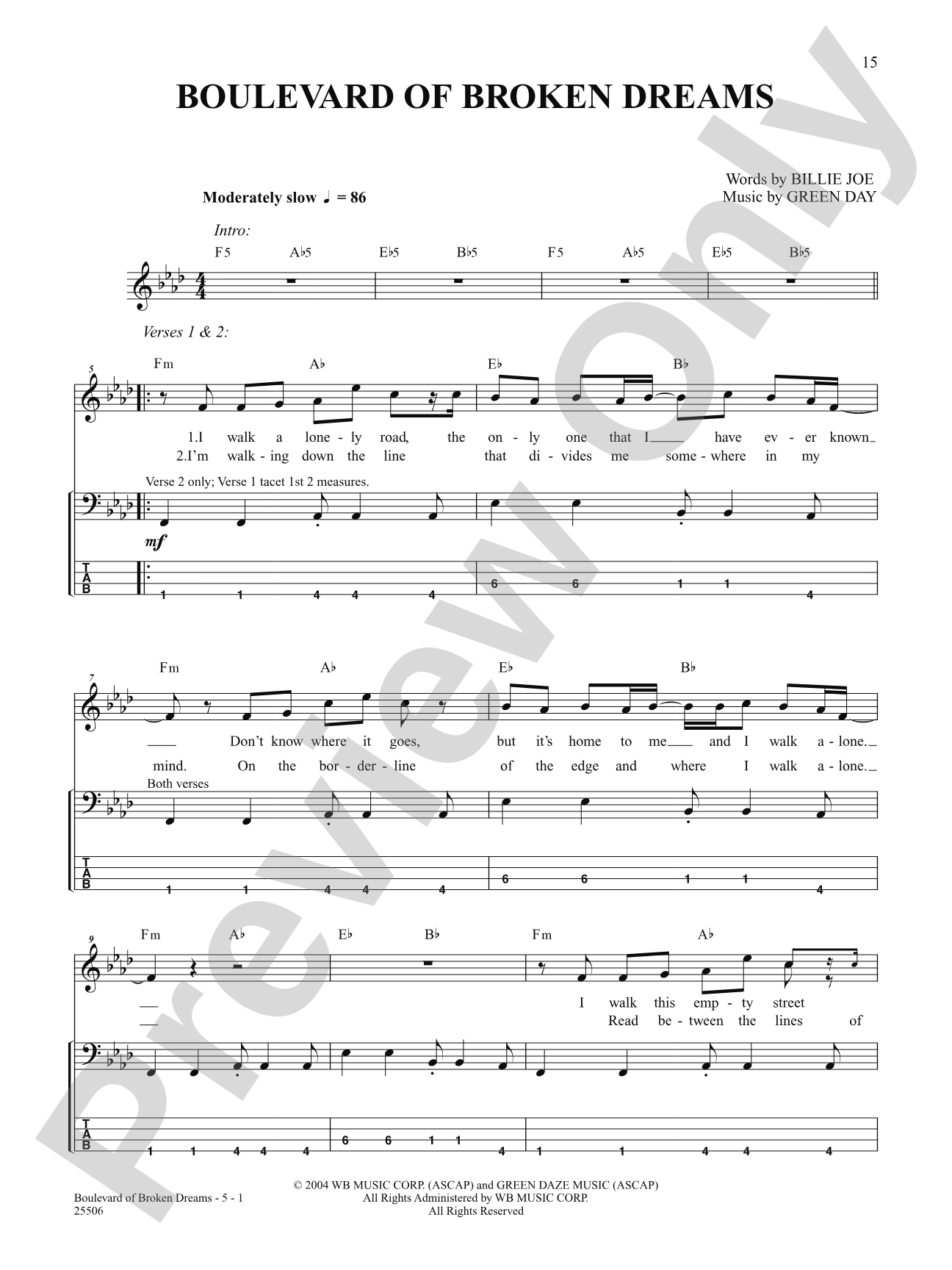

Boulevard of Broken Dreams: Bass TAB
Green Day
Item: 00-PS-0000190
$4.99
One moment…
Related Items
Nice Guys Finish Last: Bass TAB |
$4.99
|
View | |
Hitchin' a Ride: Bass TAB |
$4.99
|
View | |
Good Riddance (Time of Your Life): Bass TAB |
$4.99
|
View | |
Espionage: Bass TAB |
$4.99
|
View | |
Warning: Bass TAB |
$4.99
|
View | |
Waiting: Bass TAB |
$4.99
|
View | |
Minority: Bass TAB |
$4.99
|
View | |
Macy's Day Parade: Bass TAB |
$4.99
|
View | |
Longview: Bass TAB |
$4.99
|
View | |
Welcome to Paradise: Bass TAB |
$4.99
|
View | |
Basket Case: Bass TAB |
$4.99
|
View | |
When I Come Around: Bass TAB |
$4.99
|
View | |
Stuck With Me: Bass TAB |
$4.99
|
View | |
Brain Stew: Bass TAB |
$4.99
|
View | |
Jaded: Bass TAB |
$4.99
|
View | |
Walking Contradiction: Bass TAB |
$4.99
|
View | |
American Idiot: Bass TAB |
$4.99
|
View | |
Holiday: Bass TAB |
$5.99
|
View | |
Wake Me Up When September Ends: Bass TAB |
$4.99
|
View |
Description
Twenty of Green Day's greatest hits, fully transcribed for bass guitar. Titles are: American Idiot * Basket Case * Boulevard of Broken Dreams * Brain Stew * Espionage * Good Riddance (Time of Your Life) * Hitchin' a Ride * Holiday * Jaded * Longview * Macy's Day Parade * Minority * Nice Guys Finish Last * Stuck with Me * Waiting * Wake Me Up When September Ends * Walking Contradiction * Warning * Welcome to Paradise * When I Come Around.


Boulevard of Broken Dreams: Bass TAB isn't in MakeMusic Cloud just yet...but it could be. Let us know you'd like to see it, and you'll help shape what comes next. In the meantime, start a free trial and dive into thousands of interactive titles your students can play along with today.
Request This Title
Tell us you want it.
Start Your Free Trial
Explore everything that's ready to play right now.
Sample Audio
No sample audio found.
Sample Video
No sample videos found.
Additional Details
Series:
Bass Anthology Series
Publisher:
Alfred Music
Page Count:
84
SKU:
00-PS-0000190
More about this title
About the Composer: Green Day
Green Day emerged from the Berkeley punk scene in the early 1990s and became one of the defining rock bands of their generation. Billie Joe Armstrong, Mike Dirnt, and Tré Cool built their sound on urgent melodies, driving rhythms, and lyrics that spoke to alienation and social anxiety. Their 1994 album Dookie introduced millions to punk rock through MTV and radio, while later albums like American Idiot proved the band's staying power across decades.
From a bass education perspective, Green Day's catalogue is invaluable. Mike Dirnt's playing demonstrates how punk bass lines function as more than rhythm section support; they're melodic anchors that define songs. His lines are economical but expressive, combining palm-muted passages with open-string flourishes and occasional syncopation that rewards careful listening and deliberate execution.
Why we love this
These transcriptions capture 20 essential Green Day songs that resonate across skill levels and age groups. Mike Dirnt's bass work offers genuine pedagogical value: students study root-position playing, syncopated rhythms, palm-muting technique, and how to lock with drums, all within songs they actually want to play. The collection spans the band's career, so students progress from simpler early material like When I Come Around through the more rhythmically intricate Holiday and Wake Me Up When September Ends.
What to expect
Propulsive and direct. These songs capture punk's urgency and melodic sensibility; the bass lines pulse beneath singing guitars and drums with clarity and purpose. You'll feel the weight of notes against silence, the satisfaction of locking into a groove, and the connectivity between bass and melody that defines pop-punk's distinctive sound.
Who it's for
Bass students who want to play rock songs with immediate cultural resonance and genuine musical substance. Whether you're teaching high school students building their first electric bass vocabulary or adult learners returning to music through punk rock, these 20 songs offer accessible entry points into professional playing patterns.
How to get the most out of it
- Focus on the relationship between bass and kick drum. Green Day's songs rely on tight synchronization in the pocket; use a metronome or backing track to lock the rhythm section together before adding note detail.
- Practice palm-muting independently from the fretting hand. Many of these lines alternate between muted and open notes; isolate the muting technique so you can execute it cleanly without affecting note clarity.
- Listen to the original recordings with ears on the bass track. Dirnt's tone, articulation, and slight timing variations matter as much as the notes themselves; transcriptions capture pitch but not the feel.
How to use it
Assign individual songs as supplementary repertoire alongside your primary bass curriculum. Use them as rewards after completing technique-focused material, or thread them through the year as students develop specific skills: start with root position and straight eighth-note patterns, progress to syncopation and palm-muting, and finish with songs requiring coordination across multiple techniques. They also work beautifully in rock ensemble or informal band settings where students can play together.
Skills your students will build
- Palm-muting control across sustained passages
- Syncopated rhythms in rock contexts (sixteenth-note anticipations, swing eighths)
- Root-position playing with harmonic awareness
- Locking with kick drum through metronome and backing tracks
- Dynamic variation and articulation within consistent groove
- Reading TAB notation in practical performance settings