
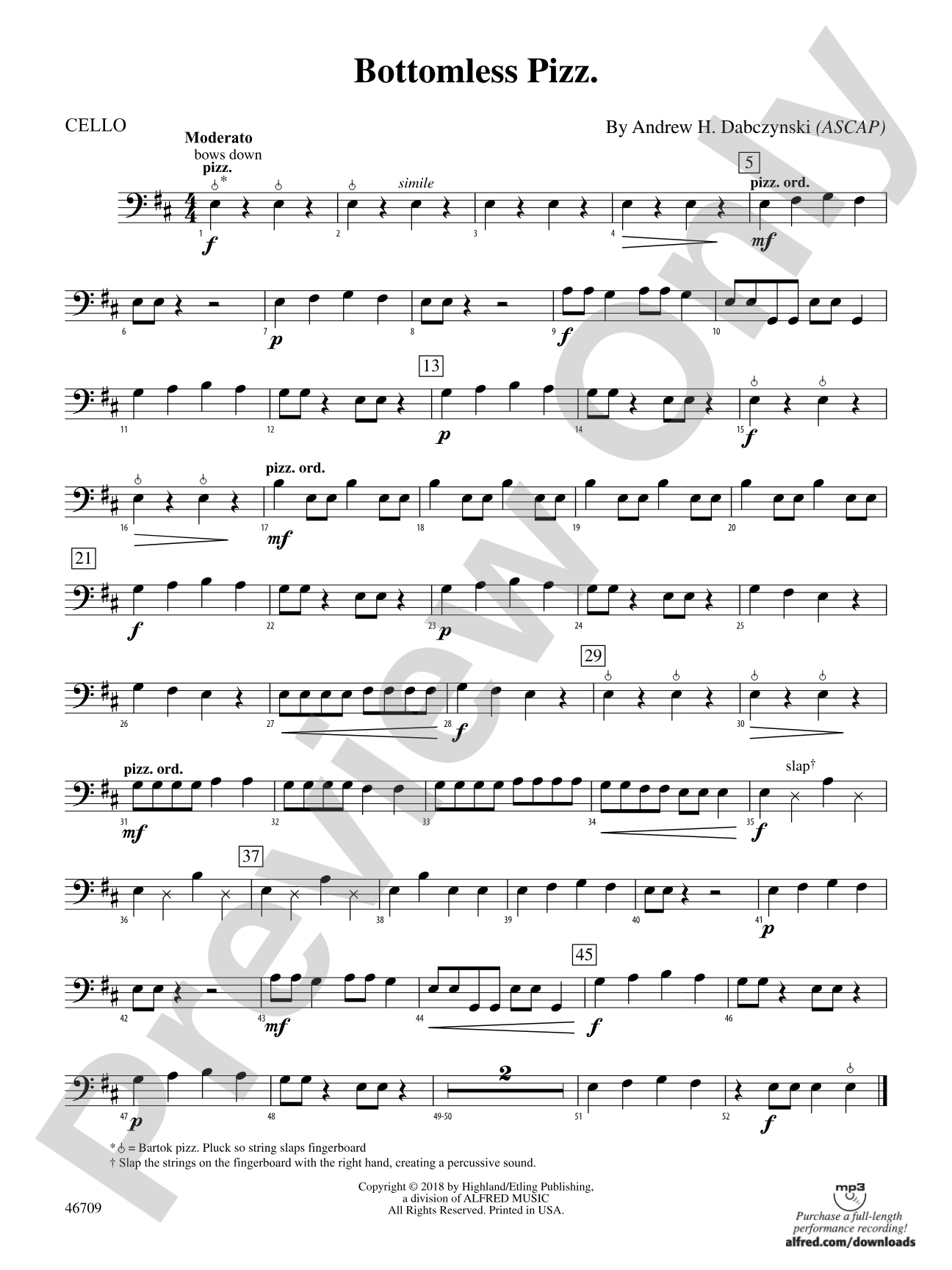

Bottomless Pizz.: Cello
By Andrew H. Dabczynski
Grade: 1
Item: 00-PC-0017844_VC1
$5.99
Pickup currently not available
Description
The perfect grade 1 piece for beginning string students, "Bottomless Pizz." by Andrew H. Dabczynski requires no bows and uses only open strings and the pitches of a one-octave D scale. Remarkably simple but contemporary-sounding rhythms, harmonies, and techniques will captivate students. Everyone will delight in the humorous musical quotes and cool beat as they discover what lies far down in the "Bottomless Pizz." Correlated to String Explorer Book 1, Unit 12.


Don't just read it, hear it, play along with it, and watch your students grow with it. In MakeMusic Cloud, Bottomless Pizz.: Cello comes alive with professional accompaniment, adjustable tempo, and built-in practice tools that turn solo practice into real progress.
Open in the Player
Jump straight in and assign it today.
Start Your Free Trial
Open this title and explore the full library in minutes.
Sample Audio
1
Audio File
--:--
0:00
0:00
Sample Video
Additional Details
Series:
Highland/Etling String Explorer
Publisher:
Alfred Music
Page Count:
72
SKU:
00-PC-0017844_VC1
More about this title
About the Composer: Andrew H. Dabczynski

Andrew H. Dabczynski shaped string education through decades of teaching, research, and curriculum development. He founded BYU's "New Horizons Orchestra" as both a performance ensemble for adult beginners and a training laboratory for string teachers, work that earned him the Joseph E. White Fellowship for Teaching and Learning. His career spans positions at the Eastman School of Music, public school districts across New York and Michigan, and leadership roles within the American String Teachers Association. Utah ASTA recognized him as "Higher Education Teacher of the Year" in 2005 and for "Outstanding Contributions to Music Education" in 2014.
As a performer, Dabczynski maintained an active career playing viola with regional orchestras including the Rochester Philharmonic, Hartford Symphony, and Portland Symphony, and served six years as a member of the Colden String Quartet at Western Michigan University. His scholarly interests extend to folk music and ethnomusicology, particularly fiddling traditions. He co-authored String Explorer, the comprehensive string method series published by Alfred, which has become foundational in string programs nationwide.
Why we love this
Dabczynski understands exactly what beginning string students need: immediate success and genuine fun. Open strings and a D-scale limitation free students from technical anxiety while contemporary rhythms and playful musical quotes keep the piece engaging rather than remedial, making rehearsals feel like real music-making from day one.
What to expect
Light and playful, with contemporary rhythmic flavor and clever musical winks that reward careful listening. The pizzicato-only texture creates brightness and intimacy, while the humorous quotes give the music personality and surprise.
Who it's for
Beginning string orchestras in their first year of study, especially those working through String Explorer Book 1. The piece works beautifully for students who have mastered open-string basics but may still be building confidence with rhythmic independence.
How to get the most out of it
- Establish the pizzicato character with a clear, articulate attack; have students think of plucking the string with intention rather than a tentative touch.
- Balance the part writing so humor and musical quotes land clearly; this piece rewards precise ensemble listening and response.
- Let students hear and feel the beat before playing; the contemporary rhythms work best when everyone has internalized the pulse together.
- Encourage expressive dynamics and character changes to match the quoted musical moments, lifting them above simple technical exercises.
How to use it
Feature this as a concert opener or novelty piece that lets young orchestras celebrate their first year of learning. It pairs well with other beginning-level concert works and gives students a memory of ensemble playing that feels fun rather than dutiful.
Skills your students will build
- Articulate pizzicato technique with consistent tone and attack
- Rhythmic precision and part independence using simple note values
- Listening and response to musical cues and quoted material
- Intonation awareness within the D-major scale and open-string context
- Dynamic control and expressive phrasing without increased technical demand