
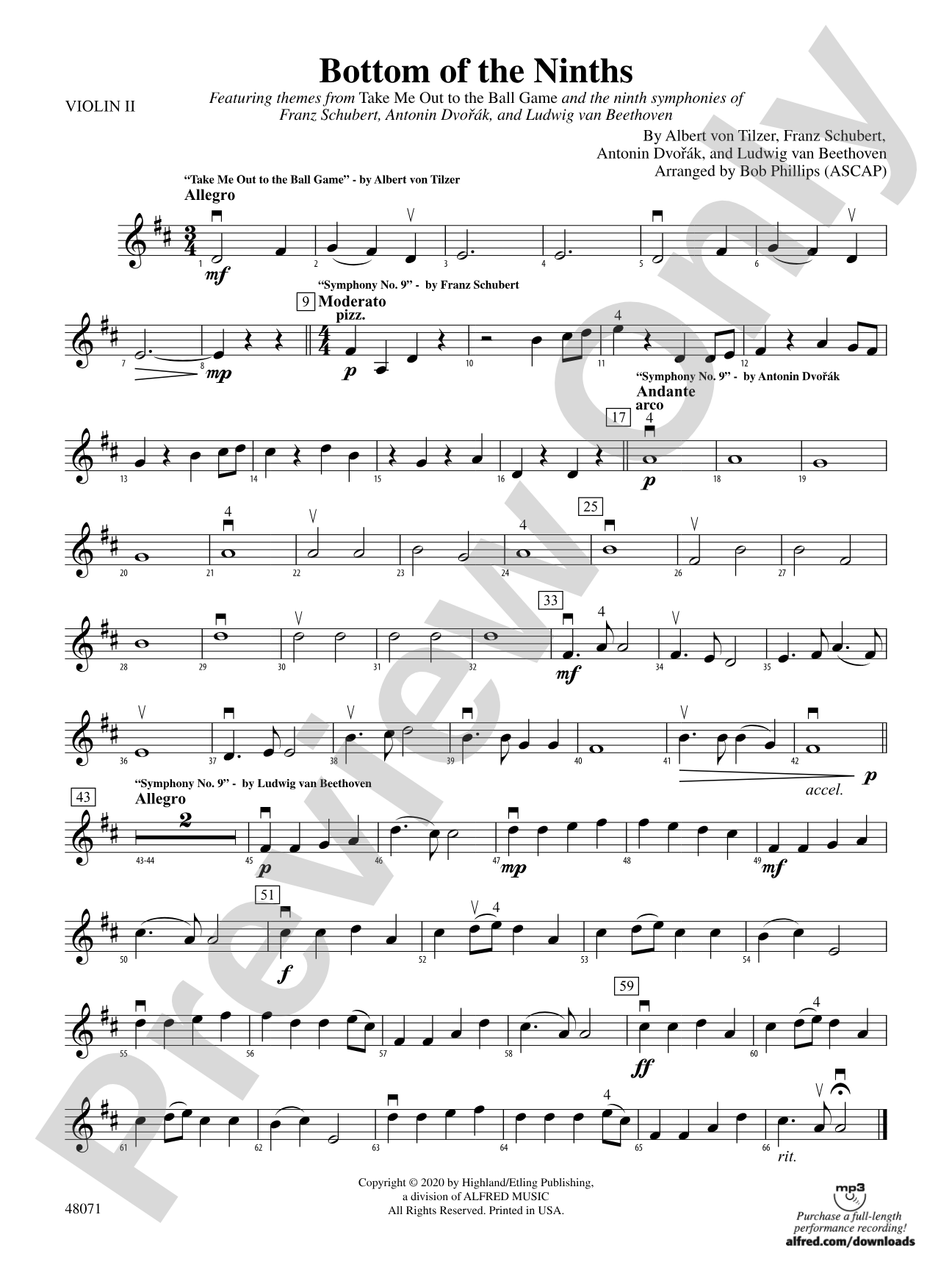

Bottom of the Ninths: 2nd Violin
Featuring Themes from "Take Me Out to the Ball Game" and the Ninth Symphonies of Franz Shubert, Antonín Dvorák, and Ludwig van Beethoven
By Albert von Tilzer, Franz Shubert, Antonín Dvorák, and Ludwig van Beethoven / arr. Bob Phillips
Grade: 1.5
Item: 00-PC-0018398_VN2
$3.00
Pickup currently not available
Description
This title features Alfred Music's String Orchestra FLEX options. That means that every part in this set is now transposed into every other part, so you can play this title with any combination of like- or mixed-string ensemble. After purchasing this set, decide what additional parts you need to meet the unique needs of your ensemble, then download and print them for free at alfred.com/supplemental---free of charge.
Tongue-in-cheek and beautiful, Bottom of the Ninths is the perfect way to delve into these masterworks with young players in a fun context! All sections remain in 1st position, in the key of D major, with no high 3's or low 1's as the melodies are passed throughout the orchestra. Easy to play and showcasing the beauty of these great composers, this piece, arranged by Bob Phillips, would shine at a festival or contest. The medley features "Take Me Out to the Ball Game;" the opening theme from Schubert's Symphony No. 9 which is, of course, at the beginning of that work; the famous "Going Home" theme from the middle of Dvorák's Symphony No. 9; and the "Ode to Joy" theme from Beethoven's Symphony No. 9, which is at the end, or the "bottom," of the 9th. Correlated to Sound Innovations for String Orchestra, Book 1, Level 5. (2:30) This title is available in MakeMusic Cloud.


Tongue-in-cheek and beautiful, Bottom of the Ninths is the perfect way to delve into these masterworks with young players in a fun context! All sections remain in 1st position, in the key of D major, with no high 3's or low 1's as the melodies are passed throughout the orchestra. Easy to play and showcasing the beauty of these great composers, this piece, arranged by Bob Phillips, would shine at a festival or contest. The medley features "Take Me Out to the Ball Game;" the opening theme from Schubert's Symphony No. 9 which is, of course, at the beginning of that work; the famous "Going Home" theme from the middle of Dvorák's Symphony No. 9; and the "Ode to Joy" theme from Beethoven's Symphony No. 9, which is at the end, or the "bottom," of the 9th. Correlated to Sound Innovations for String Orchestra, Book 1, Level 5. (2:30) This title is available in MakeMusic Cloud.
Don't just read it, hear it, play along with it, and watch your students grow with it. In MakeMusic Cloud, Bottom of the Ninths: 2nd Violin comes alive with professional accompaniment, adjustable tempo, and built-in practice tools that turn solo practice into real progress.
Open in the Player
Jump straight in and assign it today.
Start Your Free Trial
Open this title and explore the full library in minutes.
Sample Audio
1
Audio File
--:--
0:00
0:00
Sample Video
Additional Details
Series:
Sound Innovations for String Orchestra
Publisher:
Alfred Music
Page Count:
76
SKU:
00-PC-0018398_VN2
More about this title
About the Composer: Albert von Tilzer
Albert Von Tilzer (1878–1956) composed one of America's most enduring popular songs at the height of the Tin Pan Alley era. "Take Me Out to the Ball Game," written in 1908 with lyricist Jack Norworth, became an instant standard and remains a cultural touchstone nearly 120 years later. Von Tilzer's gift for memorable melody and straightforward harmonic language made his work accessible to amateur musicians and concert audiences alike.
Von Tilzer's prolific output spanned vaudeville, musical theater, and popular song. His melodies have proven remarkably durable in educational settings, where their simplicity and charm serve young musicians learning to balance technique with musicality. The enduring popularity of his best-known work speaks to a composer who understood the power of a tune that stays with listeners.
Why we love this
This arrangement pairs a beloved American standard with three symphonic "Greatest Hits" in a way that feels genuinely clever rather than gimmicky. Bob Phillips has honored each composer's melodic gift while keeping the writing transparent and playable for young ensembles; the joke lands because the music is genuinely beautiful. Directors will appreciate how the FLEX instrumentation system lets you use exactly the players you have without rewriting parts or scrambling for substitutes.
What to expect
Witty and warmhearted, this medley moves from the infectious bounce of a baseball diamond anthem into the profound beauty of Schubert's most famous symphonic moment, then builds through Dvorák's nostalgic "Going Home" into the inevitable triumph of Beethoven's "Ode to Joy." The writing stays elegant throughout while maintaining a knowing sense of humor about its own conceit. It's the sound of great composers being taken seriously without being taken too seriously.
Who it's for
String orchestras at the early intermediate level, particularly those preparing for festivals or competitions where a crowd-pleasing, sophisticated program is an asset. Ensembles with mixed instrumentation or limited instrumentation will find the FLEX system invaluable; you can assign parts based on what you actually have rather than working around missing players. Young string players who know these symphonic themes only as fragments will benefit from hearing them in complete, purposeful arrangements.
How to get the most out of it
- Keep the opening "Take Me Out to the Ball Game" section light and playful; resist the urge to drag the tempo even though the melody is familiar. The Schubert transition works best when the style shift is clear and immediate.
- Balance the melody line as it passes between sections. Each "voice" that carries the tune should project with confidence while surrounding parts stay secondary, even when they're interesting.
- Attend to the key of D major throughout; stay alert for any chromatic passing tones or altered chords that add color without requiring extended positions.
- Use the full 2:30 running time to shape each theme with its own character. The "Ode to Joy" finale gains impact when it feels genuinely triumphant rather than rushed.
How to use it
Program this as a concert opener or closing number at a festival or contest; its familiarity will engage the audience immediately while the sophisticated arrangement demonstrates your ensemble's musicianship. It pairs well with a contrasting original work or period piece, offering a refreshing tonal shift. Consider performing it in April or May when the baseball reference resonates with spring audiences.
Skills your students will build
- Maintaining intonation in D major while passing melodic material between sections
- Recognizing and executing stylistic shifts between popular song and symphonic themes
- Reading flexible instrumentation and adapting to different string voicings
- Shaping longer melodic lines that extend across multiple sections and phrases
- Balancing primary melody with secondary supporting parts