
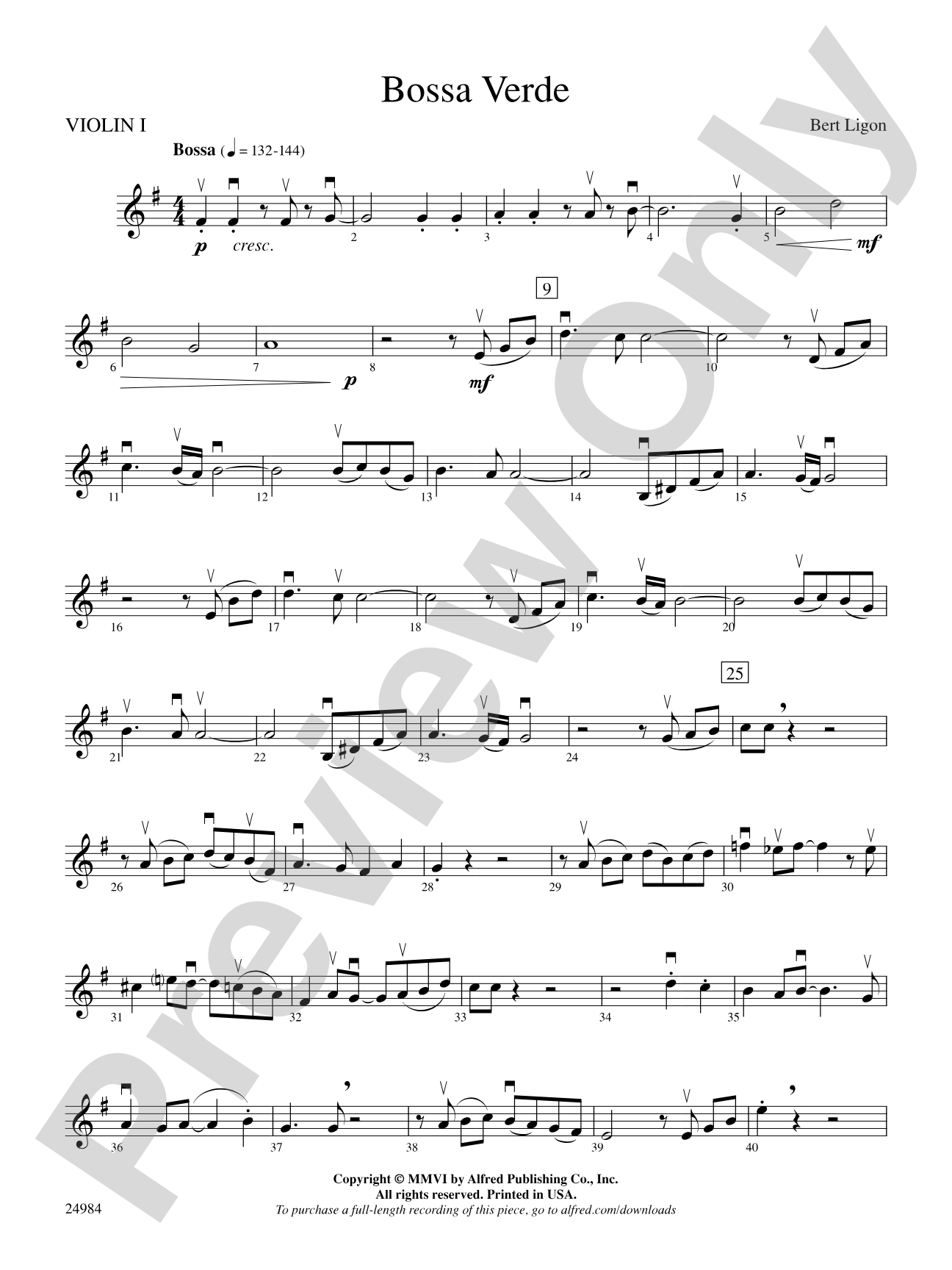

Bossa Verde: 1st Violin
By Bert Ligon
Grade: 3.5
Item: 00-PC-0000967_VN1
$5.99
Pickup currently not available
Description
"Bossa Verde" is a very pretty bossa nova over familiar chord changes for string ensemble and rhythm section. This piece is accessible for younger players and interesting for the experienced players. Counterpoint is contrasted with ensemble playing and room for improvisation. Beginning improvisers will be successful playing in the key of one sharp and experienced players will enjoy digging into the chord changes. Suggested written out solos are provided in all parts so no improvisation is required. This piece was performed at the 2003 ASTA convention in Ohio.


Don't just read it, hear it, play along with it, and watch your students grow with it. In MakeMusic Cloud, Bossa Verde: 1st Violin comes alive with professional accompaniment, adjustable tempo, and built-in practice tools that turn solo practice into real progress.
Open in the Player
Jump straight in and assign it today.
Start Your Free Trial
Open this title and explore the full library in minutes.
Sample Audio
1
Audio File
--:--
0:00
0:00
Sample Video
No sample videos found.
Additional Details
Series:
Highland/Etling String Alternatives
Publisher:
Alfred Music
Page Count:
132
SKU:
00-PC-0000967_VN1
More about this title
About the Composer: Bert Ligon

Bert Ligon directs the jazz studies program at the University of South Carolina, where he teaches theory, improvisation, arranging, and applied lessons while coordinating the university's jazz combos and big bands. His compositional work spans big band, orchestra, jazz ensemble, steel band, and string settings. Ligon has authored three significant texts on jazz musicianship: Connecting Chords with Linear Harmony, Comprehensive Technique for the Jazz Musician, and Jazz Theory Resources Volumes 1 and 2. A pianist and guitarist, Ligon performs regularly; his 2006 trio recording features him on piano alongside violinist Martin Norgaard and cellist Renata Bratt.
Why we love this
Ligon has written a piece that genuinely works for mixed-level orchestras without dumbing anything down. The provided written-out solos remove the pressure of improvisation while still teaching students what jazz phrasing and harmonic thinking sound like, making this ideal for schools building confidence with jazz repertoire. The counterpoint passages give stronger players real voice-leading work, and the bossa nova groove never loses its charm across all ability levels.
What to expect
Warm and approachable, like a breeze through a garden at sunset. The bossa nova pulse carries an easy sophistication, and the interplay between solo lines and full ensemble moments creates room for breath and expression without demanding technical virtuosity.
Who it's for
String orchestras at the intermediate level, particularly those adding jazz and contemporary styles to their repertoire for the first time. This works equally well for directors introducing younger players to improvisation and for experienced ensembles who want a piece that sounds sophisticated while remaining playable across mixed ability levels.
How to get the most out of it
- Keep the rhythmic foundation steady in the rhythm section; the bossa nova feel depends on lock between bass and drums. If you're reading the written parts, make sure the groove sits naturally rather than feeling mechanical.
- Shape the counterpoint passages with clear articulation and independent phrasing in each section. This contrast will make the ensemble passages that follow land with more impact.
- If you have improvising musicians ready, the key of one sharp gives them a forgiving harmonic space to explore. Listen back to their attempts before polishing the written solos so they understand what works within the chord changes.
How to use it
Program this as a bridge between classical and contemporary contexts in a mixed concert, perhaps pairing it with a traditional string work and a world music piece to show the diversity of the orchestra's range. The accessible level and uplifting character also make it perfect for a student-led concert or a spring pops program that invites more casual listening.
Skills your students will build
- Reading and performing jazz chord changes and harmonic language
- Understanding and executing bossa nova rhythm and swing feel
- Voice independence through counterpoint writing
- Foundational improvisation in a major key with written guidance
- Blending with rhythm section (bass, drums, piano/guitar) in a jazz context
- Phrasing and articulation choices beyond classical conventions