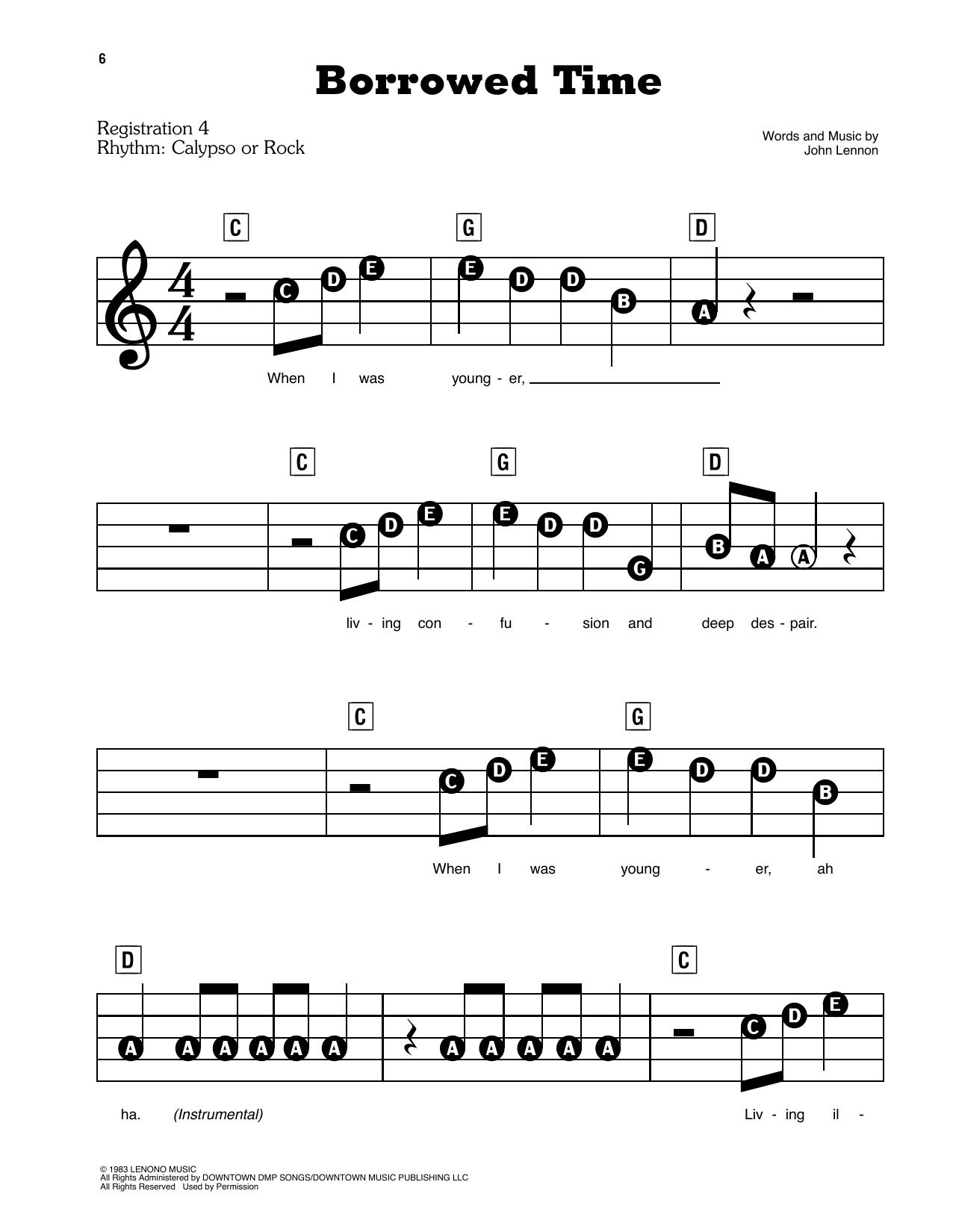
Borrowed Time Sheet Music Preview

Borrowed Time: E-Z Play Today

As performed by John Lennon & Yoko Ono

Item: 35-DS00881888

Digital Download
$4.99
Description

Borrowed Time: E-Z Play Today isn't in MakeMusic Cloud just yet...but it could be. Let us know you'd like to see it, and you'll help shape what comes next. In the meantime, start a free trial and dive into thousands of interactive titles your students can play along with today.

Sample Audio
No sample audio found.
Sample Video
Additional Details
Publisher: Hal Leonard
Page Count: 4
SKU: 35-DS00881888

More about this title

About the Artist: John Lennon & Yoko Ono

John Lennon and Yoko Ono collaborated on experimental and avant-garde music throughout the 1970s, blending rock sensibilities with conceptual art. Their partnership produced some of the era's most boundary-pushing work, challenging conventional songwriting and recording practices while maintaining accessibility to mainstream audiences.

Why we love this

This piece captures the accessible side of Lennon's post-Beatles catalog, offering pianists a four-page window into art rock songwriting that feels contemporary without overwhelming beginners. The straightforward harmonic language makes it ideal for students transitioning from classical methods to popular music, while the melodic hooks keep players engaged enough to push through the moderate technical demands.

What to expect

The piece carries a reflective, almost introspective quality typical of Lennon's solo work. There's a gentle persistence beneath the surface, with enough textural interest to prevent the listening experience from feeling simple despite its accessible construction.

Who it's for

Intermediate pianists and keyboardists exploring songwriting from rock's art rock movement will find this manageable yet musically rewarding. It works equally well for pop/rock ensemble players looking to deepen their understanding of 1970s recording aesthetics.

How to get the most out of it

  • Build the song's emotional arc by shaping the dynamic contour gradually; avoid playing it uniformly loud or soft throughout
  • Pay attention to chord voicings that may sit differently under the hands than you'd expect from traditional classical progressions
  • Balance the melody against accompaniment patterns so the vocal line (if singing along) always sits clearly above the texture

How to use it

This fits naturally into a contemporary music or American songwriting unit, especially when exploring how classical pianists can approach popular repertoire. It also works as a standalone popular music offering for recitals that seek to blend genres, or as material for a student interested in the intersection of avant-garde art and mainstream appeal.

Skills your students will build

  • Interpreting chord symbols and lead sheet notation
  • Pedal control in popular music styles
  • Balancing melody and accompaniment patterns
  • Understanding song form and arrangement in rock contexts

You May Also Like