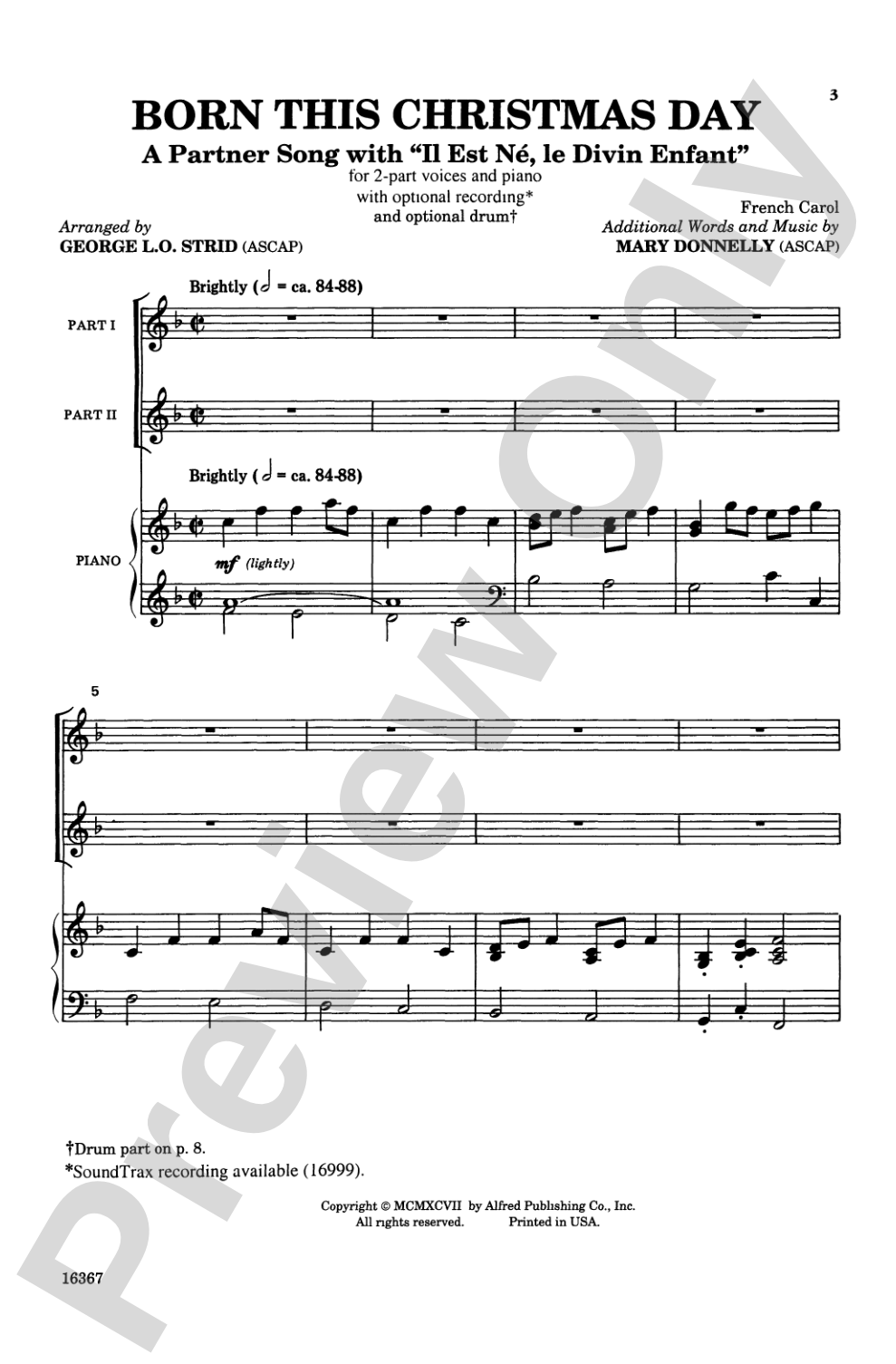
Born This Christmas Day (Il Est Né) Sheet Music Preview

Born This Christmas Day (Il Est Né): 2-Part Choral Octavo

Music by Mary Donnelly and George L. O. Strid

Item: 00-PO-0002101

Digital Download
$2.25

Minimum order quantity: 20 copies

Description
A partner song with the charming French Carol, "Il Est Né." Opens with a new and singable melody by Mary Donnelly, then adds the famous French carol. Simple, no-nonsense choral writing for young and developing choirs.

Born This Christmas Day (Il Est Né): 2-Part Choral Octavo isn't in MakeMusic Cloud just yet...but it could be. Let us know you'd like to see it, and you'll help shape what comes next. In the meantime, start a free trial and dive into thousands of interactive titles your students can play along with today.

Sample Audio
No sample audio found.
Sample Video
Additional Details
Series: Alfred Archive Edition: Alfred Choral Designs
Publisher: Alfred Music
Page Count: 8
SKU: 00-PO-0002101
Instrumentation: Percussion

More about this title

About the Composer: Mary Donnelly

Mary Donnelly

Mary Donnelly grew up in Reno, Nevada, and studied English and French at the University of Nevada before earning a Master's Degree in Education from Lesley College in Cambridge, Massachusetts, where she focused on integrating arts across the curriculum. She spent thirty years teaching general music and choir in the Washoe County School District, retiring with deep roots in music education and a commitment to making music accessible to young singers.

In 1985, Donnelly partnered with George L. O. Strid while team-teaching sixth-grade general music. Their principal challenged them to write a musical for Reading Week, launching a prolific collaboration that has produced over two hundred songs and twenty-five musicals. Both are active members of ACDA, NEA, and ASCAP.

Why we love this

Donnelly's gift for melody shines here: the opening melody feels fresh and natural for young singers, setting up a seamless transition into the beloved French carol. The partner song structure gives directors a genuine musical idea rather than a forced combination, and the straightforward voice-leading means rehearsal time goes toward musicality, not wrestling with awkward ranges or rhythmic tangles.

What to expect

Warm and inviting, with the gentle assurance of a carol you've always known. Donnelly's new melody feels like it belongs alongside the French carol, creating a moment of quiet delight when the two lines intertwine. The overall effect is intimate and joyful without sentimentality.

Who it's for

Young and developing choirs preparing holiday concerts, particularly those with mixed-age ensembles or singers new to two-part singing. The piece works well for elementary and middle school choirs seeking repertoire that feels musically complete without overwhelming singers technically.

How to get the most out of it

  • Balance the two melodic layers carefully in the middle section. The French carol should sing through clearly without drowning out the newer melody; mark dynamics explicitly during early rehearsals to establish the blend you want.
  • Use the recorded accompaniment to lock in the harmonic foundation, especially if your percussion section is still developing. This frees singers to focus on intonation and phrasing.
  • Shape the transition between the opening melody and the partner song moment as a gentle surprise rather than a dramatic shift. Slight tempo flexibility and a soft ritard can heighten the magic of the combination.
  • Engage percussion early. Even simple triangle and sleigh bells add festive color and help younger singers feel the pulse during partner song sections.

How to use it

Pair this with other carols from different cultures or traditions to create a programming arc that celebrates musical diversity across a winter concert. It also works beautifully as a teaching piece mid-rehearsal cycle, since the simple voice-leading lets singers build confidence quickly and hear results right away.

Skills your students will build

  • Singing independent melodic lines while maintaining awareness of harmonic color
  • Blending with a sung or recorded accompaniment
  • Recognizing and performing partner song structure
  • Phrasing and breath management in two-part texture
  • Intonation in close harmony

You May Also Like