
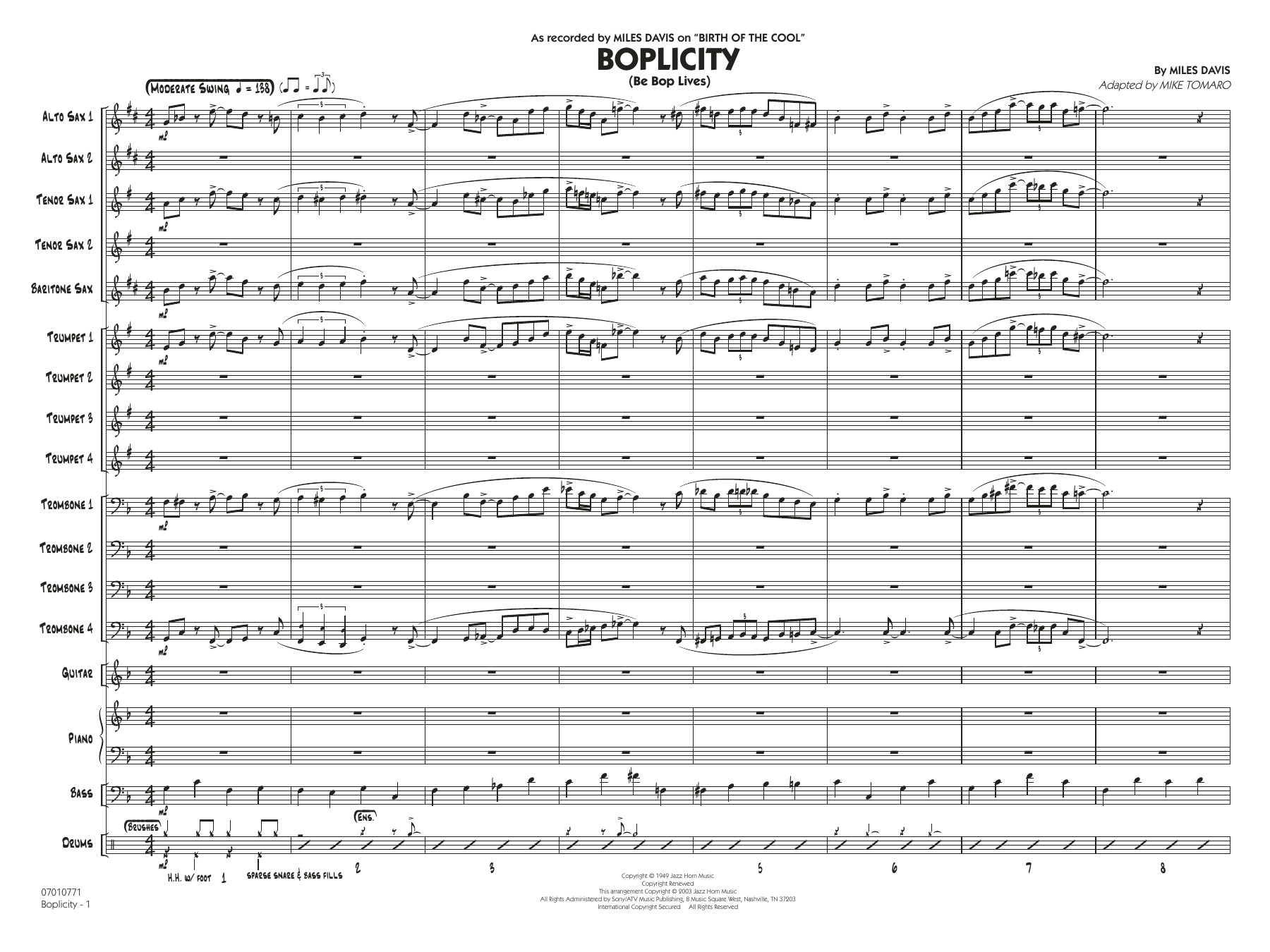

Boplicity: Jazz Ensemble Conductor Score & Parts
By Gil Evans / As performed by Miles Davis / Arranged by Mike Tomaro
Grade: 4
Item: 35-PK01252119
$55.00
Pickup currently not available
Buy Extra Parts (Digital PDF Download)
| Product | Price | Quantity |
|---|---|---|
| Boplicity - Full Score | $7.50 | |
| Boplicity - Alto Sax 1 | $6.00 | |
| Boplicity - Alto Sax 2 | $6.00 | |
| Boplicity - Tenor Sax 1 | $6.00 | |
| Boplicity - Tenor Sax 2 | $6.00 | |
| Boplicity - Baritone Sax | $6.00 | |
| Boplicity - Trumpet 1 | $6.00 | |
| Boplicity - Trumpet 2 | $6.00 | |
| Boplicity - Trumpet 3 | $6.00 | |
| Boplicity - Trumpet 4 | $6.00 | |
| Boplicity - Trombone 1 | $6.00 | |
| Boplicity - Trombone 2 | $6.00 | |
| Boplicity - Trombone 3 | $6.00 | |
| Boplicity - Trombone 4 | $6.00 | |
| Boplicity - Guitar | $6.00 | |
| Boplicity - Piano | $6.00 | |
| Boplicity - Bass | $6.00 | |
| Boplicity - Drums | $6.00 |
Parts Added to Cart!
Description
The landmark album by Miles Davis "Birth of the Cool" brought us a unique instrumentation (the nonet) along with distinctive jazz sounds. Without straying from the intent of the music and working directly with the original score, Mike Tomaro's adaptation for standard instrumentation makes this wonderful classic available to the contemporary jazz ensemble. The style is laid back swing and includes solos for baritone sax, trumpet and piano (like the original).


Boplicity: Jazz Ensemble Conductor Score & Parts isn't in MakeMusic Cloud just yet...but it could be. Let us know you'd like to see it, and you'll help shape what comes next. In the meantime, start a free trial and dive into thousands of interactive titles your students can play along with today.
Request This Title
Tell us you want it.
Start Your Free Trial
Explore everything that's ready to play right now.
Sample Audio
No sample audio found.
Sample Video
No sample videos found.
Additional Details
Publisher:
Hal Leonard
SKU:
35-PK01252119
More about this title
About the Composer: Gil Evans
Gil Evans was a pianist, composer, and arranger whose orchestrations fundamentally shaped the sound of modern jazz. Working with Miles Davis throughout the 1950s, he created intricate voicings and textures that elevated jazz arranging to an art form equal to composition itself. His ability to balance harmonic sophistication with accessibility made complex jazz concepts available to ensemble players at all levels.
Evans' legacy rests on his conviction that jazz ensemble writing could be both intellectually rigorous and deeply musical. He proved that unconventional instrumentation and careful orchestration were tools for expression, not obstacles. His arrangements continue to teach musicians how thoughtful voicing and orchestral color serve the melody and groove.
Why we love this
Mike Tomaro's adaptation honors the sophistication of the original "Birth of the Cool" recording while giving it life in a standard jazz ensemble setting. Your students get to inhabit a landmark recording with authentic solo opportunities and the laid back swing feel that defined cool jazz, all without struggling through an unusual instrumentation that would otherwise keep this masterpiece out of reach.
What to expect
This is unhurried, sophisticated jazz that invites you to listen as much as play. The laid back swing sits in a pocket of refinement where every phrase breathes; there is space between the notes as much as substance in them. It feels like being invited into a small room where serious musicians are having a private conversation.
Who it's for
Jazz ensembles at the intermediate to advancing level who want to explore a canonical recording with genuine musicianship demands. Directors seeking repertoire that combines historical significance with practical accessibility will find this adaptation opens the door to the cool jazz vocabulary for players ready to step beyond basic swing.
How to get the most out of it
- Balance the ensemble sound by keeping the horns restrained during the melody statement; this piece breathes better when soloists are featured prominently rather than buried in thick harmonies.
- Encourage your rhythm section to listen closely to the original Davis recording for the specific color and articulation that gives this chart its character; swing the eighths without making them bounce.
- Work the baritone sax, trumpet, and piano solos separately in sectionals before bringing them into the full ensemble, since each soloist needs clear space to establish their voice before transitions happen.
How to use it
Feature this on a jazz concert dedicated to historical recordings and their evolution, pairing it with other cool jazz standards to show your audience how orchestration shapes identity. Alternatively, use it as a teaching moment mid year when your ensemble has developed enough technical control to handle the subtlety and restraint the piece demands.
Skills your students will build
- Balancing melody with harmonic complexity in big band texture
- Interpreting swing articulation and phrasing from recorded models
- Supporting featured soloists through responsive ensemble playing
- Understanding cool jazz orchestration principles and voice leading
- Managing dynamics and space as compositional tools