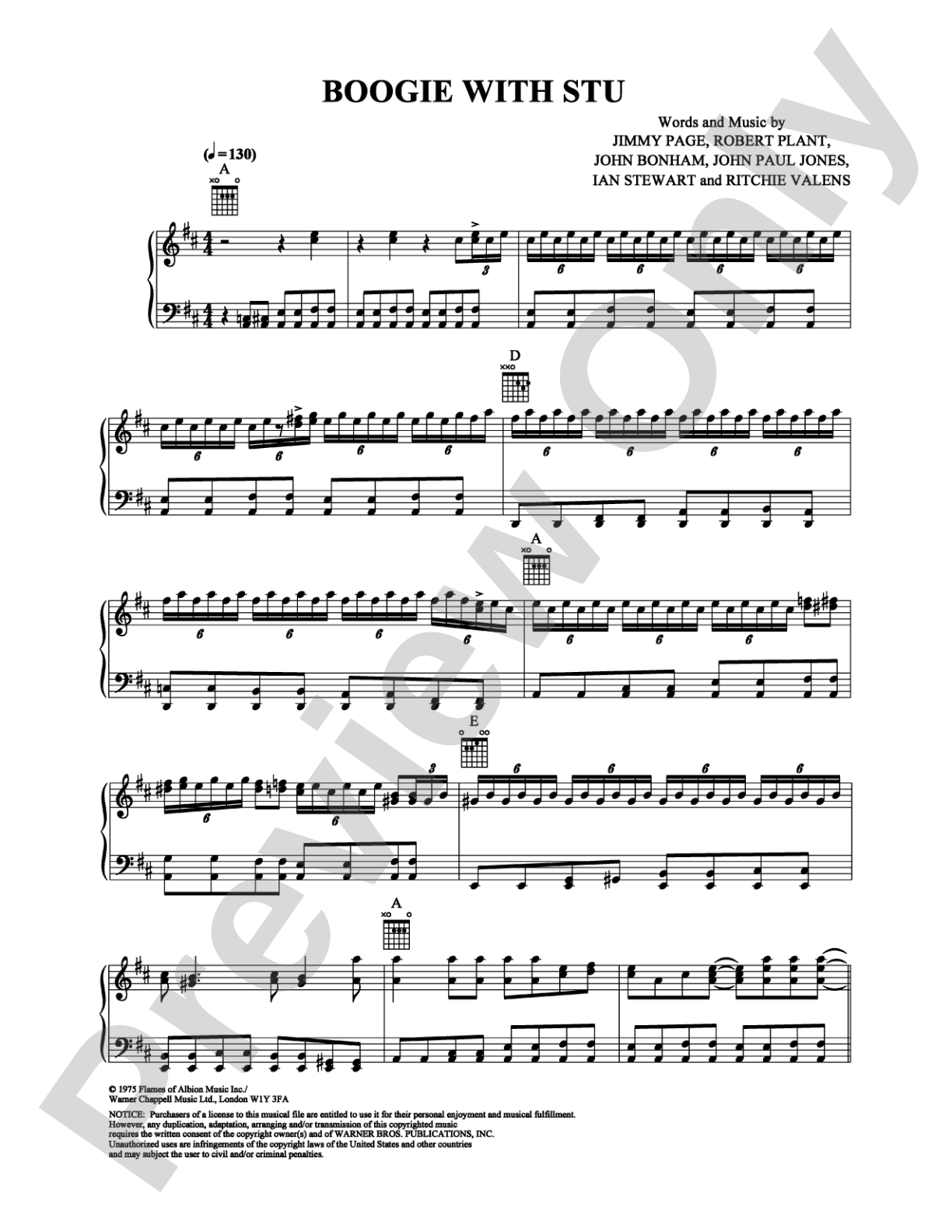
Boogie With Stu: Piano/Vocal/Chords Digital Sheet Music

Boogie With Stu: Piano/Vocal/Chords Digital Sheet Music

Led Zeppelin, Jimmy Page, Robert Plant, John Paul Jones, John Bonham, Ian Stewart, Ritchie Valens

Item: 00-PS-0002890

Digital Download
$3.99
Description

Boogie With Stu: Piano/Vocal/Chords Digital Sheet Music isn't in MakeMusic Cloud just yet...but it could be. Let us know you'd like to see it, and you'll help shape what comes next. In the meantime, start a free trial and dive into thousands of interactive titles your students can play along with today.

Sample Audio
No sample audio found.
Sample Video
Additional Details
SKU: 00-PS-0002890

More about this title

About the Artist: Led Zeppelin

Led Zeppelin stands as one of the most influential rock bands of the 1970s, known for blending blues, folk, and hard rock into a sound that redefined popular music. The band's catalog remains essential listening for understanding how blues traditions informed and shaped rock composition, arrangement, and performance practice.

For music educators and students studying rock history, Led Zeppelin's work demonstrates how to honor source material while creating something entirely new. Their instrumental prowess and willingness to experiment across genres makes their arrangements valuable teaching tools for musicians exploring rock idioms.

Why we love this

This arrangement captures the swagger and rhythmic drive that made Led Zeppelin's catalog so distinctive. Students working through piano/vocal/chords versions gain access to the band's harmonic and melodic choices in a format that reveals the song's structure in ways the original recording alone cannot.

What to expect

Raw energy meets bluesy confidence. The arrangement has a strut to it, with a relentless groove that keeps the momentum moving forward. There's room for attitude in the vocal delivery and the piano work, making it as much about attitude as it is about technique.

Who it's for

This arrangement works for pianists and vocalists studying rock repertoire, covering bands, and students interested in how blues changes function in rock contexts. It suits singers developing stage presence in a rock idiom and pianists building facility with blues-based comping.

How to get the most out of it

  • Lock into the swing feel of the rhythm; even though this is notated, the pocket sits slightly behind the beat in places to create the groove
  • Keep the vocal line conversational and rhythmically flexible rather than metrically rigid, particularly in the phrasing over the riff
  • Use the chord symbols to explore comping variations on the piano part; the basic changes leave room for personal interpretation

How to use it

This works well in a rock ensemble concert, a student recital exploring non-classical repertoire, or a band's spring program where you want to showcase contemporary covers. It pairs naturally with other blues-influenced rock material and demonstrates the connections between blues standards and 1970s rock.

Skills your students will build

  • Swing feel and rhythmic phrasing in rock contexts
  • Reading and interpreting chord symbols for improvised comping
  • Balancing vocal phrasing with groove-oriented accompaniment
  • Blues-based harmonic progressions and their rock applications

You May Also Like