
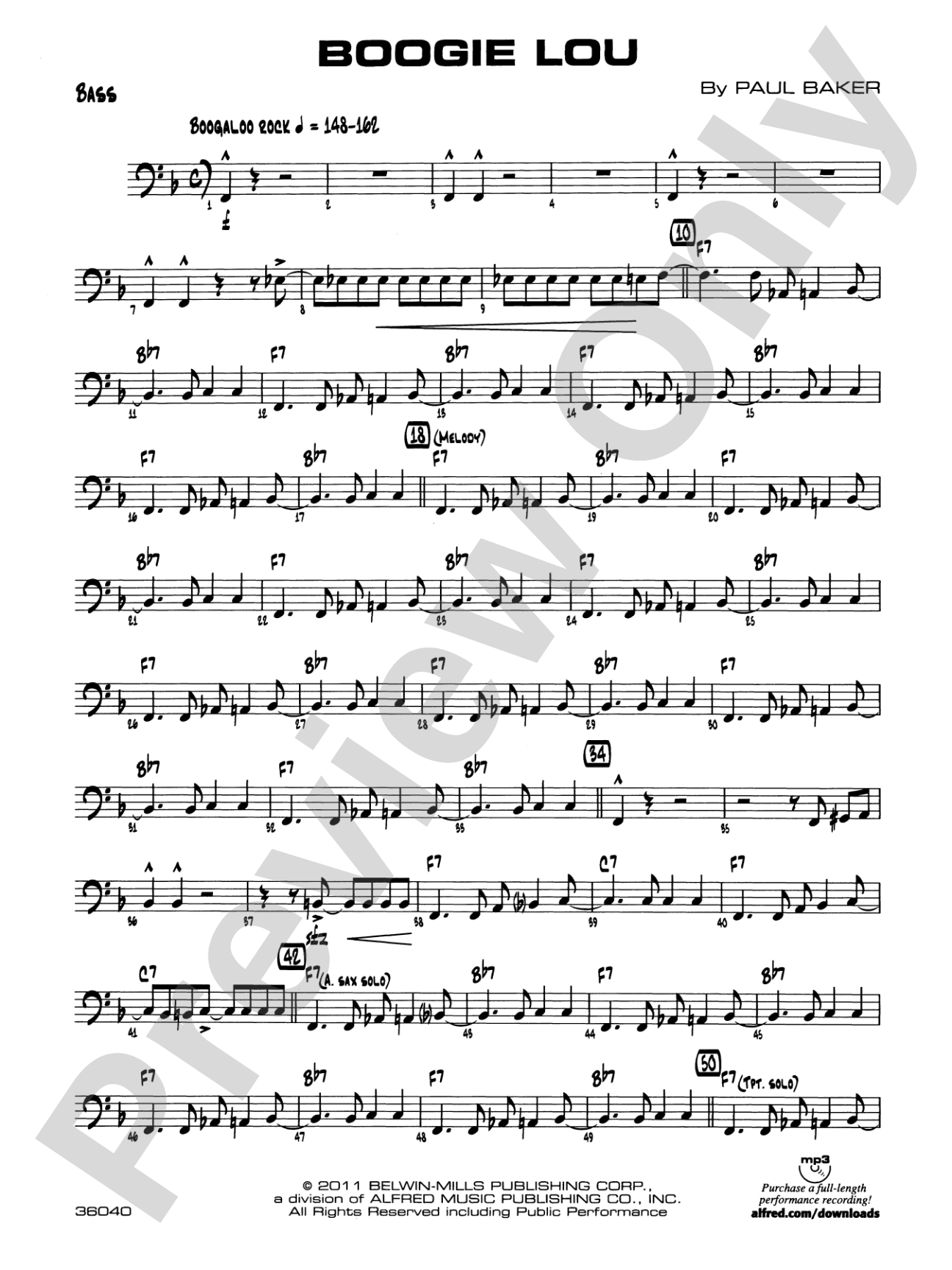

Boogie Lou: String Bass
By Paul Baker
Grade: 2 (Medium Easy)
Item: 00-PC-0017192_SB
$3.00
Pickup currently not available
Description
Your audience won't be able to resist tapping along to this boogaloo groove with a funky twist, at around 156 BPM, will have everyone tapping their feet. This groove will push the band into forward motion with features that include written solos for alto 1, trumpet 2, and trombone 2, lead trumpet top note to a written G, a few stop-time sax section licks, and energy bursting from every part.


Don't just read it, hear it, play along with it, and watch your students grow with it. In MakeMusic Cloud, Boogie Lou: String Bass comes alive with professional accompaniment, adjustable tempo, and built-in practice tools that turn solo practice into real progress.
Open in the Player
Jump straight in and assign it today.
Start Your Free Trial
Open this title and explore the full library in minutes.
Sample Audio
1
Audio File
--:--
0:00
0:00
Sample Video
No sample videos found.
Additional Details
Series:
Young Jazz Ensemble
Publisher:
Alfred Music
Page Count:
90
SKU:
00-PC-0017192_SB
More about this title
About the Composer: Paul Baker

Paul Baker brings decades of professional experience across jazz, film, television, and Broadway to his work as a composer and arranger. Based in Austin, Texas, he has performed at landmark venues including the Village Vanguard and Universal Amphitheater, and has clinicked at jazz festivals throughout Europe. His compositional range spans jazz ensembles of every size and level, theater productions, film scores, and interactive media.
Baker holds a B.M. in jazz studies from North Texas State University and completed advanced studies in film composition at USC. His background as both a working saxophonist and educator informs his ability to write idiomatically for student ensembles while maintaining professional musical standards.
Why we love this
Baker understands what makes a Grade 2 ensemble groove without dumbing down the groove itself. The boogaloo feel at 156 BPM sits in that sweet spot where students feel the forward motion immediately, and the distributed solo features (alto 1, trumpet 2, trombone 2) ensure multiple section leaders get a chance to shine without requiring virtuosos. The stop-time sax licks and high trumpet writing give the piece character and lift without becoming a rhythm section showcase.
What to expect
The boogaloo vibe is infectious and instantly recognizable. Forward motion builds from the opening funky groove, the ensemble passages have real energy bursting through each part, and the distributed solos create moments where individual voices emerge from the collective sound. This is music that makes audiences want to move.
Who it's for
Jazz ensemble directors working with Grade 2 (medium-easy) ensembles who want material with professional groove and enough solo space to build individual musician confidence. This score works for high school programs just building their jazz curriculum as well as middle school groups ready for their first real funk chart.
How to get the most out of it
- Lock the rhythm section pocket early in rehearsal. The boogaloo groove only clicks when the bass and drums feel the same subdivision; spend rehearsal time isolating these parts before adding the horns.
- Balance the alto 1 and trumpet 2 solos so they sit as featured voices, not buried under the ensemble background. These moments are student showcases, so shape the ensemble dynamics accordingly.
- Mark the stop-time sax section licks clearly in all parts. Saxophonists often rush or drag when trading ensemble background for rhythmic figures; count through these passages together until they're rock solid.
- Approach the lead trumpet's top G as a target note worth arriving at cleanly. This high point creates natural energy lift if the section shapes the line intentionally rather than just hitting the note.
How to use it
Program this as a crowd-pleaser on a jazz concert alongside a ballad and a more challenging ensemble feature; the groove and accessible solos make it ideal for bringing audiences into the jazz ensemble sound. It also works as a third or fourth chart in a rehearsal sequence where students are building foundational jazz vocabulary and ensemble cohesion.
Skills your students will build
- Maintaining consistent swing eighth-note subdivision within a boogaloo groove
- Playing written jazz solos with stylistic phrasing and time feel
- Executing stop-time figures as a section without rushing or dragging
- Reading high-register trumpet writing while maintaining tone and intonation
- Balancing ensemble backgrounds against featured solo voices