Boogie Blues: Piano Sheet Music Preview

Boogie Blues: Piano

By Deborah Baker Monday

Grade: 1

Item: 98-PC-DST6375_K

Digital Download
$7.00
Description
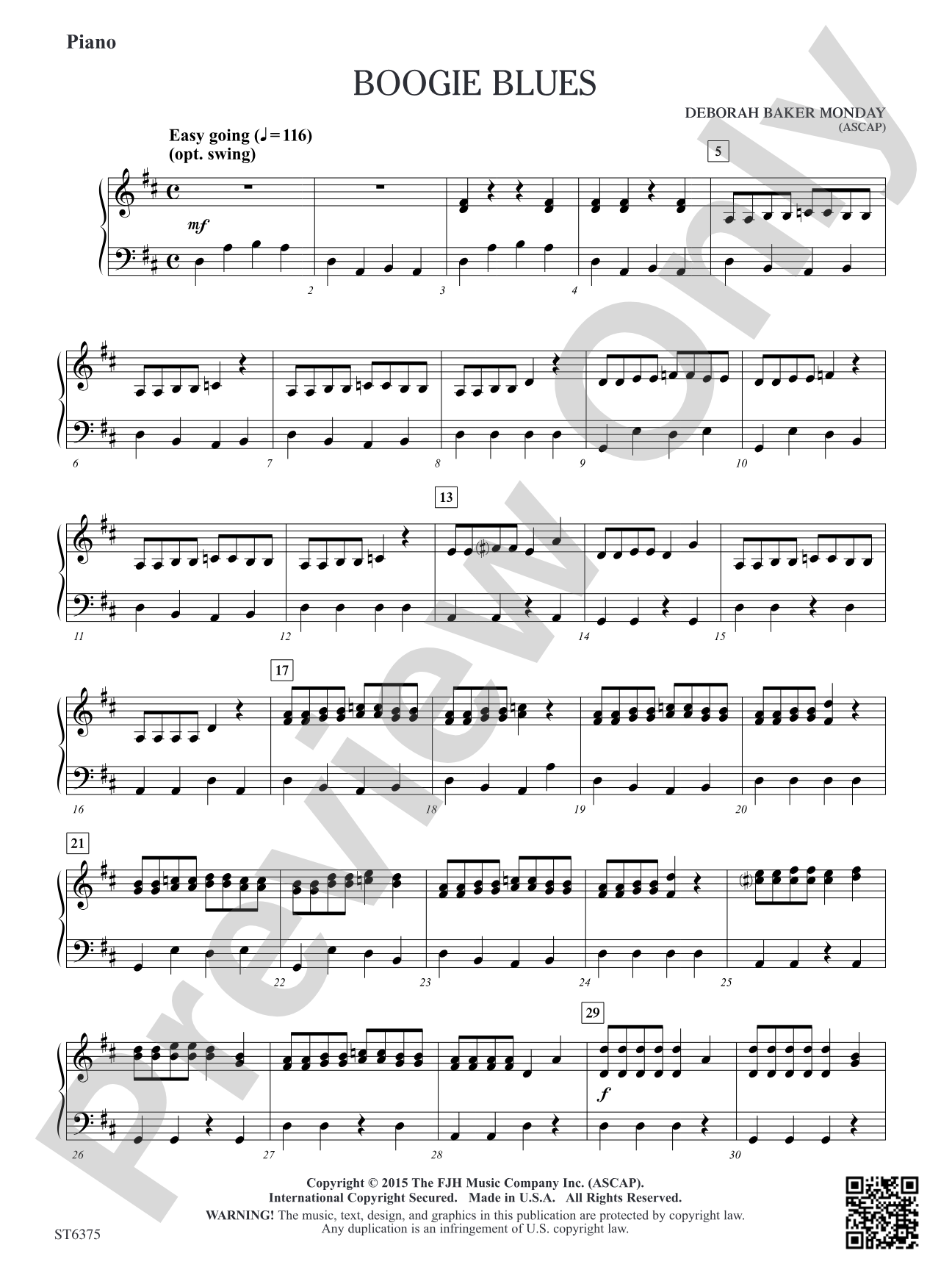
Written in the key of D using simple quarter and repeated eighth note patterns, Boogie Blues is a bundle of fun based on a blues progression. All instruments have interesting parts and will enjoy the easy, yet effective groove. Certain to become a student (and audience) favorite!

Don't just read it, hear it, play along with it, and watch your students grow with it. In MakeMusic Cloud, Boogie Blues: Piano comes alive with professional accompaniment, adjustable tempo, and built-in practice tools that turn solo practice into real progress.

Sample Audio
0:00
0:00
Sample Video
Additional Details
Series: FJH Beginning Strings
Publisher: The FJH Music Company, Inc.
SKU: 98-PC-DST6375_K

More about this title

About the Composer: Deborah Baker Monday

Deborah Baker Monday

Deborah Baker Monday spent 25 years leading the acclaimed Logan City orchestra program before transitioning to guest conducting, clinician work, and teacher supervision. She holds a B.M.E. from Florida State University with a focus on string education, an M.M. in composition from the University of Alabama, and completed doctoral coursework at Louisiana State University, where she studied under James Yestadt. Her teachers in composition and theory included Harold Schiffman, John Boda, Frederic Goossen, Paul Hedwall, and Dinos Constantinides.

Monday's career as a bassist with regional orchestras and her work as a low strings specialist in the Logan City School District shaped her approach to writing for student ensembles. She has composed and arranged more than 130 works across seven publishing companies, with particular expertise in educational string literature. Her contributions to music education have earned her the UtahASTA Composition Competition award (2006, 2011), Outstanding Elementary Educator recognition, and Superior Accomplishment honors from UtahMEA.

Why we love this

Monday writes with a genuine understanding of what makes beginning string players engaged and confident. The straightforward quarter and eighth note patterns mean students can focus on tone production and rhythmic precision while the blues groove gives them something genuinely fun to play, not just an exercise disguised as music.

What to expect

The piece carries the relaxed, walking swagger of classic blues, built on a foundation accessible enough for young players but with harmonic and groove content that feels real. There's a lightness and playfulness in the writing that invites students to swing a little, smile a little, and feel like real musicians playing something with character.

Who it's for

Beginning string orchestras at Grade 1 level will find this piece immediately playable and genuinely rewarding. Directors seeking a novelty selection that doesn't compromise musicianship or student engagement will return to this one year after year.

How to get the most out of it

  • Lock in the groove by having all sections maintain a steady, relaxed pulse; the simplicity of the rhythmic figures means ensemble precision becomes the star.
  • Shape the quarter notes with consistent bow pressure so the piece swings even at an accessible tempo.
  • Balance the parts so no section overpowers the blues progression; each line should be clearly heard without competing for attention.
  • Encourage students to feel the underlying blues harmonic movement rather than thinking of it as isolated note patterns.

How to use it

Slot this into a concert as a high-energy interlude between more formal selections, or use it as a closer on a beginning strings concert where you want to send the audience out smiling. It also works beautifully mid-year as a morale booster when students are ready for something beyond their early repertoire but not yet prepared for grade 2 difficulty.

Skills your students will build

  • Maintaining consistent pulse and ensemble rhythm in blues progressions
  • Executing repeated eighth note patterns with even tone
  • Playing with relaxed bow technique across quarter note figures
  • Understanding and responding to blues harmonic structure
  • Building confidence through accessible yet musically complete repertoire

You May Also Like