Bonzorno Madonna (Good Day Dear) Sheet Music Preview

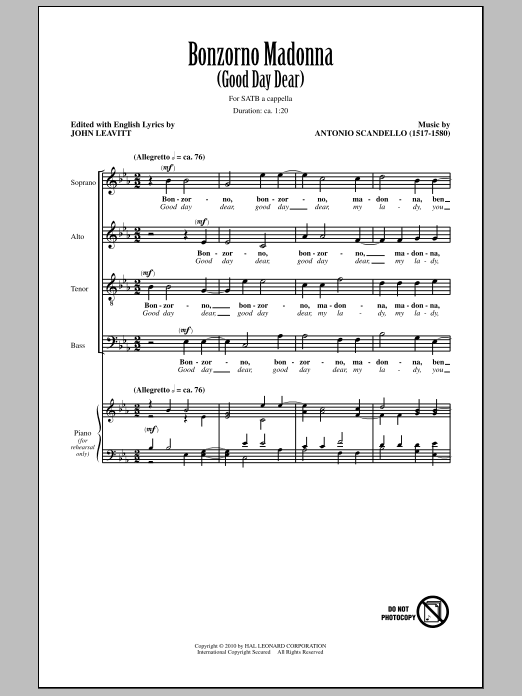
Bonzorno Madonna (Good Day Dear): SATB Choral Octavo

By Antonio Scandello

Item: 35-DS00143779

Digital Download
$2.99
Description

Bonzorno Madonna (Good Day Dear): SATB Choral Octavo isn't in MakeMusic Cloud just yet...but it could be. Let us know you'd like to see it, and you'll help shape what comes next. In the meantime, start a free trial and dive into thousands of interactive titles your students can play along with today.

Sample Audio
No sample audio found.
Sample Video
Additional Details
Publisher: Hal Leonard
Page Count: 6
SKU: 35-DS00143779

More about this title

About the Composer: Antonio Scandello

Antonio Scandello (1517-1580) was a Flemish composer and singer whose career bridged the Renaissance transition from sacred to secular vocal music. Working primarily in Italy and Germany, he gained renown for his ability to craft singable, expressive four-part works that appealed to both court and civic singers. His secular vocal music, including "Bonzorno Madonna," reflects the lighter spirit of 16th-century madrigal traditions while maintaining the structural clarity that made his works widely circulated across Europe.

Why we love this

Scandello's secular part-songs occupy a refreshing middle ground between the ornamental complexity of madrigals and the straightforward homeliness of folk-based chorales. This piece demonstrates how Renaissance composers could balance melodic charm with genuine contrapuntal substance, giving singers something engaging to perform without requiring virtuosic showmanship. Programming it alongside heavier sacred repertoire provides your audience (and your singers) a moment of warmth and civility.

What to expect

A courtly greeting wrapped in Renaissance harmony; warm without being sentimental, elegant without pretension. The piece unfolds with the ease of conversation among cultured speakers, its four voices weaving together like a witty exchange at a royal gathering. There is genuine affection in the writing, yet it never lapses into theatrical display.

Who it's for

This octavo suits advanced high school choirs and collegiate groups comfortable with Renaissance harmonic language and willing to invest in clean ensemble singing. It works equally well for concert choirs seeking a secular breather and for early music ensembles exploring the lighter end of 16th-century secular vocal repertoire.

How to get the most out of it

  • Treat the text declamation with natural speech rhythms rather than forcing syllables into metrically rigid units. Let the words guide the phrasing, especially in passages where Scandello sets repeated text fragments.
  • Balance the voice parts so that no single line dominates the texture. Renaissance four-part writing often hides thematic material in unexpected voices; full rehearsal time spent listening across the ensemble reveals these threads.
  • Approach the a cappella texture as an opportunity to shape harmonic color through vowel modification. Minor adjustments to vowel openness between phrase endings create subtle shifts in sonority that enhance the piece's emotional arc.
  • Secure rhythmic unanimity in the section work first. Once parts feel independent and secure, the conductor can relax slightly, allowing the singers to breathe naturally without losing ensemble cohesion.

How to use it

Position this between more substantial concert works to provide textural and emotional contrast without breaking the flow of a program. It functions beautifully as an opener that establishes intimacy with the audience, or as a palate-cleansing encore after demanding contemporary or large-scale repertoire. Its modest scale and secular character also make it an excellent choice for early-in-the-season rehearsal when building ensemble confidence in Renaissance style.

Skills your students will build

  • Balanced voice leading across four independent lines
  • Period-appropriate text declamation in Renaissance style
  • A cappella intonation without instrumental reference
  • Harmonic awareness of modal and early tonal language
  • Ensemble listening and blend in intimate four-part texture

You May Also Like