
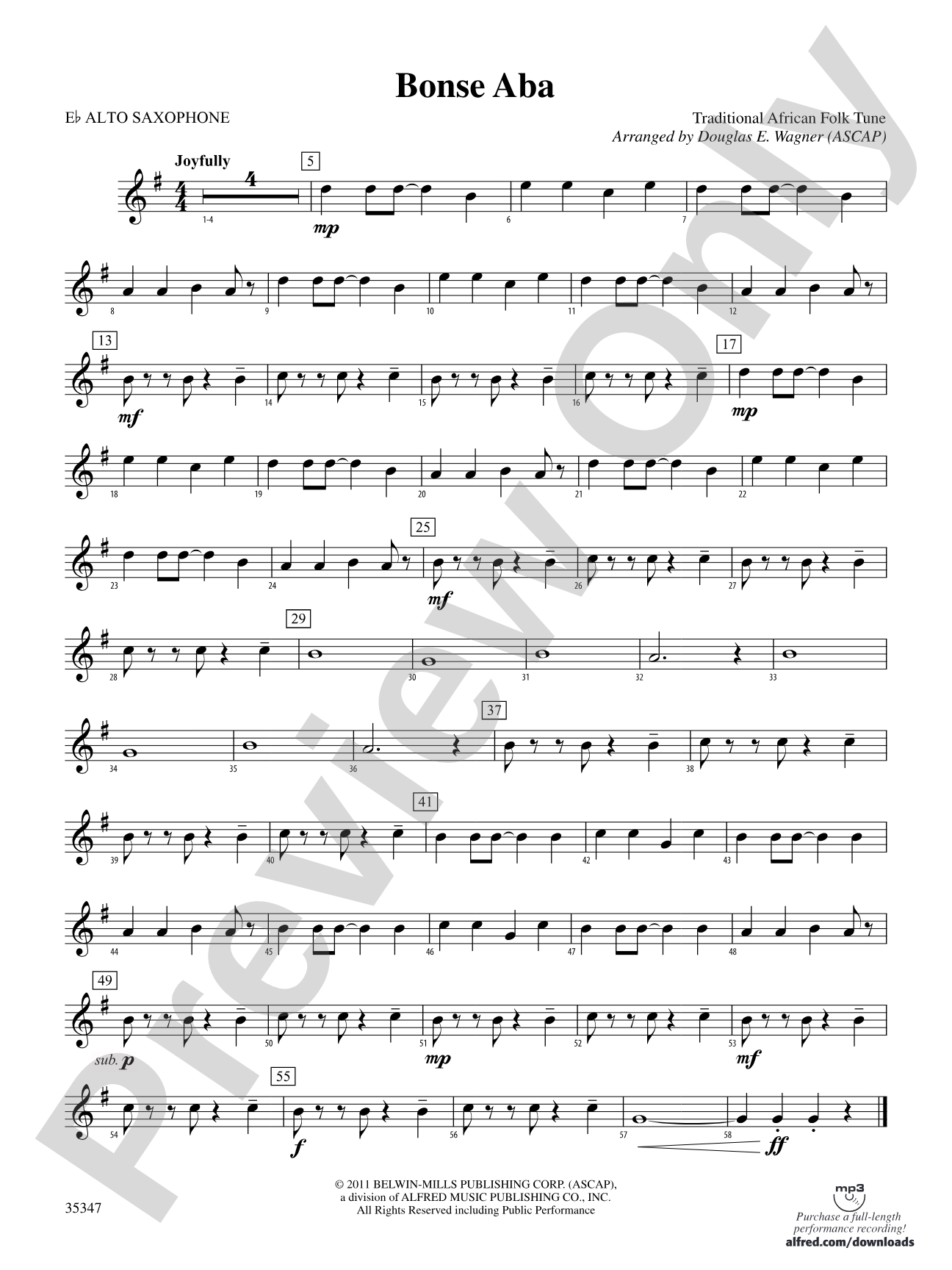

Bonse Aba: E-flat Alto Saxophone
Traditional African Folk Tune / arr. Douglas E. Wagner
Grade: 1 (Very Easy)
Item: 00-PC-0014902_AX1
$3.00
Pickup currently not available
Description
Based on a traditional African folk song from the Republic of Zambia, "Bonse Aba" is a joyful and happy folk tune. Loosely translated from Bemba language, it equates to "all who sing." Compelling rhythms and solid harmonies all come together in presenting this musical celebration of life, a joyful multicultural and musical experience for players and audiences alike. This title is available in MakeMusic Cloud.


Don't just read it, hear it, play along with it, and watch your students grow with it. In MakeMusic Cloud, Bonse Aba: E-flat Alto Saxophone comes alive with professional accompaniment, adjustable tempo, and built-in practice tools that turn solo practice into real progress.
Open in the Player
Jump straight in and assign it today.
Start Your Free Trial
Open this title and explore the full library in minutes.
Sample Audio
1
Audio File
--:--
0:00
0:00
Sample Video
No sample videos found.
Additional Details
Series:
Belwin Beginning Band
Publisher:
Alfred Music
Page Count:
134
SKU:
00-PC-0014902_AX1
More about this title
About the Arranger: Douglas E. Wagner

Douglas E. Wagner studied composition and music education at Butler University, earning both undergraduate and graduate degrees. He spent three decades as a high school music educator and administrator before transitioning to full-time composing and arranging work.
Since 1973, Wagner has created more than 3,500 published works across multiple genres and ensembles: school and church choirs, concert bands, orchestras, handbell ensembles, organ, piano, and vocal music. His compositions have been performed in concert halls throughout the United States and internationally, reaching audiences through concert programs, radio broadcasts, and television. More than seventeen million copies of his music are in circulation worldwide. Wagner lives in Indianapolis, Indiana.
Why we love this
Wagner's arrangement brings a folk melody from Zambia into your beginning band with immediate accessibility and genuine musicality. The Grade 1 scoring never condescends; instead, it trusts young players to execute clean harmonies and respond to rhythmic energy that feels authentic rather than simplified. This is the kind of piece that proves beginning ensembles can make real music while building fundamentals.
What to expect
Bright, celebratory, and alive. The arrangement captures the spirit of the Bemba words "all who sing" by creating a piece where every section has something genuine to play. The rhythms feel dance-like without becoming complicated; the harmonies settle comfortably while still sounding like real music.
Who it's for
Conductors of beginning concert bands looking for repertoire that honors world music traditions while respecting the technical limits of novice players. This works equally well for middle school programs introducing multicultural literature or high school beginning-level ensembles seeking substantial concert or festival material.
How to get the most out of it
- Establish the pulse early in rehearsal by clapping the main rhythmic motif together before instruments enter. Young players often chase the melody rather than anchoring the beat.
- Balance the harmonies by having parts play their lines solo during sectionals. At Grade 1, every voice needs clarity so the arrangement's architecture becomes audible.
- Lean into the joyful character without rushing. Beginning bands often speed up when excited; hold steady tempo and let the energy come from rhythmic precision and dynamic contrast instead.
- Isolate the transitions between sections in rehearsal. Even simple key changes or meter shifts benefit from explicit preparation with young ensembles.
How to use it
Program this early in a concert or festival to set an optimistic tone and showcase your ensemble's versatility with multicultural literature. It pairs well with other world music selections or serves as an effective warmup competition number because the piece communicates joy and musical maturity despite its accessibility.
Skills your students will build
- Reading and executing straightforward rhythmic figures in a consistent harmonic context
- Sustaining independent ensemble lines while listening to surrounding parts
- Responding to cultural and stylistic context beyond standard concert band repertoire
- Maintaining steady tempo through repeated rhythmic patterns
- Blending dynamics and tone across an entire ensemble section