
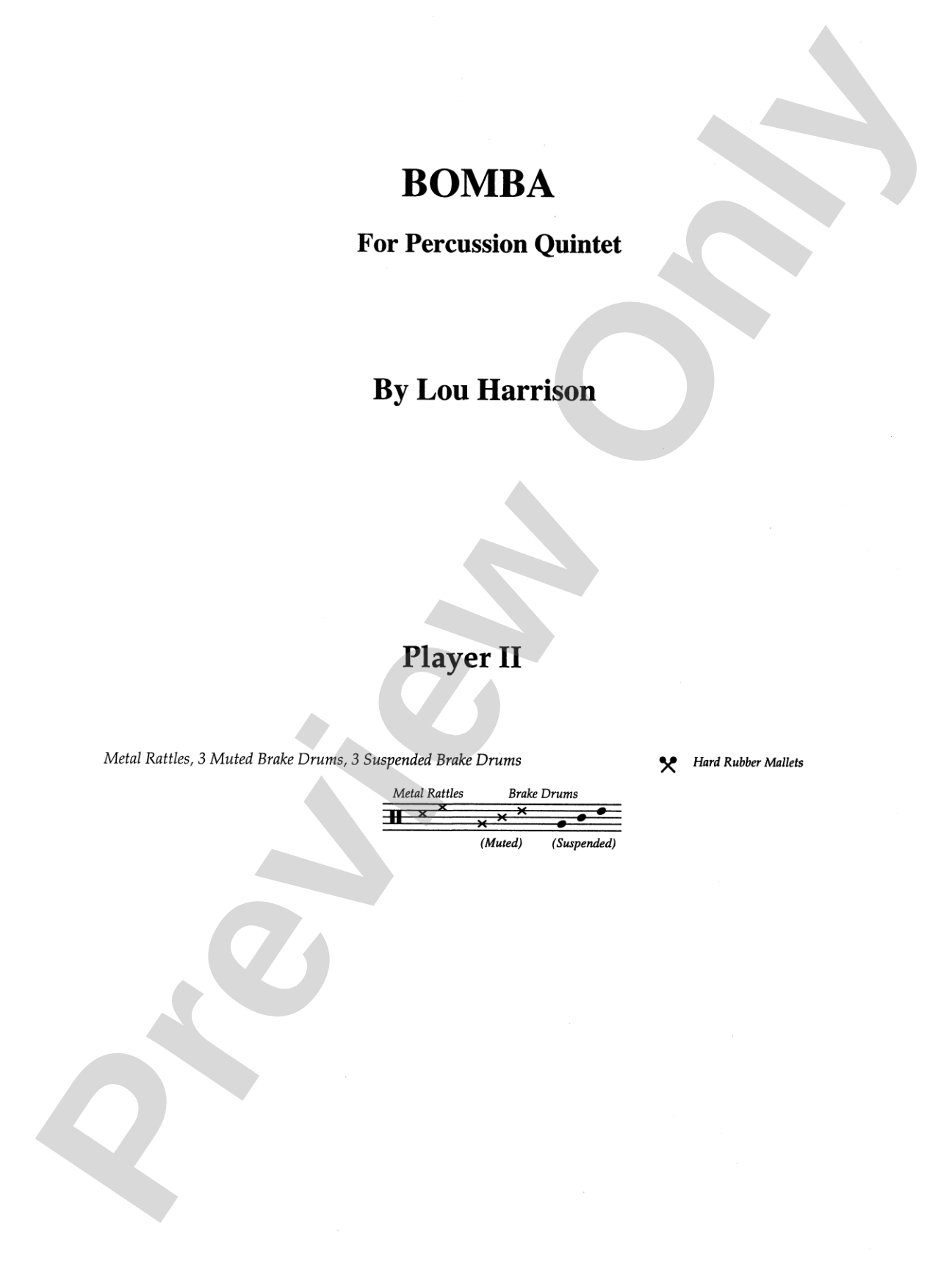

Bomba: 2nd Percussion
For Percussion Quintet
By Lou Harrison
Level: Intermediate Plus
Item: 00-PC-0000001_PC2
$3.00
Pickup currently not available
Description
For five players. This series contains several of Lou's percussion ensembles written for more advanced percussionists. The instrumentation is diverse, containing conventional and unconventional instruments. These are the works of a true master! Instrumentation is: maracas, 3 flower pots (Player I); metal rattles, 3 muted brake drums, 3 suspended brake drums (Player II); thundersheet, 3 temple blocks (Player III); rasp, 3 Chinese woodblocks (Player IV); tam-tam, bass drum (Player V).


Don't just read it, hear it, play along with it, and watch your students grow with it. In MakeMusic Cloud, Bomba: 2nd Percussion comes alive with professional accompaniment, adjustable tempo, and built-in practice tools that turn solo practice into real progress.
Open in the Player
Jump straight in and assign it today.
Start Your Free Trial
Open this title and explore the full library in minutes.
Sample Audio
No sample audio found.
Sample Video
No sample videos found.
Additional Details
Series:
Master Percussion Ensemble Series
Publisher:
Alfred Music
Page Count:
32
SKU:
00-PC-0000001_PC2
More about this title
About the Composer: Lou Harrison
Lou Harrison (1917-2003) was an American composer whose curiosity about world music systems and unconventional instruments fundamentally shaped his compositional voice. He studied with Henry Cowell and Arnold Schoenberg, yet his most distinctive contributions came through his exploration of non-Western tuning systems, gamelan music, and percussion writing that treated conventional and found instruments as equal voices in the ensemble.
Harrison's percussion works represent some of the most inventive writing in the twentieth-century percussion repertoire. Rather than relegating percussion to rhythmic accompaniment, he treated it as a primary expressive medium, crafting complex rhythmic textures and timbral colors that demanded sophisticated musicianship from players. His legacy in music education extends to generations of percussionists who have learned ensemble playing, rhythmic independence, and timbral awareness through his demanding and rewarding scores.
Why we love this
Harrison writes percussion ensembles that respect the intelligence and musicality of intermediate players while refusing to simplify the compositional thinking. The scoring pushes beyond standard drum kit expectations, asking percussionists to manage an arsenal of instruments and unlock expressive possibilities in objects most musicians never consider as musical instruments. This is the work of someone who fundamentally believed in percussion as a complete musical language.
What to expect
Bomba unfolds as a controlled exploration of rhythm and timbral color, layering unpitched percussion sounds into intricate polyrhythmic conversations. The instrumentation creates an organic, almost percussive-world-music energy without relying on a single tonal center, letting the focus rest entirely on the interplay of attack, decay, and resonance across five distinct sonic palettes.
Who it's for
Advanced high school or college percussion ensembles with five committed players who can manage multi-instrument coordination and develop nuanced control over unconventional percussion instruments. Directors seeking to expand their students' conception of what percussion music can be will find this series invaluable for students ready to move beyond standard kit playing.
How to get the most out of it
- Establish clear ensemble protocols for muting and dampening techniques before rehearsal, since several players manage multiple brake drums and suspended instruments that require immediate control.
- Map out player 5's tam-tam and bass drum entrances with particular attention to dynamic release; the tam-tam's resonance will sustain across phrases and demands intentional listening to avoid muddiness.
- Build rhythmic precision through sectional work pairing players who share complex rhythmic figures (particularly the woodblock and temple block lines) before running full ensemble passages.
- Balance the unconventional instruments (flower pots, metal rattles, rasp, Chinese woodblocks) in rehearsal by isolating each timbre's dynamic range; what registers as prominent in solo practice may disappear in the full ensemble texture.
How to use it
Program this as a concert closer or a special showcase piece that demonstrates your ensemble's versatility and sophistication. It pairs effectively with other mid-century American works that explore non-European musical systems, or stand it alone as an event piece that invites audiences to listen differently to what percussion can communicate.
Skills your students will build
- Coordinating multiple instruments per player while maintaining rhythmic accuracy
- Developing sensitivity to unconventional timbres and their dynamic properties
- Reading complex ensemble rhythmic textures with independent lines across five players
- Managing damping and muting techniques for sustained and pitched percussion
- Listening actively to blend and balance in an ensemble without traditional harmonic reference