
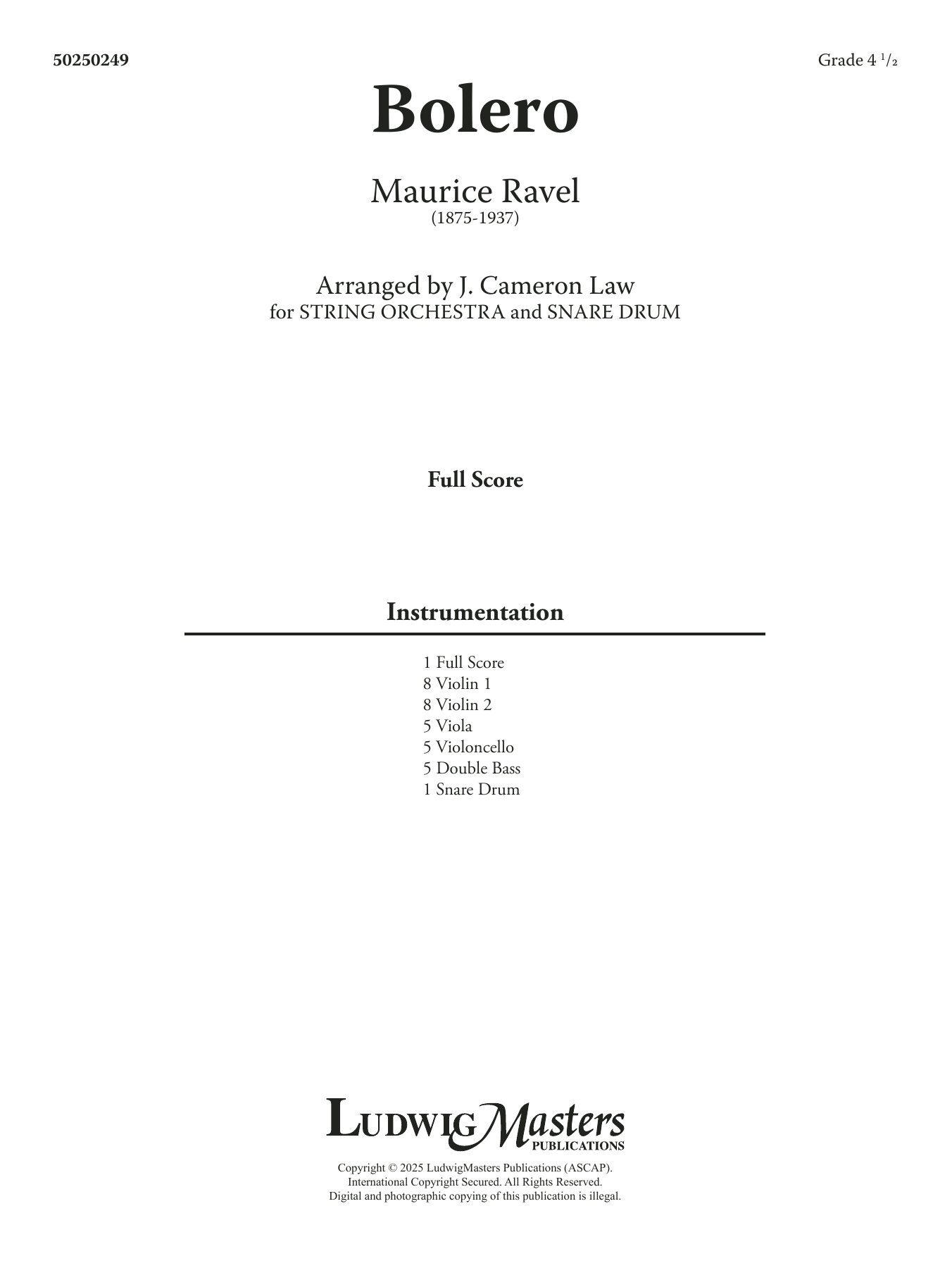

Bolero for Strings (arr. Cameron Law): String Orchestra Conductor Score & Parts
By Maurice Ravel / Arranged by Cameron Law
Grade: 4.5
Item: 35-PK01699080
$60.00
Pickup currently not available
Buy Extra Parts (Digital PDF Download)
Parts Added to Cart!
Description
Bolero is probably the best-known work of the French Impressionist composer Maurice Ravel (1875-1937). The piece was commissioned by Ida Rubenstein in 1928 and performed at the Paris Opera that same year. Bolero has a hypnotic rhythm and a simple melody that repeat over and over for nearly 15 minutes, with the orchestra gradually increasing in volume and intensity. Ravel's genius is evident in his orchestration where he assigns a different sound color to each iteration. This version of Ravel's Bolero reduces the duration of the piece by two thirds while still maintaining the long buildup of volume, intensity, and heavy orchestration. The arranger has masterfully scored a large symphonic work for string orchestra while maintaining the integrity of the original Spanish/Cuban dance. Violins, violas, and celli all get to try their hands at this famous melody.


Bolero for Strings (arr. Cameron Law): String Orchestra Conductor Score & Parts isn't in MakeMusic Cloud just yet...but it could be. Let us know you'd like to see it, and you'll help shape what comes next. In the meantime, start a free trial and dive into thousands of interactive titles your students can play along with today.
Request This Title
Tell us you want it.
Start Your Free Trial
Explore everything that's ready to play right now.
Sample Audio
No sample audio found.
Sample Video
No sample videos found.
Additional Details
Publisher:
Hal Leonard
SKU:
35-PK01699080
More about this title
About the Composer: Maurice Ravel
Maurice Ravel (1875-1937) was a French composer who mastered orchestral color with surgical precision. While often grouped with the Impressionists, Ravel was a meticulous craftsman whose works reveal mathematical structure beneath their shimmering surfaces. His gift for orchestration—reassigning the same musical idea to different instrumental combinations to create new textures—became his signature technique and remains one of the most instructive models for any musician studying how sound evolves.
Ravel's output was relatively small but immensely influential. He understood both the historical weight of classical forms and the possibilities of modernism, which allowed him to honor tradition while expanding its boundaries. For string musicians and conductors, studying Ravel's work teaches clarity of voice, balance among multiple lines, and the power of restraint.
Why we love this
Cameron Law's arrangement keeps the hypnotic core of Ravel's masterpiece intact while solving a practical problem: the original orchestration requires forces most school orchestras cannot field. Distributing the famous melody across all three string sections gives every student a chance to inhabit this iconic theme, and the shortened duration means you retain the architecture of the buildup without testing your ensemble's stamina for fifteen minutes. This is Ravel orchestration written with your ensemble's capabilities in mind.
What to expect
Hypnotic momentum builds beneath a theme so direct it lodges in the ear immediately. The repetition creates a trance-like state; each new orchestral color wakes listeners just as they settle into comfort, pulling them forward through mounting intensity. By the climax, the entire string section rings with accumulated power, transformed by nothing more than Ravel's genius for reassigning the same melody to new instruments.
Who it's for
String orchestras at the intermediate-advanced level who want to tackle a world-famous work without requiring a full symphony orchestra. This arrangement serves directors programming a concert that needs an attention-grabbing centerpiece and students hungry to play music they recognize and love.
How to get the most out of it
- Establish the pulse as a physical sensation rather than a metronomic tick. The opening rhythm should feel inevitable and slightly hypnotic, so conduct with a relaxed frame and invite your string players to feel the motion in their bodies.
- Rotate focus strategically as new instruments enter with the melody. Cue the shift clearly so that handoff of the theme never feels accidental; each section should know when they're taking the torch and play with quiet confidence.
- Build dynamic intensity gradually across the arrangement rather than in sudden jumps. Mark specific crescendo points in your score and conduct them with visible intention; your students will follow the visual architecture you create.
- Balance the rhythmic foundation with the melodic material. The accompaniment figures must remain even and consistent throughout so the repeated melody can float distinctly above. Work the second violin, viola, and cello parts with the same care you give the violins.
How to use it
Open a concert with this piece to establish atmosphere and draw the audience into the performance immediately. The familiar melody disarms listeners while the orchestral colors keep them engaged, and concluding on the swell of the full section creates a natural moment to acknowledge applause before moving to contrasting repertoire. Pair it with shorter, lighter works to balance the emotional weight of the buildup.
Skills your students will build
- Sustaining focus across an extended, repetitive structure with minimal melodic variation
- Blending and balancing accompaniment patterns with shifting melodic responsibilities
- Responding to subtle dynamic changes and crescendos across an entire section
- Rhythmic precision in accompanying figures at multiple tempi and dynamic levels
- Listening across sections to track the theme as it travels through the arrangement