

Bolero for Band (arr. R. Mark Rogers): Concert Band Conductor Score & Parts
By Maurice Ravel / Arranged by R. Mark Rogers
Grade: 5
Item: 35-PK01727949
$95.00
Pickup currently not available
Buy Extra Parts (Digital PDF Download)
Parts Added to Cart!
Description
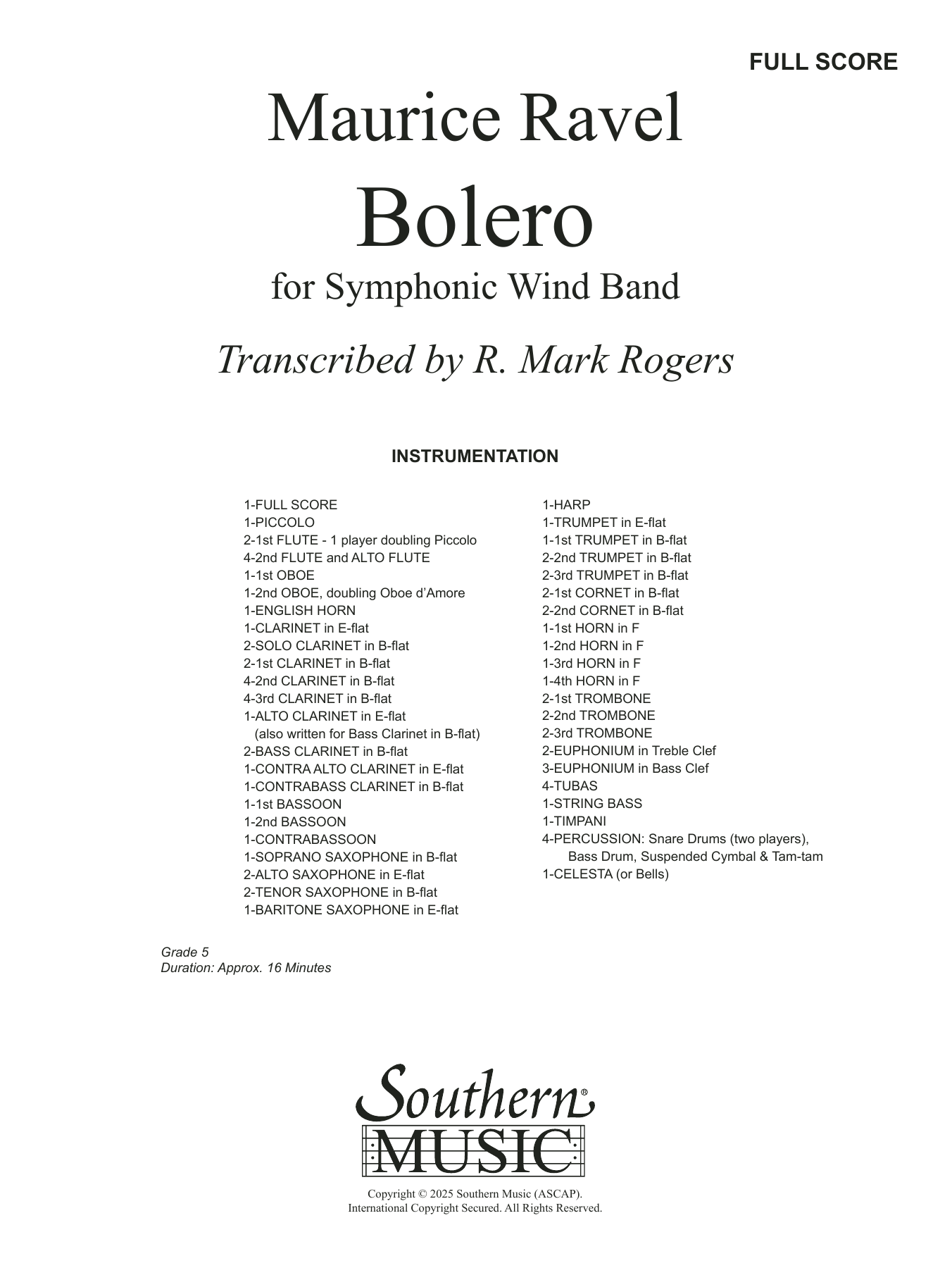
Initially commissioned by Ida Rubenstein as a ballet work, Maurice Ravels BOLERO has become his most popular and often-performed orchestra composition, which was a surprise to the composer who described it as seventeen minutes of orchestra without any music. With a structure that is simplicity itself, BOLERO uses two alternating melodies in what Ravel described as a crescendo on commonplace melod[ies]. Mark Rogers transcription of BOLERO is an entirely complete wind band version of the piece; omitting not a single note or exotic instrument, thereby transferring the brilliance of Ravels orchestral score to the symphonic wind band with as much fidelity to the original as possible. Ravel calls for a very large orchestra (triple woodwinds, saxophones, large brass section, harp, celesta and percussion). Consequently, this transcription of BOLERO contains a large amount of divisi writing. It goes without saying that this transcription will be most successfully performed by large symphonic wind band.


Bolero for Band (arr. R. Mark Rogers): Concert Band Conductor Score & Parts isn't in MakeMusic Cloud just yet...but it could be. Let us know you'd like to see it, and you'll help shape what comes next. In the meantime, start a free trial and dive into thousands of interactive titles your students can play along with today.
Request This Title
Tell us you want it.
Start Your Free Trial
Explore everything that's ready to play right now.
Sample Audio
No sample audio found.
Sample Video
No sample videos found.
Additional Details
Publisher:
Hal Leonard
SKU:
35-PK01727949
More about this title
About the Composer: Maurice Ravel
Maurice Ravel (1875-1937) was a French composer whose orchestrations rank among the most luminous in all of classical music. His meticulous approach to instrumental color and harmonic innovation shaped twentieth-century compositional practice, and his works remain staples of both orchestral and wind band repertoires. Ravel's technical mastery and fascination with non-European musical traditions produced music that sounds both modern and timeless.
Though Ravel famously dismissed Bolero as "a piece for orchestra without music," its hypnotic structure and relentless crescendo have made it his most performed work. The piece demonstrates Ravel's genius for orchestration: through resourceful doubling, countermelody, and timbre manipulation, he builds tension and color from the barest musical material. This quality makes the work particularly rewarding for wind band transcription, where judicious divisi writing can capture the original's kaleidoscopic effect.
Why we love this
Rogers's transcription honors every detail of Ravel's orchestral thinking rather than simplifying for wind band convenience. The extensive divisi writing requires a large ensemble capable of handling sophisticated doublings, and the result justifies that investment entirely. You get seventeen minutes of pure architectural precision: students witness firsthand how a single idea, reorchestrated relentlessly, becomes something irresistible through sheer accumulation of color and dynamic shape.
What to expect
Hypnotic and relentless. A single snare drum pulse anchors the band while two melodies circle each other, gradually absorbing more color and sonority. Ravel's orchestration feels orchestral in the truest sense: the wind band glimmers with harp-like textures, gleaming brass doubling, and kaleidoscopic woodwind combinations. By the final moments, every player has become part of an unstoppable crescendo, the simplest tune transformed into something monumental.
Who it's for
Advanced concert bands and symphonic wind ensembles with robust instrumentation across all sections. This work demands mature musicians who can sustain focus through hypnotic repetition and execute complex divisi writing with precision.
How to get the most out of it
- Establish the snare drum pattern as the absolute pulse before anything else enters. Every musician must lock to that ostinato; without its metronomic clarity, the whole structure wavers.
- Balance the two alternating melodies with great care during the first several minutes. They should sound equally prominent and equally hypnotic, so when the second melody emerges, it feels like a new discovery rather than a secondary voice.
- Schedule multiple rehearsals focused solely on the divisi sections. The texture relies on precise voice independence; spend time ensuring each divided section knows its specific part and can hear itself within the fuller sound.
- Shape the dynamics in sweeping arcs that span entire sections, not just bar to bar. Ravel builds his crescendo over measures, not beats. Conductors who drive too aggressively week-to-week often disrupt the measured inevitability that makes the ending so overwhelming.
How to use it
Program Bolero as the centerpiece of a spring or winter concert where you can afford extended performance and rehearsal time. Its relentless momentum and spectacular finish reward both audience attention and the ensemble's technical maturity, making it ideal for showcasing your strongest players and the band's overall refinement. Pair it with shorter, contrasting works to frame rather than compete with its architectural power.
Skills your students will build
- Sustaining rhythmic precision and pulse over extended, minimally varied ostinatos
- Maintaining steady dynamic control through long crescendos spanning multiple phrases
- Balancing and tuning divisi chords with multiple instruments on single lines
- Listening across an ensemble to identify and adjust to a hidden melodic line
- Shapingharmonic and textural color through careful attention to orchestration and doubling