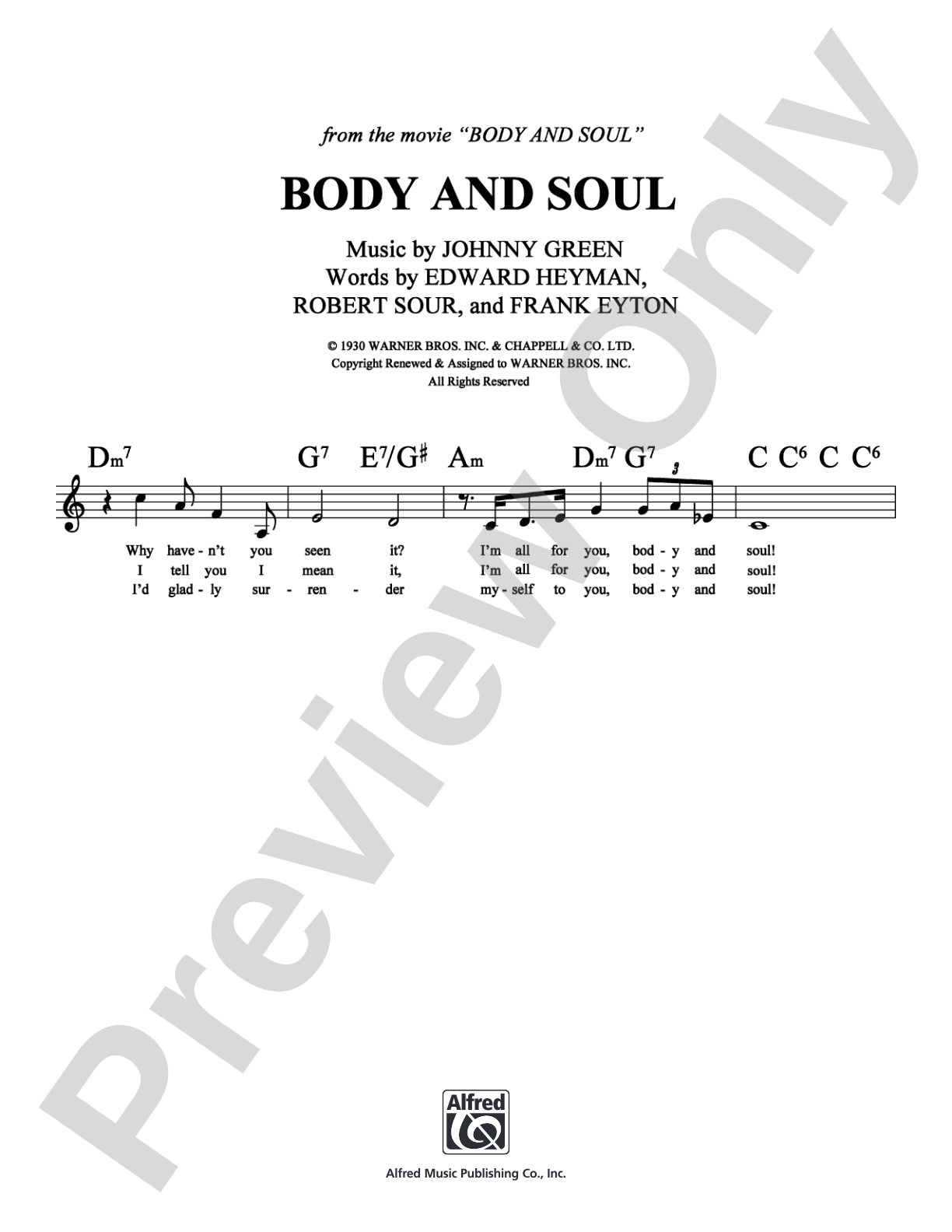
Body and Soul: Lead Sheet Digital Sheet Music

Body and Soul: Lead Sheet Digital Sheet Music

Benny Goodman, Johnny Green, Louis Armstrong, Paul Whiteman

Item: 00-PS-0008417

Digital Download
$1.99
Description

Body and Soul: Lead Sheet Digital Sheet Music isn't in MakeMusic Cloud just yet...but it could be. Let us know you'd like to see it, and you'll help shape what comes next. In the meantime, start a free trial and dive into thousands of interactive titles your students can play along with today.

Sample Audio
No sample audio found.
Sample Video
Additional Details
SKU: 00-PS-0008417

More about this title

About the Artist: Louis Armstrong

Louis Armstrong (1901-1971) remains one of the most influential figures in jazz history. His innovative approach to improvisation, scat singing, and trumpet playing fundamentally shaped how musicians across all genres approach soloing and phrasing. Armstrong's ability to interpret a melody with warmth and rhythmic freedom while maintaining absolute clarity made him a master of the American Songbook.

As a bandleader, recording artist, and ambassador for jazz, Armstrong demonstrated how a lead sheet could serve as a launching point for genuine musical conversation. His recordings of standards like "Body and Soul" show a musician listening intently to the harmony and responding with inventive melodic ideas. For educators, Armstrong's interpretations offer a masterclass in how to honor a composition while making it entirely your own.

Why we love this

"Body and Soul" is a jazz standard that rewards close attention to harmony and phrasing, and Armstrong's iconic interpretation makes it an essential reference for any jazz musician learning this tune. The lead sheet format lets students study the melody and changes independent of any single recorded version, then return to Armstrong's recording to hear how a master navigates the form. This piece naturally invites discussion about melody paraphrase, space, and dynamics as tools of expression.

What to expect

"Body and Soul" is introspective and unhurried, built on rich chromatic harmony that shifts underneath a yearning melody. The tune invites a conversational tone from the soloist; there's space for reflection and response rather than constant motion. Playing or singing this standard creates a sense of intimacy, as if the musician is confiding something carefully chosen and deeply felt.

Who it's for

Jazz instrumentalists and vocalists who are building their standard repertoire and want to study the chord changes and form without committing to a single arrangement. Improvisers at the intermediate level will benefit from learning the tune's harmonic structure and then listening to Armstrong's recording as a model for tasteful melodic interpretation. This also serves educators who want their students to engage with lead sheets as working documents for jazz study.

How to get the most out of it

  • Sing the melody first without the changes to feel its arc and emotional shape, then gradually layer in harmonic awareness as you improvise.
  • Study Armstrong's use of space and silence; he rarely fills every beat, and his restraint is as important as his ideas.
  • Listen to how the melody interacts with the chord progression, especially through chord tones and approach notes, rather than treating melody and harmony as separate layers.
  • Work from a jazz comping accompaniment or play with a pianist to understand how the tune breathes in ensemble contexts.

How to use it

Assign this as part of a jazz standards unit where students learn melody, form, and harmonic navigation before improvising. The lead sheet works well alongside recordings by different artists to illustrate how the same composition can be interpreted in contrasting ways. For a jazz ensemble or combo, use it as a vehicle for featuring soloists at a formal concert, letting each musician bring their own voice to the standard.

Skills your students will build

  • Reading and interpreting lead sheet notation and chord symbols
  • Understanding 32-bar song form (AABA structure)
  • Identifying and resolving chromatic harmony through improvisation
  • Phrasing and articulation choices in a standards context
  • Listening to and analyzing a recorded interpretation as a study model

You May Also Like