
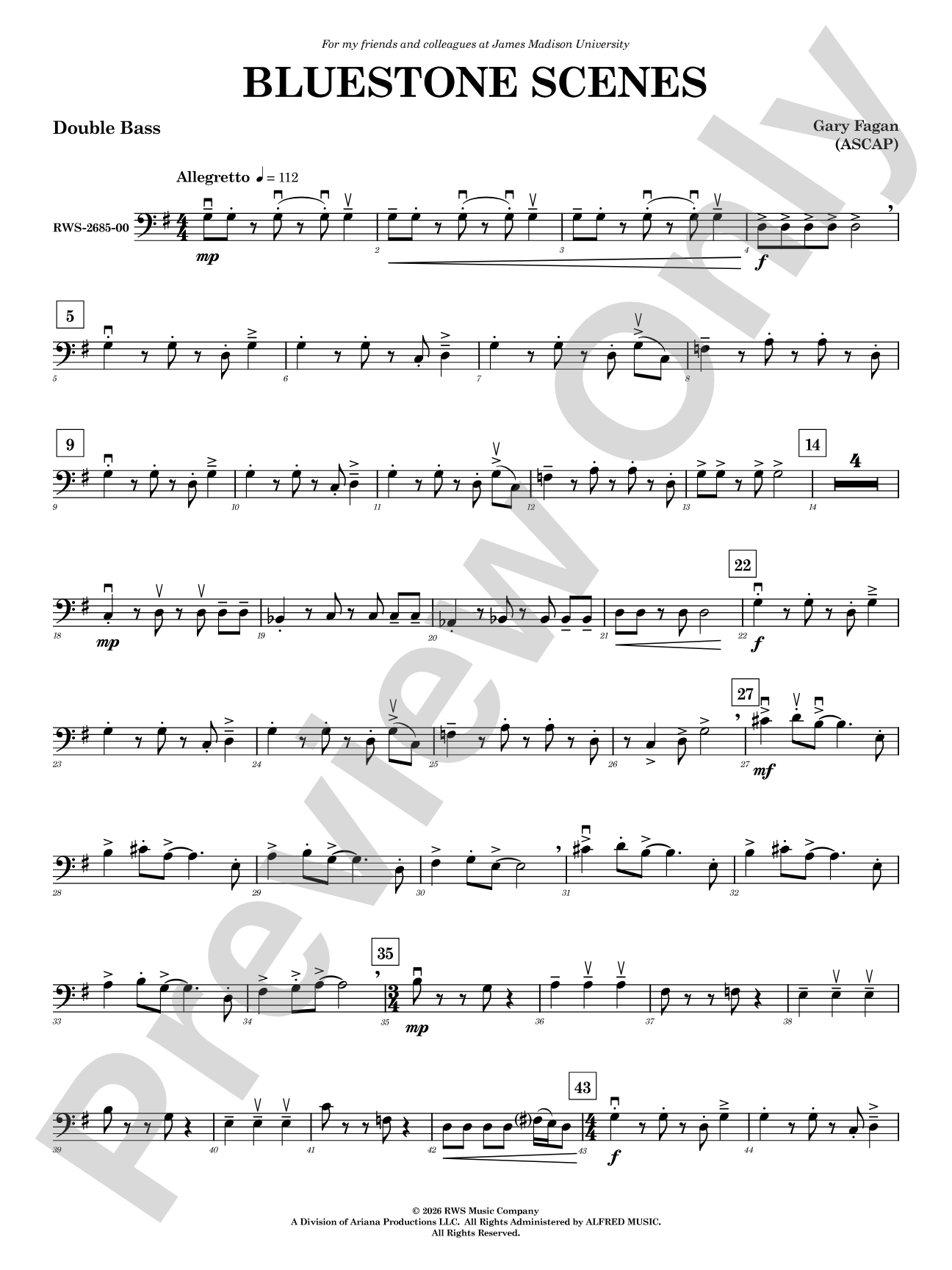

Bluestone Scenes: String Bass
By Gary Fagan
Grade: 3
Item: 98-PC-0000059_SB
$3.00
Pickup currently not available
Description
The inspiration came from the composers time enrolled in a Master of Music Education program at James Madison University in the beautiful Shenandoah Valley of Virginia. The campus features many original buildings, built in the early 20th century, constructed from a local stone called "bluestone," a type of limestone mined in the surrounding area. This Grade 3 piece will appeal to middle and high school directors looking for an exciting and useful teaching tool. Written in a traditional ABA overture style, Bluestone Scenes features infectious syncopated rhythms and interesting harmonies.


Bluestone Scenes: String Bass isn't in MakeMusic Cloud just yet...but it could be. Let us know you'd like to see it, and you'll help shape what comes next. In the meantime, start a free trial and dive into thousands of interactive titles your students can play along with today.
Request This Title
Tell us you want it.
Start Your Free Trial
Explore everything that's ready to play right now.
Sample Audio
1
Audio File
--:--
0:00
0:00
Sample Video
Additional Details
Series:
RWS - Concert Strings
Publisher:
RWS Music Company
SKU:
98-PC-0000059_SB
More about this title
About the Composer: Gary Fagan

Gary Fagan's career spans three decades as a band director in Albemarle County, Virginia, where he earned recognition as Central Virginia's Outstanding Middle School Teacher and received honors from both the Virginia Governor's School for the Visual and Performing Arts and the Piedmont Council of the Arts. His compositions and arrangements have reached audiences at the Midwest Band and Orchestra Clinic, the White House, and official state ceremonies, establishing him as a respected voice in music education circles.
A Bridgewater College graduate with a Master's degree from James Madison University, Fagan now serves as a University Supervisor at JMU while maintaining an active schedule as a clinician, adjudicator, and percussionist. His memberships in ASCAP, the National Band Association, and Phi Beta Mu Bandmasters Fraternity reflect his ongoing commitment to the profession and to supporting the next generation of music educators.
Why we love this
Fagan taps into a genuine artistic inspiration here—those distinctive bluestone buildings become the scaffolding for a piece that balances immediate appeal with real musicality. The syncopated rhythms grab attention while the harmonies keep players engaged; this is Grade 3 writing that respects both the ensemble and the audience without talking down to either.
What to expect
Bluestone Scenes captures the spirit of a place through music that feels both nostalgic and forward-moving. The syncopated rhythms propel the piece with energy while the harmonic language suggests something deeper—a sense of place, tradition, and the stories embedded in architecture.
Who it's for
Middle and high school orchestras seeking a Grade 3 piece with substance for festival or concert programming. Directors who want their students to wrestle with rhythmic precision and harmonic awareness without sacrificing the joy of playing.
How to get the most out of it
- Emphasize the rhythmic precision in the syncopated passages by having students tap their parts independently before adding the full texture; this clarity prevents the piece from sounding loose or meandering.
- Shape each section of the ABA form distinctly through dynamic contrast and articulation choices, so the architecture remains audible even at concert tempo.
- Bring out the interesting harmonies by balancing inner voices; assign a rehearsal to isolating second violins and violas so the harmonic color doesn't disappear under the melody.
How to use it
Position this as a concert opener or mid-program energizer; the infectious rhythms and overture style make it an excellent vehicle for engaging an audience without requiring dramatic context. It pairs well with more introspective pieces in a mixed program, providing textural and rhythmic contrast.
Skills your students will build
- Reading and executing syncopated rhythms in ensemble context
- Balancing harmonic voices within the string section
- Understanding ABA form through performance and conducting
- Articulation control to clarify rhythmic content
- Dynamic shaping across multi-section structures