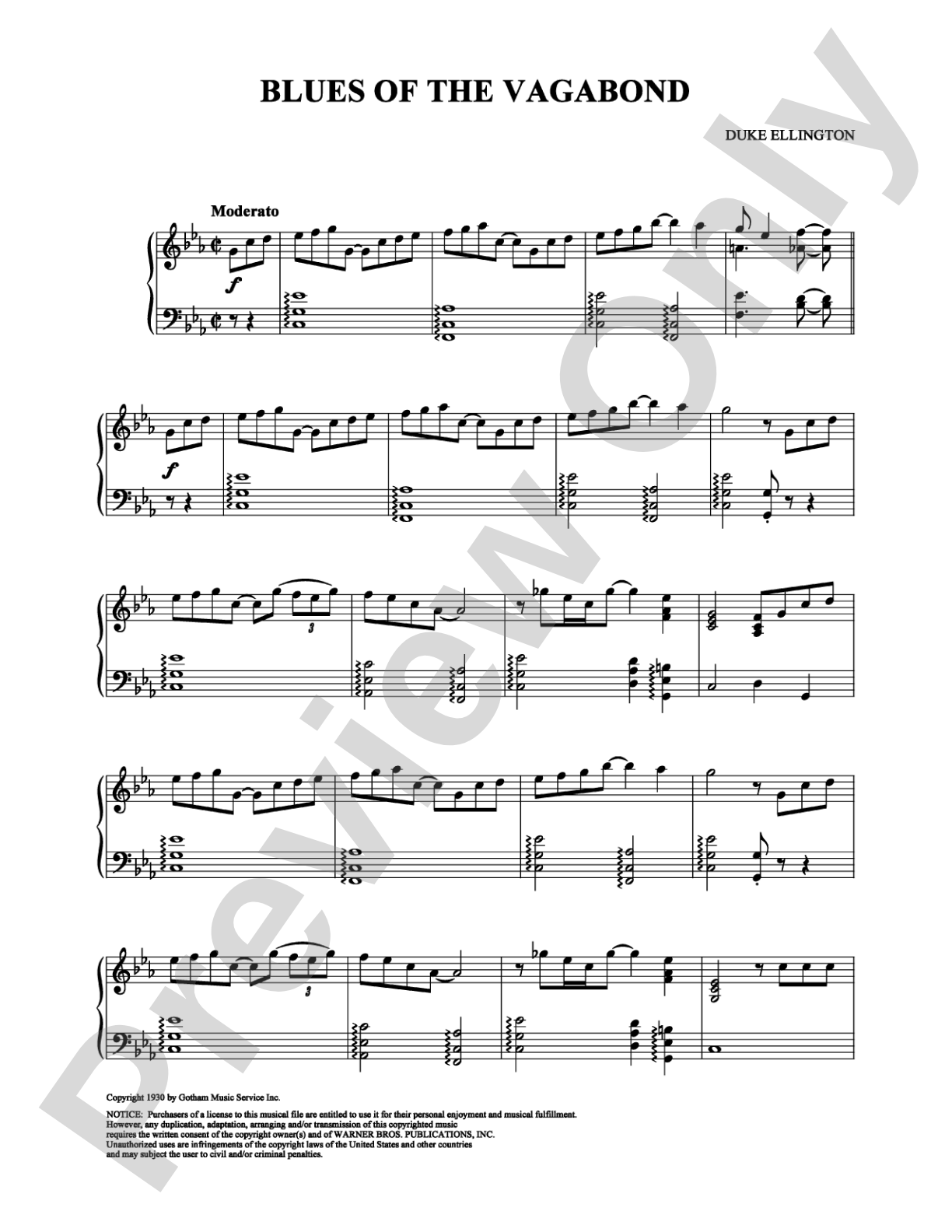
Blues of the Vagabond: Piano Digital Sheet Music

Blues of the Vagabond: Piano Digital Sheet Music

Duke Ellington

Item: 00-PS-0008191

Digital Download
$3.99
Description

Blues of the Vagabond: Piano Digital Sheet Music isn't in MakeMusic Cloud just yet...but it could be. Let us know you'd like to see it, and you'll help shape what comes next. In the meantime, start a free trial and dive into thousands of interactive titles your students can play along with today.

Sample Audio
No sample audio found.
Sample Video
Additional Details
SKU: 00-PS-0008191

More about this title

About the Artist: Duke Ellington

Duke Ellington (1899-1974) shaped American music across seven decades as a composer, bandleader, and pianist whose harmonic sophistication and orchestral thinking elevated jazz to concert hall status. His prolific output spans thousands of compositions, from three-minute standards to extended suites, all marked by his distinctive harmonic language and refusal to be confined by genre boundaries. Ellington's influence on both jazz and classical composers remains unmatched; his work continues to reveal new layers with each encounter.

Why we love this

Blues of the Vagabond sits comfortably in the Ellington canon of accessible yet musically substantial pieces that pianists genuinely enjoy playing. The blues foundation gives performers clear harmonic footing while Ellington's trademark voice leading and chromatic sophistication prevent the piece from becoming predictable. Jazz standards at this level rarely balance playability with the kind of compositional integrity that makes a piece worth returning to.

What to expect

The piece evokes the restless, reflective quality its title suggests—a wandering figure encountering the blues not as tragedy but as a philosophical stance. Ellington's harmonies wander through unexpected tonal territories while anchored in blues tradition, creating a mood that's introspective without being heavy. The overall impression is sophisticated melancholy tinged with ironic distance.

Who it's for

Piano students with solid jazz fundamentals and comfort reading lead sheets or figured chord symbols will find this piece immediately rewarding. Jazz pianists preparing for recitals or competitions benefit from its proven musicality and intermediate-advanced technical demands. Teachers seeking an Ellington standard that sits between beginner jazz repertoire and concert-level material will appreciate its pedagogical balance.

How to get the most out of it

  • Let the blues changes breathe. Resist the urge to rush; Ellington's harmonic movement creates its own forward momentum without needing tempo inflation.
  • Voice your left hand comping with intention. The walking bass and chord shells should sound conversational rather than purely functional.
  • Shape the melody with phrase logic rather than mechanical phrasing. Each statement should feel like something being said, not recited.
  • Explore the dynamic range available within a moderate tempo. Ellington wrote for expressive gradation, not dramatic swings.

How to use it

Program this alongside other Ellington standards to showcase his compositional range and influence across American music. It pairs well with classical pieces featuring blues influence, creating a bridge between repertoires that many audiences don't realize are connected. Jazz recitals benefit from including it as a substantial solo piece that demonstrates harmonic depth beyond stride piano or bebop vehicles.

Skills your students will build

  • Reading and voicing jazz chord changes
  • Phrasing melody over walking bass patterns
  • Harmonic improvisation within Ellington's extended jazz vocabulary
  • Blues form and variation
  • Interpreting lead sheet notation with stylistic authority

You May Also Like