
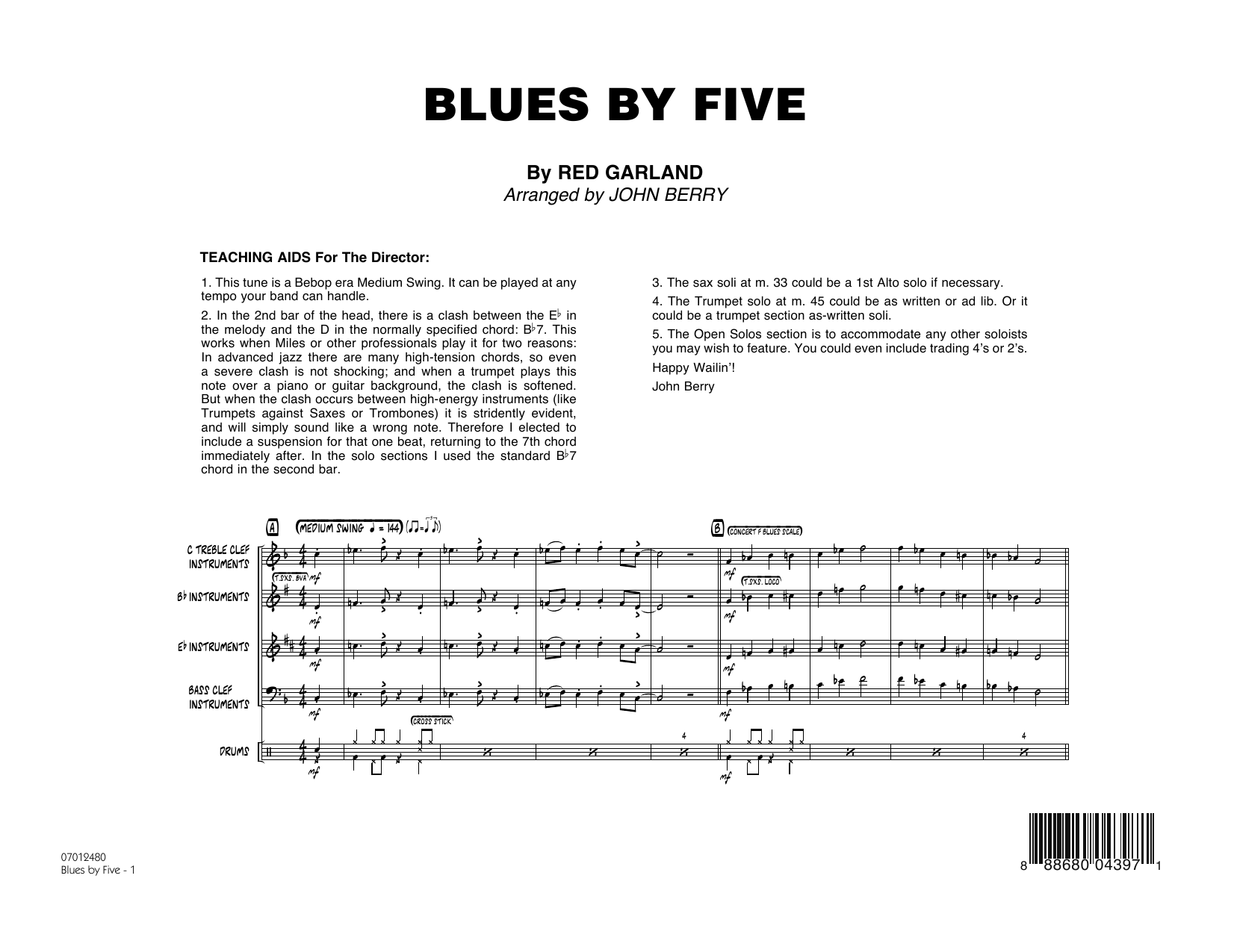

Blues by Five: Jazz Ensemble Conductor Score & Parts
As performed by Miles Davis / Arranged by John Berry
Grade: 1.5
Item: 35-PK00303678
$45.00
Pickup currently not available
Buy Extra Parts (Digital PDF Download)
| Product | Price | Quantity |
|---|---|---|
| Blues by Five - Conductor Score (Full Score) | $7.50 | |
| Blues by Five - Alto Sax 1 | $6.00 | |
| Blues by Five - Alto Sax 2 | $6.00 | |
| Blues by Five - Tenor Sax 1 | $6.00 | |
| Blues by Five - Tenor Sax 2 | $6.00 | |
| Blues by Five - Baritone Sax | $6.00 | |
| Blues by Five - Trumpet 1 | $6.00 | |
| Blues by Five - Trumpet 2 | $6.00 | |
| Blues by Five - Trumpet 3 | $6.00 | |
| Blues by Five - Trombone 1 | $6.00 | |
| Blues by Five - Trombone 2 | $6.00 | |
| Blues by Five - Trombone 3 | $6.00 | |
| Blues by Five - Guitar | $6.00 | |
| Blues by Five - Piano | $6.00 | |
| Blues by Five - Bass | $6.00 | |
| Blues by Five - Drums | $6.00 | |
| Blues by Five - Vibes | $6.00 | |
| Blues by Five - Flute | $6.00 | |
| Blues by Five - Clarinet 1 | $6.00 | |
| Blues by Five - Clarinet 2 | $6.00 | |
| Blues by Five - F Horn | $6.00 | |
| Blues by Five - Tuba | $6.00 |
Parts Added to Cart!
Description
Recorded on the 1956 album "Cookin' with the Miles Davis Quintet", this jazz standard composed by pianist Red Garland adapts beautifully for beginning jazzers. With a moderate tempo, riff-based melody, and non-threatening soloing on the blues progression, this is the perfect introduction to the music of Miles Davis for your students.


Discover MakeMusic Cloud: thousands of interactive titles your students can play along with today.
Sample Audio
No sample audio found.
Sample Video
Additional Details
Publisher:
Hal Leonard
SKU:
35-PK00303678
More about this title
About the Artist: Miles Davis
Miles Davis fundamentally reshaped jazz multiple times across his career, moving from bebop trumpet to cool jazz to modal improvisation to fusion. His 1956 quintet with John Coltrane, Red Garland, Paul Chambers, and Philly Joe Jones became a proving ground for the hard bop sound that defined the decade. Davis's approach to ensemble playing valued clarity, space, and conversational interaction among musicians, principles that transfer directly to student jazz groups.
Why we love this
Red Garland's composition sits in that rare territory where it's genuinely easy to play but never feels condescending. The riff-based melody gives beginners something concrete to latch onto, while the blues changes underneath create natural space for soloists to find their voice without drowning in complexity. You get to teach real jazz history and real Davis quintet sound without needing advanced readers.
What to expect
Relaxed but focused. The moderate tempo and blues changes create a comfortable pocket where students can breathe and listen to each other. There's a understated coolness to the riff that feels sophisticated without demanding perfection.
Who it's for
Beginning jazz ensembles ready to move beyond simplified charts into actual repertoire. Conductors seeking historically grounded introductions to the jazz canon that don't require readers with advanced technique or harmonic sophistication.
How to get the most out of it
- Shape the melody as a conversation between sections rather than a unison statement. The riff breathes better when trumpet and saxophone respond to each other rather than lock in perfectly.
- Let the rhythm section establish the groove first in rehearsals. Once bass and drums commit to a pocket, soloists will settle into the blues progression far more naturally.
- Encourage soloists to listen to the recorded version before they take their turn. Knowing the specific tone and phrasing from the original quintet informs musical choices beyond just hitting the changes.
How to use it
Pair this with another Davis composition or contemporary blues-based tune to build a thematic jazz history set. It also works beautifully early in the school year as a confidence builder for new ensemble members before tackling faster, more demanding material.
Skills your students will build
- reading and executing riff-based melodic lines with rhythmic precision
- improvising blues solos over a 12-bar blues progression in a moderate tempo
- listening to and balancing trumpet-saxophone voice leading
- understanding the relationship between composed melody and harmonic backing
- responding to rhythm section comping and adjusting phrasing accordingly