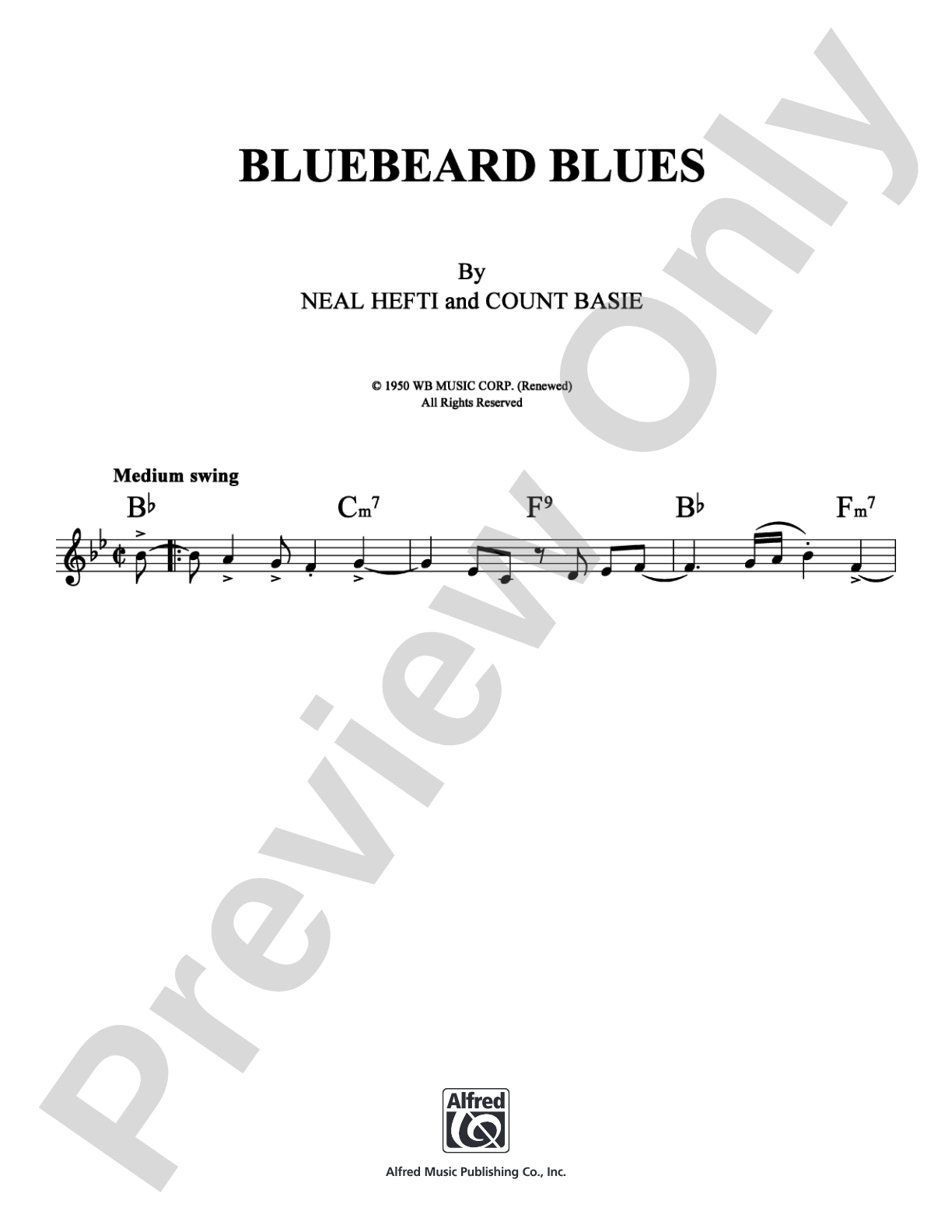
Bluebeard Blues: Lead Sheet Digital Sheet Music

Bluebeard Blues: Lead Sheet Digital Sheet Music

Neal Hefti, Count Basie

Item: 00-PS-0006912

Digital Download
$1.99
Description

Bluebeard Blues: Lead Sheet Digital Sheet Music isn't in MakeMusic Cloud just yet...but it could be. Let us know you'd like to see it, and you'll help shape what comes next. In the meantime, start a free trial and dive into thousands of interactive titles your students can play along with today.

Sample Audio
No sample audio found.
Sample Video
Additional Details
SKU: 00-PS-0006912

More about this title

About the Artist: Neal Hefti

Neal Hefti (1922-2008) was a composer, arranger, and conductor whose work defined the sound of mid-century jazz and television. He wrote for Count Basie's orchestra, composed the theme for The Odd Couple, and arranged countless sessions for singers and big bands. His compositions balance sophisticated harmonic language with immediate melodic appeal, making them staples in jazz education and professional performance alike.

Why we love this

Hefti's lead sheets offer jazz students and performers access to compositions with genuine harmonic substance and singable melodies. The blues framework provides scaffolding for improvisation while the chord changes reward careful listening and harmonic awareness.

What to expect

The tune carries the easy sophistication of early 1950s jazz; it's bluesy without being heavy, and accessible without sacrificing the harmonic interest that keeps musicians engaged through multiple choruses. There's warmth in the melody and room to stretch in the changes.

Who it's for

Jazz musicians at the intermediate level and above who are building a repertoire of standards and expanding their harmonic vocabulary through composition study. High school jazz bands, college jazz combos, and private jazz students preparing for jam sessions or recitals will all benefit from this lead sheet.

How to get the most out of it

  • Pay attention to the specific chord qualities Hefti notates; his blues variations move beyond basic I-IV-V changes and reward harmonic precision in comping and soloing.
  • Use the melody as your anchor during ensemble playing, especially in passages where the changes might tempt players to wander from the form.
  • Experiment with different rhythmic feels during the head; jazz ballad tempo, medium swing, and up-tempo versions all work musically and highlight different aspects of the tune.

How to use it

Include this in a jazz repertoire unit focused on blues variations, or program it on a recital where you want to show students exploring authentic jazz composition beyond textbook examples. It works equally well in a combo setting or as a feature for a jazz ensemble with strong soloists.

Skills your students will build

  • Reading and interpreting jazz lead sheet notation
  • Understanding blues form extensions and non-diatonic chord substitutions
  • Developing single-line improvisation over sophisticated changes
  • Listening for and comping through harmonic tension and resolution

You May Also Like