
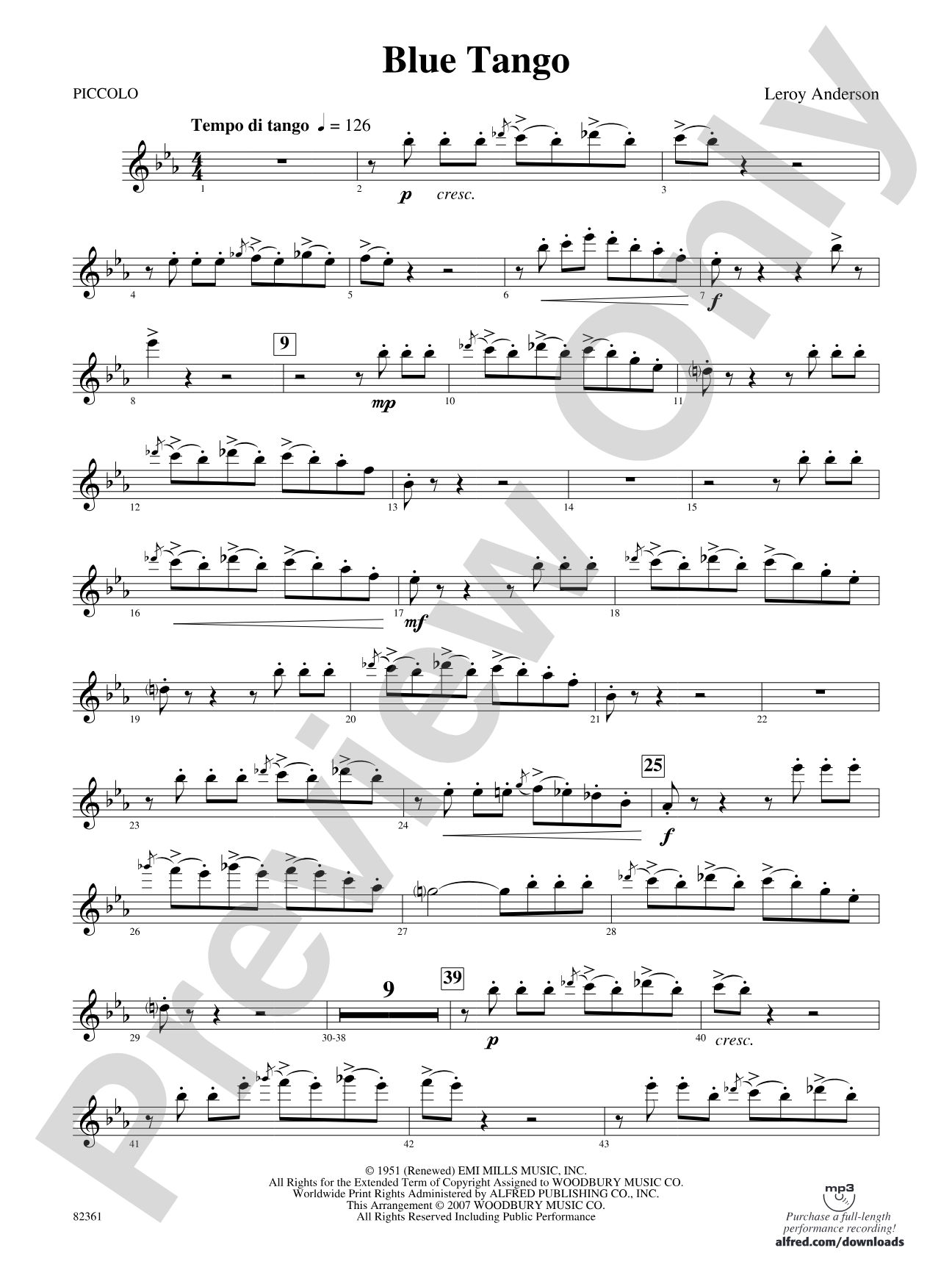

Blue Tango: Piccolo
By Leroy Anderson
Grade: 3 (Medium Easy)
Item: 00-PC-0001937_P1
$3.00
Pickup currently not available
Description
At the height of his career in the mid-1930s, Leroy Anderson began arranging for Arthur Fiedler's Boston Pops Orchestra. Later, Fiedler encouraged him to write his own tunes for the Pops. His compositions, more than 50 in number, virtually define the sound of the contemporary American pops orchestra.
Blue Tango was a #1 hit in 1951, juxtaposing the charismatic melody over a traditional tango pulse. The work captured the spirit of an era. This new edition was originally arranged by the composer for concert band and has been freshly re-engraved with a full score for the first time, permitting a uniformity of articulation throughout the work. This title is available in MakeMusic Cloud.


Blue Tango was a #1 hit in 1951, juxtaposing the charismatic melody over a traditional tango pulse. The work captured the spirit of an era. This new edition was originally arranged by the composer for concert band and has been freshly re-engraved with a full score for the first time, permitting a uniformity of articulation throughout the work. This title is available in MakeMusic Cloud.
Don't just read it, hear it, play along with it, and watch your students grow with it. In MakeMusic Cloud, Blue Tango: Piccolo comes alive with professional accompaniment, adjustable tempo, and built-in practice tools that turn solo practice into real progress.
Open in the Player
Jump straight in and assign it today.
Start Your Free Trial
Open this title and explore the full library in minutes.
Sample Audio
1
Audio File
--:--
0:00
0:00
Sample Video
No sample videos found.
Additional Details
Series:
Symphonic Band
Publisher:
Alfred Music
Page Count:
158
SKU:
00-PC-0001937_P1
More about this title
About the Composer: Leroy Anderson
Leroy Anderson (1908-1975) transformed American popular music by proving that accessible, tuneful compositions could thrive in concert halls. Beginning as an arranger for Arthur Fiedler's Boston Pops Orchestra in the 1930s, Anderson went on to compose more than 50 original works that became the foundation of the modern pops orchestra repertoire. His gift was an ability to blend sophisticated orchestration with melodies so direct and charming that audiences instantly connected with them.
Anderson's music exemplifies a distinctly American sound: inventive, unpretentious, and built on genuine melodic inspiration rather than complexity for its own sake. His works appear regularly on concert programs across the country and remain essential teaching tools for young musicians learning to balance clarity of line with ensemble cohesion.
Why we love this
Blue Tango strikes the rare balance of being immediately engaging and genuinely well-crafted. The fresh engraving with a full score ensures consistent articulation across all parts, making it straightforward to rehearse while the iconic melody and infectious tango rhythm keep your band energized and motivated through the preparation process.
What to expect
Blue Tango captures the sleek sophistication of 1950s American popular music, with a beguiling melody that seems to dance just slightly ahead of the beat. The tango pulse gives the piece rhythmic spine and motion, while Anderson's orchestration keeps the texture transparent and buoyant rather than heavy.
Who it's for
This Grade 3 arrangement works for concert bands with developing ensemble skills and solid note-reading ability. It's an excellent choice for bands seeking contest or festival literature that demonstrates musicianship without requiring advanced technical facility.
How to get the most out of it
- Shape the opening solo line with genuine warmth; this melody is the heart of the piece and needs a vocalist's sense of phrasing even though it's instrumental.
- Lock the rhythmic foundation by having the lower instruments (bassoon, low reeds, euphonium, tuba) feel the tango pulse as a subdivision of the beat, not a syncopation laid on top.
- Balance the written dynamics carefully so the characteristic melody remains audible when the full ensemble enters; Anderson wrote this orchestration specifically for clarity.
- Maintain steady tempo throughout; the tango rhythm loses its charm if it rushes or drags, so a conductor's steady pulse is essential from first rehearsal onward.
How to use it
This work fits naturally into a concert that celebrates American composers or explores the pops orchestra tradition. Its popularity and immediate appeal make it an excellent closer for a program aimed at community audiences, or a standout feature for a festival performance where impact and precision matter equally.
Skills your students will build
- Balancing solo lines against ensemble texture
- Executing tango rhythm with precision and stability
- Responding to conductor's phrasing and dynamic shaping
- Reading a full conductor score and following coordinated entrances
- Sustaining melodic interest at moderate tempos without rushing