
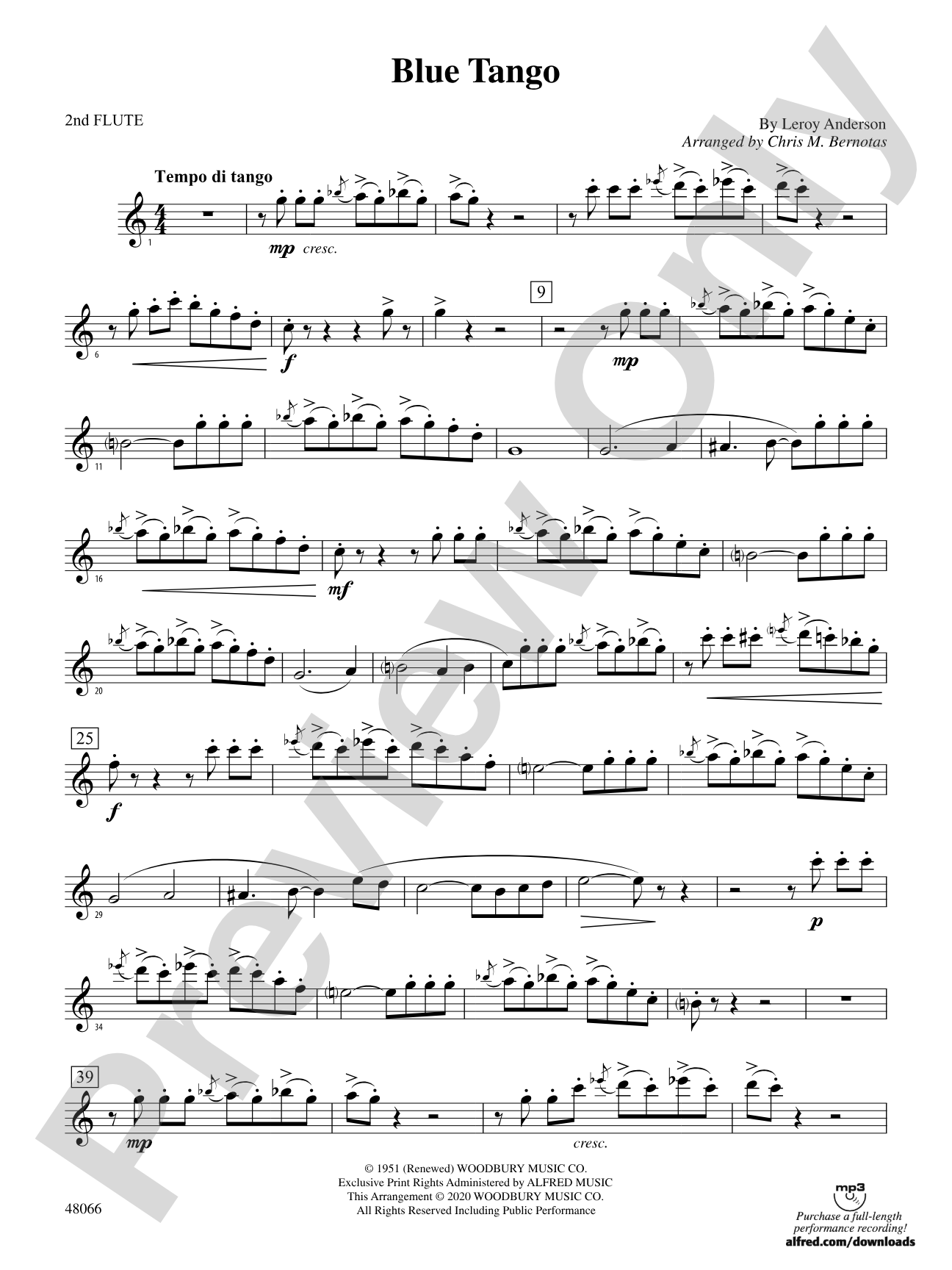

Blue Tango: 2nd Flute
By Leroy Anderson / arr. Chris M. Bernotas
Grade: 3.5
Item: 00-PC-0018397_F2
$3.00
Pickup currently not available
Description
Brilliantly scored and in a friendly key, "Blue Tango" by Leroy Anderson, arranged by Chris M. Bernotas, will highlight your symphony orchestra in any concert or festival. This classic reached the top of the Billboard charts in the early 1950s and will be a favorite for both your students and audience. Closely arranged to the original, the beautiful melodies, full range of dynamics, and clearly marked articulations will provide excellent teaching moments and exciting performances. (3:00) This title is available in MakeMusic Cloud.


Don't just read it, hear it, play along with it, and watch your students grow with it. In MakeMusic Cloud, Blue Tango: 2nd Flute comes alive with professional accompaniment, adjustable tempo, and built-in practice tools that turn solo practice into real progress.
Open in the Player
Jump straight in and assign it today.
Start Your Free Trial
Open this title and explore the full library in minutes.
Sample Audio
1
Audio File
--:--
0:00
0:00
Sample Video
Additional Details
Series:
Pop Concert Full Orchestra
Publisher:
Alfred Music
Page Count:
196
SKU:
00-PC-0018397_F2
More about this title
About the Composer: Leroy Anderson
Leroy Anderson (1908–1975) was an American composer and conductor who became one of the most recorded orchestral composers of the twentieth century. His gift for melody and orchestration made concert music accessible to general audiences; his works appeared regularly on radio and television, and several reached the pop charts. Anderson composed over 140 pieces for full orchestra, many of them now standard repertoire for community and school orchestras seeking approachable yet musically substantial concert material.
Anderson's arrangements and original compositions emphasize clarity and tunefulness without condescending to the listener. He understood orchestral color as deeply as he understood popular taste, and his scores teach orchestration through example. Teachers return to Anderson again and again because his music rewards both careful rehearsal and spontaneous enjoyment.
Why we love this
This arrangement delivers the charm of a mid-century hit without requiring your students to navigate an unfamiliar key or obscure articulation choices. Bernotas has honored Anderson's original instrumentation and melodic intent while writing clearly enough that rehearsal time focuses on musicality rather than decoding parts. Your orchestra will sound polished and confident, and your audience will recognize an actual song they can hum on the way out.
What to expect
Sophisticated without being remote. The tango rhythm keeps energy flowing, the melodies are memorable and warming, and the full orchestration gives every section moments to shine. This is music that feels like an achievement to perform well, yet never threatens to become a struggle.
Who it's for
Conductors of grade 3.5 orchestras seeking material that satisfies both concert programming standards and student engagement. This is ideal for teachers who want their ensemble to experience a tuneful, well-crafted score that doesn't require heroic musicianship to sound good, while still rewarding careful attention to articulation and dynamics.
How to get the most out of it
- Balance the melody across sections rather than isolating it in one voice; Anderson's orchestration weaves the tango theme through violins, woodwinds, and brass, and sharing the line creates the seamless, songlike quality that makes this arrangement sing.
- Shape the dynamics according to the phrasing marked in your parts, not metrically. The beautiful full-range dynamics Anderson employs support the melody's emotional arc, so honor the markings even if a crescendo spans an odd number of measures.
- Give the rhythm section breathing room. The tango rhythm needs flexibility in the accompaniment to swing properly; overly rigid timekeeping flattens the style.
- Listen carefully to articulation consistency across all instruments. Clear staccatos and clean phrase endings are what separate a polished performance from a muddy one at this level.
How to use it
Program this as a centerpiece in a pops concert or as the second piece in a concert that opens with a heavier work; it provides stylistic contrast and gives audiences a familiar entry point. The three-minute duration makes it an excellent closer as well, especially if you want your orchestra to leave the stage on a confident, audience-friendly note.
Skills your students will build
- Balancing melody across multiple sections
- Executing dynamic nuance and long-line phrasing
- Rhythmic precision and flexibility in light concert style
- Clear articulation coordination in a full ensemble
- Stylistic sensitivity to tango rhythmic characteristics