
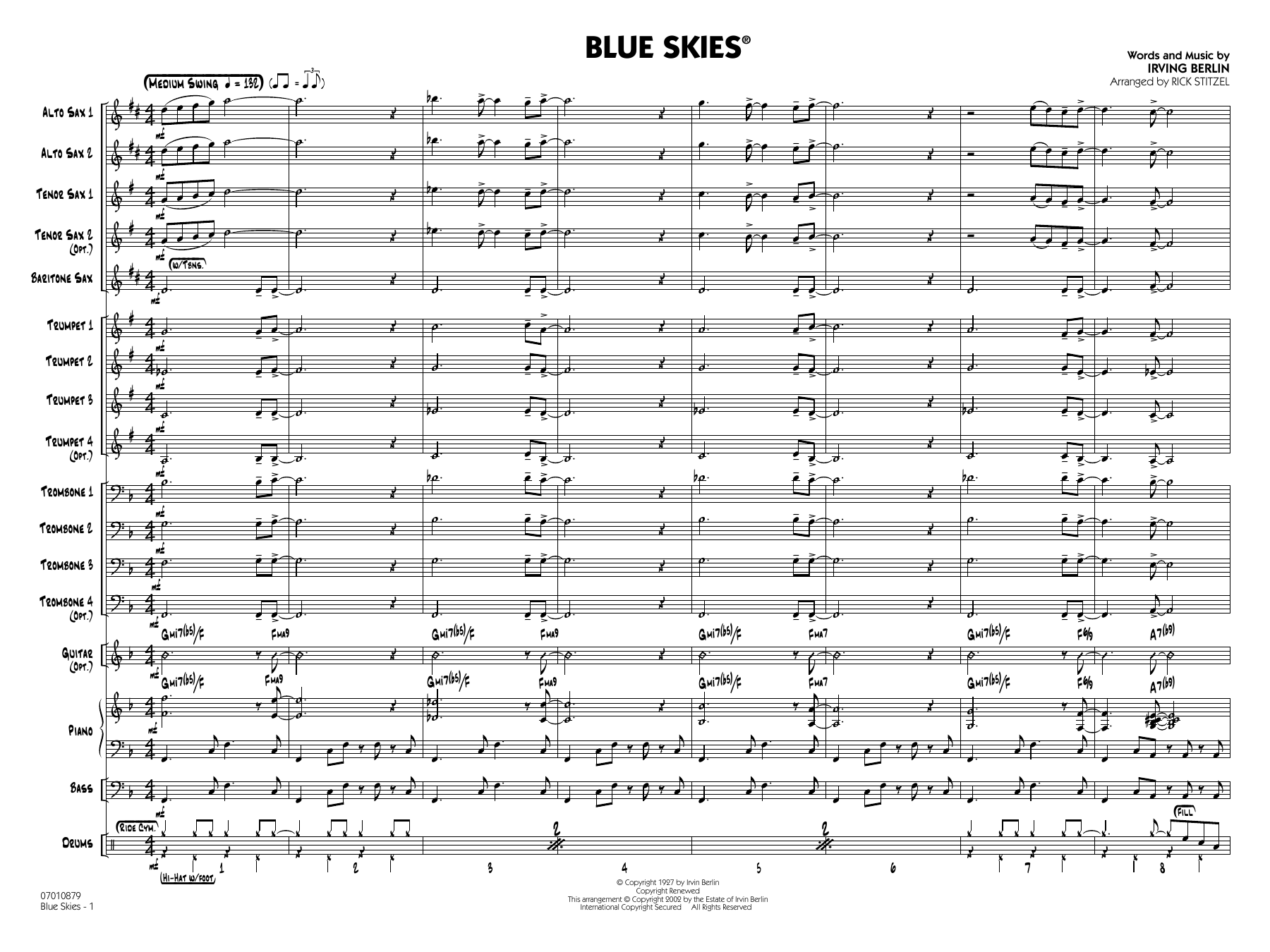

Blue Skies (arr. Rick Stitzel): Jazz Ensemble Conductor Score & Parts
By Irving Berlin / Arranged by Rick Stitzel
Grade: 2
Item: 35-PK01209874
$45.00
Pickup currently not available
Buy Extra Parts (Digital PDF Download)
Parts Added to Cart!
Description
One of Irving Berlin's most performed melodies, "Blue Skies" is arranged here in a medium swing style to sound great with inexperienced players. Enjoy great flexibility with the "Easy Jazz Ensemble series"! Playable with 4 saxes, 3 trumpets, 3 trombones and rhythm.


Blue Skies (arr. Rick Stitzel): Jazz Ensemble Conductor Score & Parts isn't in MakeMusic Cloud just yet...but it could be. Let us know you'd like to see it, and you'll help shape what comes next. In the meantime, start a free trial and dive into thousands of interactive titles your students can play along with today.
Request This Title
Tell us you want it.
Start Your Free Trial
Explore everything that's ready to play right now.
Sample Audio
No sample audio found.
Sample Video
No sample videos found.
Additional Details
Publisher:
Hal Leonard
SKU:
35-PK01209874
More about this title
About the Composer: Irving Berlin
Irving Berlin (1888-1989) was one of America's most prolific songwriters, composing over 1,000 songs across a career spanning nearly eight decades. His melodies became the soundtrack to American popular music, performed by everyone from Bing Crosby to Ella Fitzgerald, and his songs remain standards in jazz repertoires worldwide.
Berlin's genius lay in crafting instantly memorable tunes with sophisticated harmonic underpinnings that reward both casual listening and deep musical exploration. For educators, his work offers students immediate access to authentic jazz standards with melodic integrity that has endured for over a century.
Why we love this
Rick Stitzel's arrangement strips away the complexity often associated with jazz standards and delivers a straightforward, swinging reading that keeps the focus on Berlin's irresistible melody. Grade 2 ensembles can achieve real musicality here without scrambling through changes, and the flexible instrumentation means you're not locked into a specific lineup. Your students will sound like they're playing jazz, not struggling through it.
What to expect
Bright optimism wrapped in an easy groove. The melody floats effortlessly over a relaxed swing beat, evoking a sunlit moment of pure contentment. There's warmth here without sentimentality, and genuine joy without excess.
Who it's for
Jazz ensembles just beginning to tackle swing standards benefit enormously from this arrangement. Directors building a foundational jazz repertoire will find it equally useful as a teaching tool for younger students or as a confidence builder for groups still developing their swing vocabulary.
How to get the most out of it
- Balance the melody line across your saxophone section during the head; slight emphasis on the lead sax ensures the tune cuts through without overblowing the rhythm section.
- Lock the comping chords with your rhythm section early in rehearsal. The drummer and bassist need to feel the pulse together before you layer in the horn voicings.
- Keep the swing feel relaxed and conversational rather than driving hard. This tune breathes better when players think of it as a conversation rather than a race.
- Let the soloists breathe between phrases. Open space around single-note lines creates space for the rhythm section to shine and prevents the arrangement from sounding cluttered.
How to use it
Position this early in a jazz concert to establish energy and goodwill with your audience. Its accessibility makes it perfect for family concerts or school assemblies where non-musicians need to immediately connect with what they're hearing. You might also use it as a bridge piece in a program that moves between traditional and contemporary jazz styles.
Skills your students will build
- Reading and executing medium swing feel (not fast, not ballad)
- Phrasing in jazz style with appropriate articulation and emphasis
- Comping and chord voicing (rhythm section players)
- Solo construction over a 32-bar standard form
- Listening across an ensemble to maintain rhythmic cohesion