
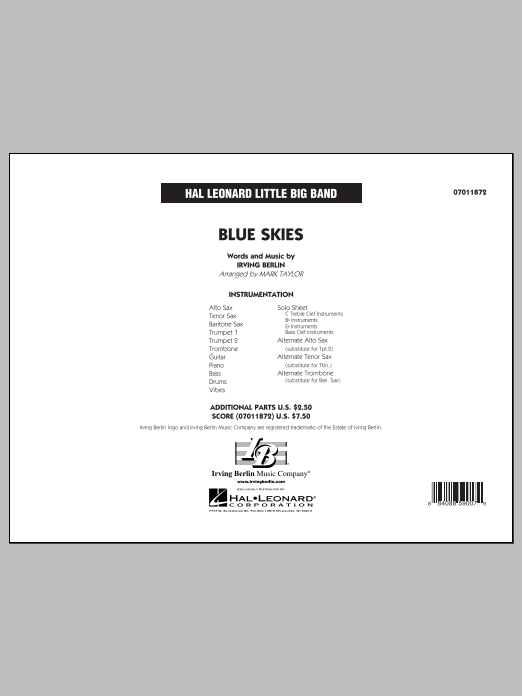

Blue Skies: Jazz Ensemble Conductor Score & Parts
As performed by Irving Berlin
Grade: 4
Item: 35-PK00273306
$45.00
Pickup currently not available
Buy Extra Parts (Digital PDF Download)
| Product | Price | Quantity |
|---|---|---|
| Blue Skies - Full Score | $7.50 | |
| Blue Skies - Alto Sax | $6.00 | |
| Blue Skies - Tenor Sax | $6.00 | |
| Blue Skies - Baritone Sax | $6.00 | |
| Blue Skies - Trumpet 1 | $6.00 | |
| Blue Skies - Trumpet 2 | $6.00 | |
| Blue Skies - Trombone | $6.00 | |
| Blue Skies - Guitar | $6.00 | |
| Blue Skies - Piano | $6.00 | |
| Blue Skies - Bass | $6.00 | |
| Blue Skies - Drums | $6.00 | |
| Blue Skies - Vibes | $6.00 | |
| Blue Skies - C Solo Sheet | $6.00 | |
| Blue Skies - Bb Solo Sheet | $6.00 | |
| Blue Skies - Eb Solo Sheet | $6.00 | |
| Blue Skies - Bass Clef Solo Sheet | $6.00 | |
| Blue Skies - Alternate Alto Sax | $6.00 | |
| Blue Skies - Alternate Tenor Sax | $6.00 | |
| Blue Skies - Alternate Trombone | $6.00 |
Parts Added to Cart!
Description
Here is a creative and unique version of this familiar standard that alternates between samba and swing styles. Featuring intricate and effective 6-horn scoring along with solos for tenor sax and/or guitar, this is a terrific full-blown production for little big band. (Grade 4)


Blue Skies: Jazz Ensemble Conductor Score & Parts isn't in MakeMusic Cloud just yet...but it could be. Let us know you'd like to see it, and you'll help shape what comes next. In the meantime, start a free trial and dive into thousands of interactive titles your students can play along with today.
Request This Title
Tell us you want it.
Start Your Free Trial
Explore everything that's ready to play right now.
Sample Audio
No sample audio found.
Sample Video
No sample videos found.
Additional Details
Publisher:
Hal Leonard
SKU:
35-PK00273306
More about this title
About the Artist: Irving Berlin
Irving Berlin (1888-1989) was a Russian-born American composer and lyricist who became one of the most prolific songwriters in American popular music. He wrote over 1,000 songs across musical theater, film, and concert settings, and his melodies remain instantly recognizable to audiences of all ages. Berlin's gift for writing singable, memorable tunes made his standards ideal material for jazz reinterpretation.
For music educators, Berlin's catalog offers enduring repertoire that engages students across multiple genres. His chord progressions and song structures lend themselves naturally to jazz arranging, and pieces like "Blue Skies" demonstrate why his work continues to teach the fundamentals of American song.
Why we love this
The arrangement's stylistic pivot between samba and swing keeps players and listeners engaged throughout a familiar melody. The 6-horn voicing creates full, sonorous textures without overwhelming smaller ensemble forces, and the built-in solo opportunities for tenor sax and guitar give your featured performers meaningful spotlight moments that feel natural within the score.
What to expect
Bright, rhythmically alive, and conversational. The samba sections bring tropical warmth and syncopated momentum, while the swing passages return to classic big band swing with a lighter touch. Together they create a piece that feels sophisticated without losing its roots in popular song.
Who it's for
Jazz ensembles at the high school or early college level, particularly groups with solid rhythm sections and at least one capable jazz soloist. The Grade 4 difficulty suits ensembles ready for style-shifting and fuller harmonic textures but not yet diving into the most demanding lead-sheet or atonal work.
How to get the most out of it
- Balance the samba and swing sections by rehearsing them as distinct entities first, then connecting the transition. The shift should feel intentional, not accidental.
- Let your tenor saxophonist and guitarist know exactly how much solo space they're getting and whether the tune has a head-solo-head structure or something different. Clarity here prevents mid-performance confusion.
- The 6-horn section will need tight unison and blend work. Spend rehearsal time on vowel shape and dynamic matching so the scoring actually sounds intricate rather than cluttered.
- Nail the rhythm section pocket in both styles. The samba groove and swing shuffle sit differently; lock those feels before the horns layer in their parts.
How to use it
Program this as a concert centerpiece or second-half opener. The stylistic blend appeals to mixed audiences (not just jazz fans) and the solo opportunities make it satisfying for student performers. It also works beautifully on a pops or spring concert where you want jazz credibility with crowd appeal.
Skills your students will build
- Executing clean style shifts between samba and swing feels
- Reading horn voicings and blending within a 6-piece section
- Supporting and listening to jazz soloists (rhythm section awareness)
- Phrasing a familiar melody in an unfamiliar harmonic context