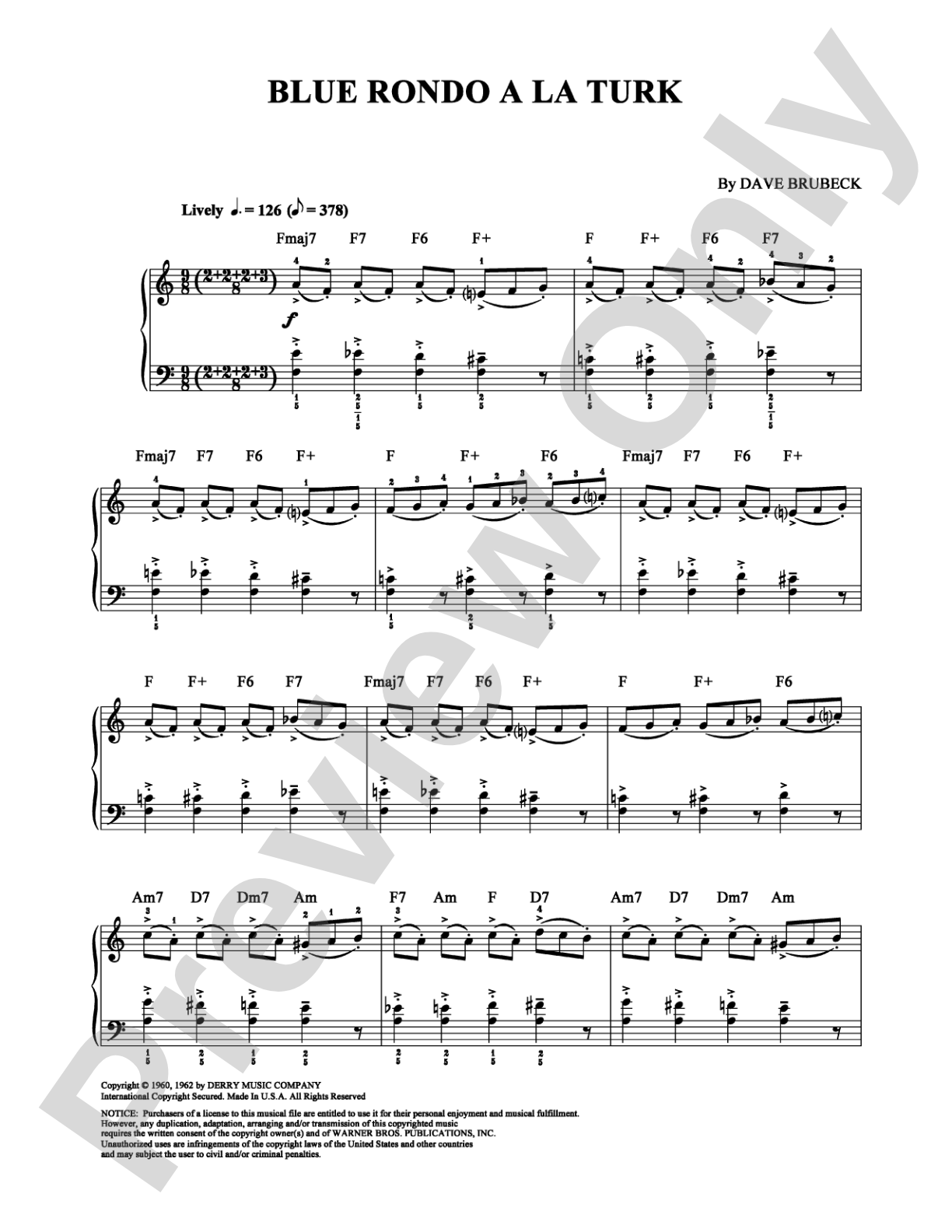
Blue Rondo a la Turk: Piano Digital Sheet Music

Blue Rondo a la Turk: Piano Digital Sheet Music

Dave Brubeck

Item: 00-PS-0000876

Digital Download
$3.99
Description

Blue Rondo a la Turk: Piano Digital Sheet Music isn't in MakeMusic Cloud just yet...but it could be. Let us know you'd like to see it, and you'll help shape what comes next. In the meantime, start a free trial and dive into thousands of interactive titles your students can play along with today.

Sample Audio
No sample audio found.
Sample Video
Additional Details
SKU: 00-PS-0000876

More about this title

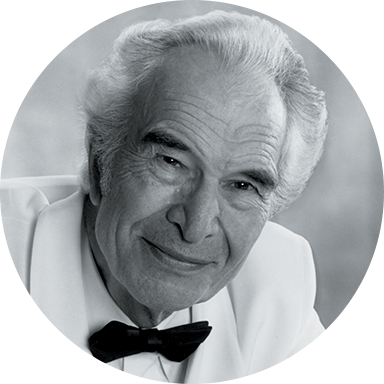
About the Artist: Dave Brubeck

Dave Brubeck

Dave Brubeck was a pianist and composer whose improvisational command and harmonic sophistication shaped modern jazz. Beyond his celebrated role as a bandleader, he wrote across genres: choral works, orchestral pieces, chamber music, ballet suites, and sacred compositions like his mass To Hope! His 1959 album Time Out became the first jazz recording to sell over a million copies, establishing him as a cultural force who expanded what jazz audiences expected to hear.

Brubeck's influence extended beyond music into the social fabric of mid-twentieth-century America, where he actively challenged racial divisions in jazz performance and programming. After studying with Darius Milhaud at Mills College following World War II, he integrated classical compositional techniques with jazz idioms, a synthesis that defined his artistic voice. His honors include a Grammy Lifetime Achievement Award, the Presidential Medal of the Arts, and induction into the American Classical Music Hall of Fame in 2003.

Why we love this

Blue Rondo a la Turk stands as one of jazz's most sophisticated piano vehicles, demanding both technical precision and interpretive confidence. The piece's angular melody and complex rhythmic foundation make it an excellent test of a pianist's ability to balance written structure with the improvisational freedom that defines jazz; performers cannot simply read the notes but must inhabit the style. Programming this classic signals serious engagement with jazz as a composed art form, not just a popular diversion.

What to expect

Propulsive and angular, with an exotic flavor that comes from its Turkish-influenced melody set atop a hypnotic, driving rhythm. The piece swings with restless energy, its complex time signature and syncopated phrasing creating a sense of forward momentum that feels both carefully composed and spontaneously alive.

Who it's for

Intermediate to advanced pianists seeking substantive jazz repertoire that combines written composition with performance artistry. This works well for recital programming, jazz ensemble performances, or serious students exploring the intersection of classical training and jazz idiom.

How to get the most out of it

  • Lock the opening melody's angular phrasing by practicing it without tempo first, mapping where the natural breathing points fall within the unusual meter; this prevents rushing and clarifies the melodic shape.
  • Study the left-hand ostinato pattern until it becomes a steady pulse you don't have to think about, freeing mental energy for the right-hand improvisation and melodic inflection.
  • Listen to Brubeck's own recording of the piece to absorb the rhythmic swagger and articulation choices that bring the composition to life; transcribing key moments can deepen your understanding of how the notation translates to sound.
  • Approach the harmonic movement with sensitivity to tension and release; the piece's chromatic and modal colors demand clean voicing and deliberate pedal work rather than blur.

How to use it

Position this as a centerpiece in a jazz recital or as part of a program exploring twentieth-century composition across classical and jazz traditions. Its rhythmic complexity and harmonic sophistication pair well alongside other modern works, and it stands strongly as a solo statement of a pianist's versatility.

Skills your students will build

  • Reading and performing in non-standard meters and syncopated rhythms
  • Balancing left-hand ostinato patterns with right-hand independence
  • Articulation and phrasing choices that serve jazz style
  • Interpreting notated melody within an improvisational framework
  • Pedal control in harmonically complex jazz contexts

You May Also Like