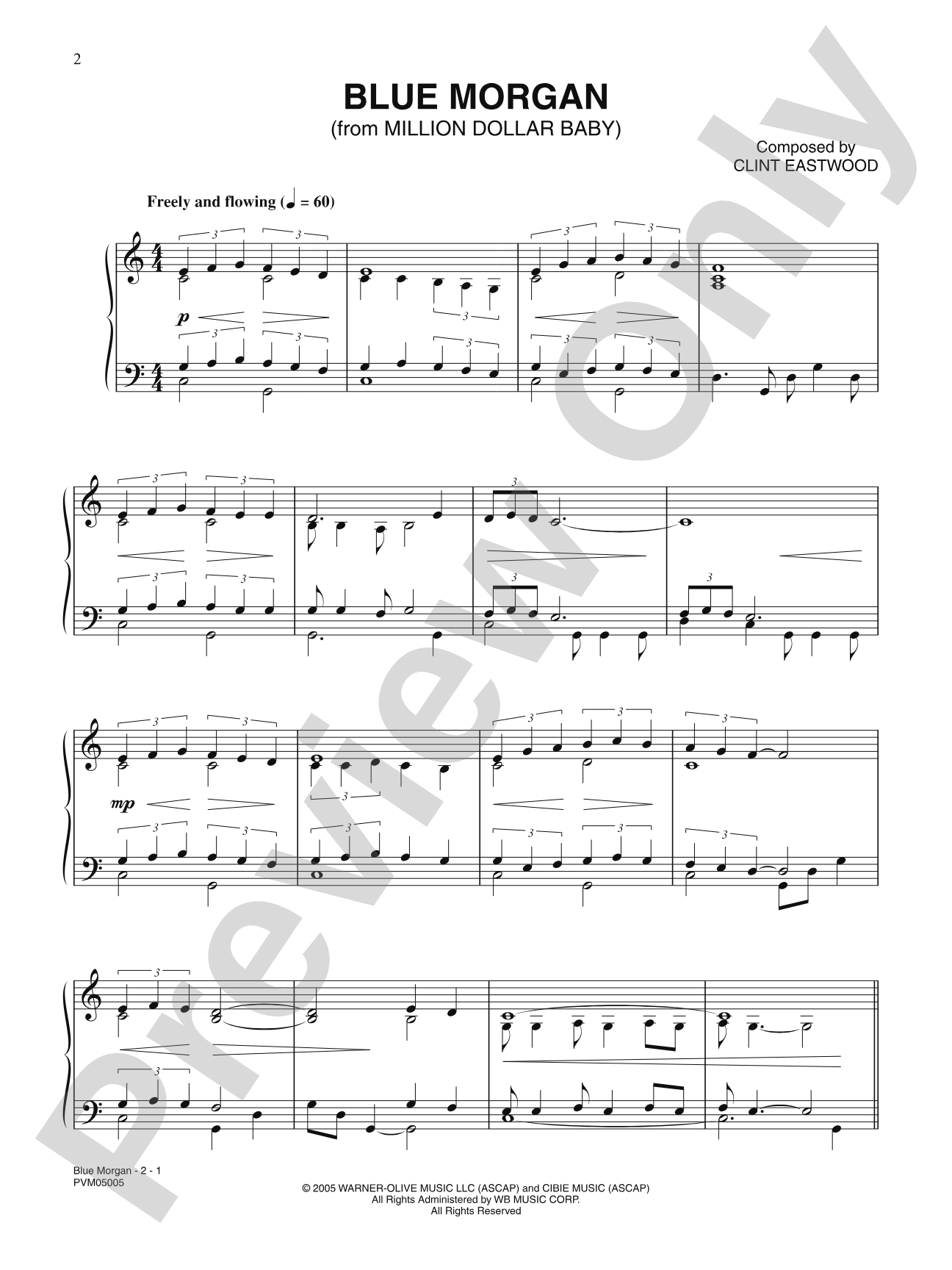
Blue Morgan (from Million Dollar Baby) Sheet Music Preview

Blue Morgan (from Million Dollar Baby): Piano/Vocal/Chords

Composed by Clint Eastwood

Item: 00-PIP-000619

Digital Download
$3.99
Description

Blue Morgan (from Million Dollar Baby): Piano/Vocal/Chords isn't in MakeMusic Cloud just yet...but it could be. Let us know you'd like to see it, and you'll help shape what comes next. In the meantime, start a free trial and dive into thousands of interactive titles your students can play along with today.

Sample Audio
No sample audio found.
Sample Video
Additional Details
Publisher: Alfred Music
SKU: 00-PIP-000619

More about this title

About the Composer: Clint Eastwood

Clint Eastwood is an Academy Award-winning film director and actor whose work behind the camera spans decades of American cinema. Beyond his legendary directing career, Eastwood has composed original scores for many of his films, demonstrating a gift for creating music that deepens emotional storytelling and serves the narrative with restraint and authenticity.

Eastwood's approach to film composition prioritizes melody and emotional directness. His scores avoid excess, instead allowing sparse arrangements and clear thematic material to resonate with audiences. This philosophy produces music that translates effectively to concert and recital settings, where the core melodic and harmonic content can stand independent of visual context.

Why we love this

This arrangement captures the intimate, understated elegance that defines Eastwood's compositional voice. The piano/vocal setting lets singers access a film score written for cinema without sacrificing the melody's emotional weight, making it ideal for recital programming that values restraint and storytelling over technical display.

What to expect

The piece carries the quiet dignity and emotional clarity of a film moment frozen in time. There's no sentimentality here; instead, the music achieves its emotional impact through directness and restraint, with each melodic phrase and harmonic choice serving a specific emotional purpose.

Who it's for

Singers preparing material for art song recitals, jazz and popular music voice students exploring film scoring, and pianists seeking accessible repertoire with genuine artistic substance. Voice teachers will find this useful for students who respond to contemporary song writing and film music.

How to get the most out of it

  • Treat the piano part as a complete musical statement, not merely accompanying texture. The voicings and rhythmic choices carry as much narrative weight as the vocal line.
  • Honor the simplicity of the melodic line by maintaining steady legato phrasing and allowing rubato only where the harmonic rhythm naturally invites it.
  • Balance the vocal and piano parts so neither dominates. This is a duet between voice and instrument, not a voice supported by accompaniment.
  • Pay attention to dynamic control at softer volumes. Much of the piece likely lives in the mezzo-piano to mezzo-forte range, where subtle shifts in tone color matter greatly.

How to use it

Program this alongside other film scores and contemporary American songs to create a recital section exploring how cinema influences modern vocal writing. It also works as a bridge piece between classical art song and contemporary popular music, useful for demonstrating that emotional authenticity transcends genre.

Skills your students will build

  • Interpreting understatement in contemporary melody
  • Balancing vocal and piano lines with equal musical weight
  • Reading and performing chord charts alongside written vocal melody
  • Understanding film music composition as legitimate art song

You May Also Like