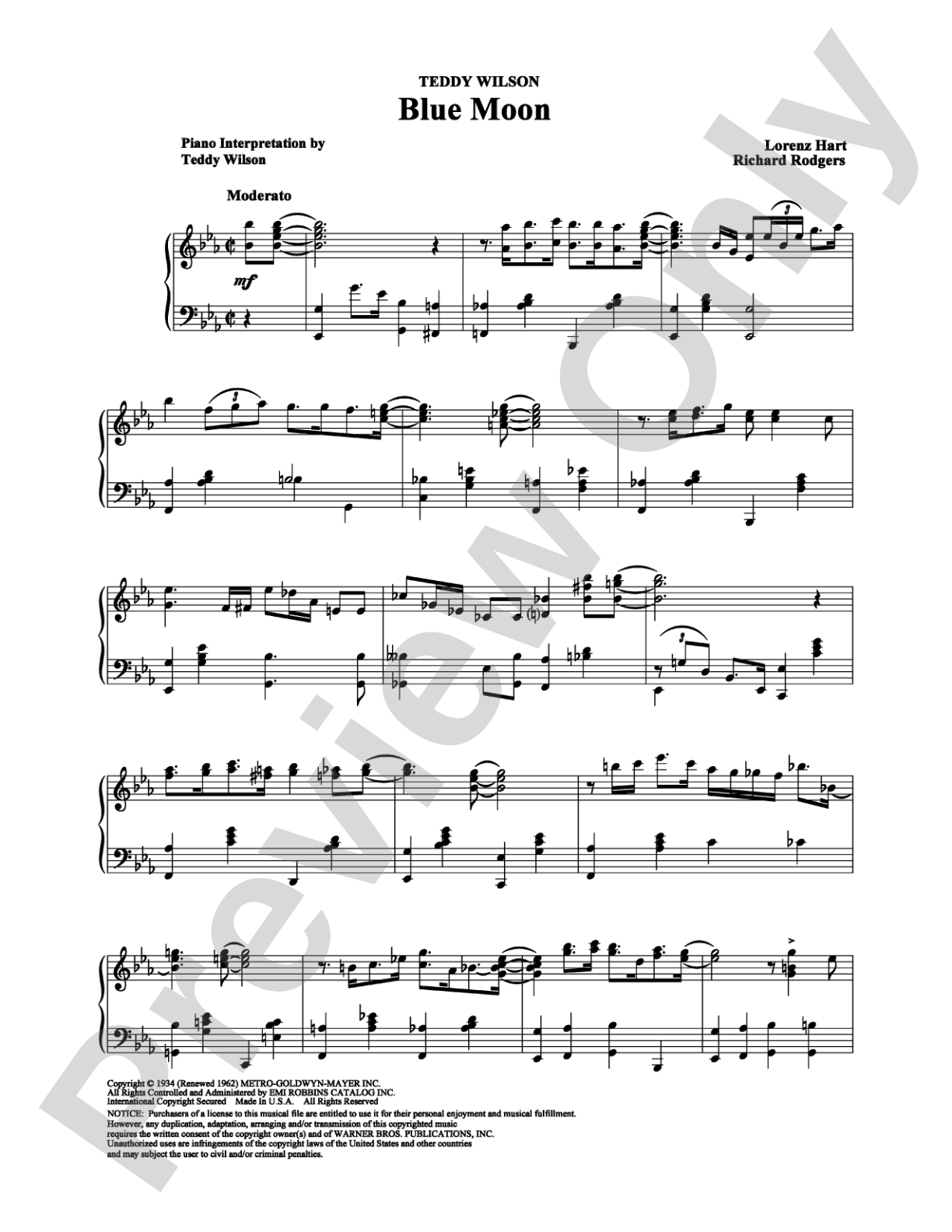
Blue Moon: Piano Digital Sheet Music

Blue Moon: Piano Digital Sheet Music

Richard Rodgers, Lorenz Hart, Teddy Wilson

Item: 00-PS-0007274

Digital Download
$3.99
Description

Blue Moon: Piano Digital Sheet Music isn't in MakeMusic Cloud just yet...but it could be. Let us know you'd like to see it, and you'll help shape what comes next. In the meantime, start a free trial and dive into thousands of interactive titles your students can play along with today.

Sample Audio
No sample audio found.
Sample Video
Additional Details
SKU: 00-PS-0007274

More about this title

About the Artist: Teddy Wilson

Teddy Wilson (1912-1986) was a pianist and bandleader whose virtuosic touch and harmonic sophistication shaped the sound of swing jazz. He led one of the first racially integrated big bands in the 1930s and recorded extensively as a sideman and leader, becoming known for his elegant comping and crystal-clear solo work across thousands of sessions.

Wilson's approach to the keyboard emphasized rhythmic precision and harmonic awareness. His arrangements and interpretations of standards set a template for jazz piano that influenced generations of musicians, making his recordings essential listening for anyone studying jazz repertoire and performance practice.

Why we love this

Teddy Wilson's reading of this standard offers a masterclass in swing-era jazz piano vocabulary. The piece captures his signature clarity and restraint, making it an ideal study for students learning how to comp responsively and voice chords idiomatically within a jazz context.

What to expect

Sophisticated and unhurried, this arrangement has the elegant restraint of a seasoned bandleader who trusts the strength of a well-crafted melody. Wilson's touch is warm and precise; every note lands with intention, and silence becomes as musical as sound.

Who it's for

Jazz pianists working to internalize swing-era comping and soloing language will find this a valuable reference recording and performance score. Advanced high school and college-level players can use it to study authentic voicing choices, rhythmic placement, and the balance between accompaniment and solo work.

How to get the most out of it

  • Observe the rhythmic placement of chord hits against the melody line; Wilson's comping never crowds the tune, so practice the balance between supporting and stepping back.
  • Pay attention to his voicings for seventh chords and extended harmonies. Reverse-engineer the voice leading to understand how he achieves that warm, open sound characteristic of swing-era piano.
  • Let the tempo breathe naturally. Wilson's recordings swing with a relaxed feel rather than mechanical precision, so aim for flexibility within the beat rather than metronomic strictness.
  • Study the single-note lines and runs he uses to bridge phrases. His right-hand vocabulary combines block voicings with fluid scalar passages, so practice each element separately before combining them.

How to use it

Feature this in a jazz ensemble concert or recital devoted to standards and swing-era repertoire, or use it as a teaching demonstration of how to accompany a singer or horn player with rhythmic and harmonic sensitivity. Its accessibility and historical significance also make it effective as a listening example in jazz history or piano literature courses.

Skills your students will build

  • Comping in swing style with appropriate rhythmic feel and harmonic awareness
  • Voicing seventh chords and extended harmonies in a jazz context
  • Balancing solo and accompaniment roles within a single performance
  • Interpretive phrasing and flexible tempo within a jazz standard
  • Transcription and reverse-engineering of professional jazz piano vocabulary

You May Also Like