Blue Moon: Piano Digital Sheet Music

Blue Moon: Piano Digital Sheet Music

Richard Rodgers, Art Tatum

Item: 00-PS-0007273

Digital Download
$3.99
Description

Blue Moon: Piano Digital Sheet Music isn't in MakeMusic Cloud just yet...but it could be. Let us know you'd like to see it, and you'll help shape what comes next. In the meantime, start a free trial and dive into thousands of interactive titles your students can play along with today.

Sample Audio
No sample audio found.
Sample Video
Additional Details
SKU: 00-PS-0007273

More about this title

About the Artist: Art Tatum

Art Tatum (1909-1956) was a pianist whose technical command and improvisational brilliance fundamentally transformed jazz piano. Born in Toledo, Ohio, Tatum developed his virtuosic style despite being nearly blind from infancy, becoming one of the most influential figures in jazz history. His interpretations of popular standards revealed harmonic possibilities that influenced generations of musicians across jazz, classical, and contemporary genres.

Tatum's approach to the standards repertoire set a new benchmark for pianistic sophistication. He approached familiar melodies as springboards for elaborate reharmonization and technical display, often reworking songs beyond recognition while maintaining their emotional core. His recordings remain essential listening for pianists seeking to understand jazz phrasing, stride technique, and the art of melodic transformation.

Why we love this

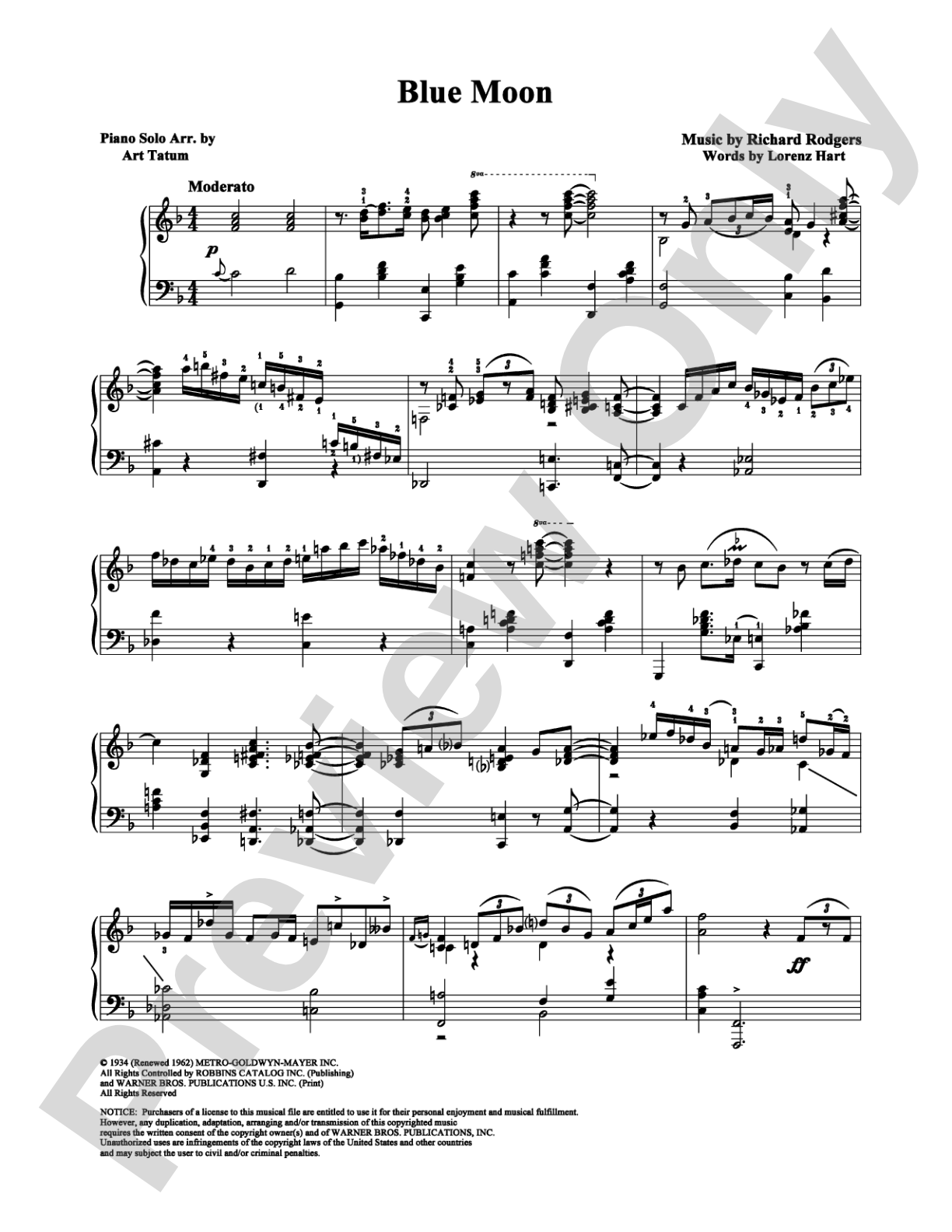
Tatum's transcription of "Blue Moon" showcases his signature approach: taking a straightforward standard and reconstructing it through intricate reharmonization, rhythmic displacement, and technical wizardry. For pianists studying jazz interpretation and advanced harmonic thinking, this arrangement reveals how a master musician hears beneath the surface of a familiar tune. It's an invaluable resource for understanding jazz piano language at its most sophisticated.

What to expect

Tatum's "Blue Moon" sparkles with technical urgency and harmonic sophistication. Underneath the rapid figuration and clever reharmonization runs a deep affection for the melody itself, which emerges through the elaborate textures like a familiar face glimpsed in a crowd. The piece balances dazzling display with genuine musicality, never sacrificing substance for flash.

Who it's for

This transcription serves advanced jazz pianists and serious music students investigating how legendary improvisers transformed popular standards. It's equally valuable for classical pianists interested in expanding their jazz vocabulary and understanding a different approach to harmony and technique. Educators preparing students for jazz history study or competitive jazz performance will find this an exemplary model of professional-level arrangement and interpretation.

How to get the most out of it

  • Study the harmonic movement in sections rather than attempting the entire piece at tempo initially; Tatum's reharmonizations often layer multiple harmonic possibilities that reveal themselves more clearly at slower speeds.
  • Pay attention to Tatum's rhythmic placement of melodic fragments; many notes land slightly ahead of or behind the beat in ways that create forward momentum and swing feel.
  • Balance technical display with melodic clarity; even in the most elaborate passages, trace where the original "Blue Moon" melody appears to maintain connection to the song's identity.
  • Reference recordings of Tatum's original performance to understand the intended voicing and pedal effects, which transcription alone cannot fully capture.

How to use it

Include this in recitals, masterclasses, or jazz history demonstrations where sophisticated piano interpretation is the focus. It works well alongside other standards transcriptions to illustrate how different pianists approach the same material, or as a model for students learning transcription and arrangement. This piece also serves advanced jazz curriculum that emphasizes listening to and learning from historical recordings.

Skills your students will build

  • Reading complex jazz reharmonizations and non-functional chord progressions
  • Understanding rhythmic displacement and swing articulation within written notation
  • Analyzing how improvisation-based interpretation differs from composed music
  • Voicing jazz chords across the keyboard while maintaining melodic legibility
  • Recognizing and performing stride piano technique and accompaniment patterns
  • Interpreting jazz standards through a master musician's harmonic and melodic lens

You May Also Like