
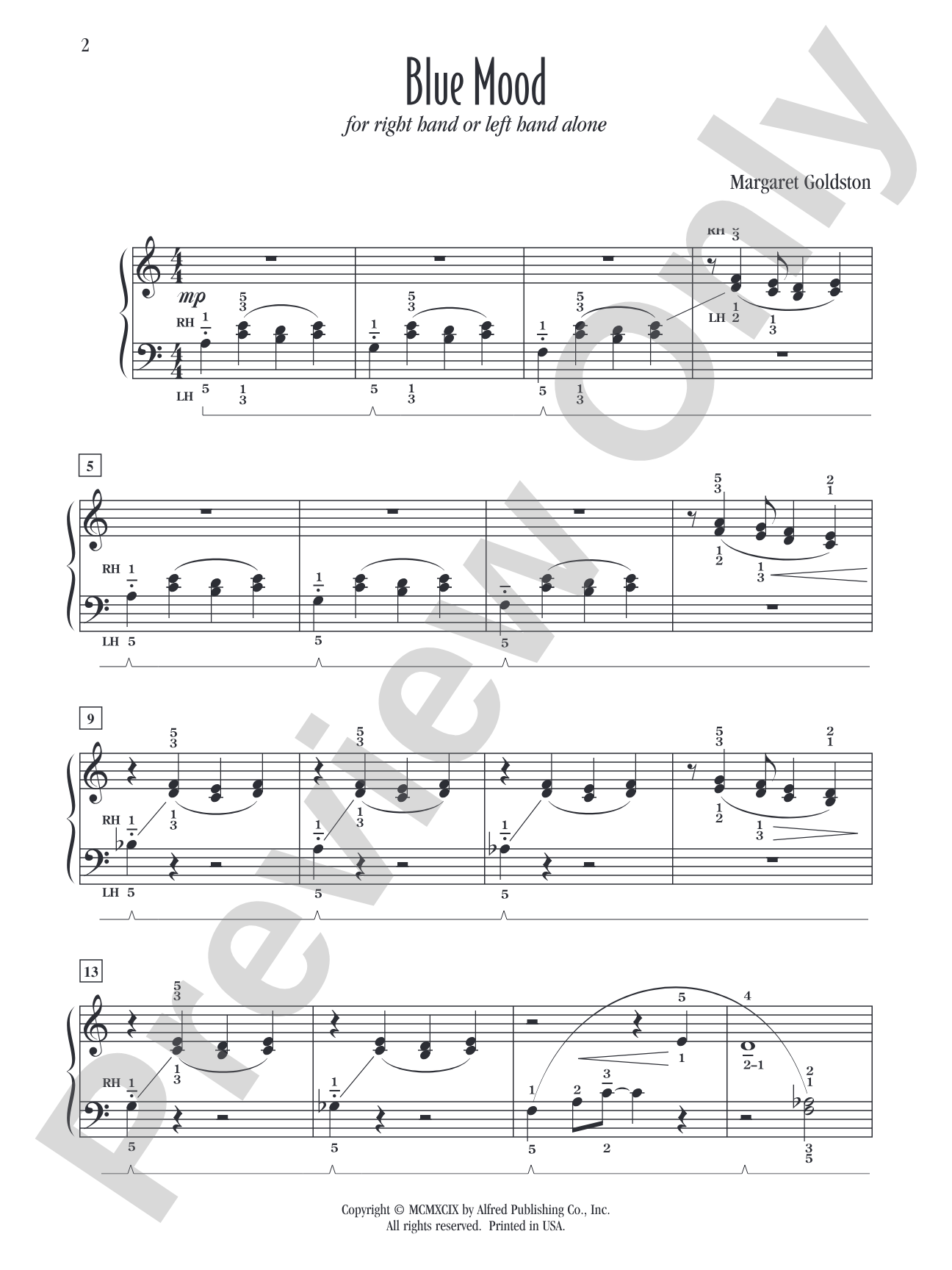

Blue Mood (for right hand or left hand alone) - Piano Solo: Piano
By Margaret Goldston
Level: Early Intermediate
Item: 00-PB-0000772
$3.50
Pickup currently not available
Related Items
Blue Mood (for right hand or left hand alone): Piano Sheet |
$3.50
|
View |
Description
This song is written to be played with either the right or the left hand, alone. Developing strength and independence of each hand is a worthy goal for every pianist. "Blue Mood" will assist the early intermediate level student with the development of either hand using a legato, "wistful," blues style. Fingering is provided for both hands, and pedaling and articulation markings provide a good map for interpretation. A Federation Festivals 2024-2028 selection.


Blue Mood (for right hand or left hand alone) - Piano Solo: Piano isn't in MakeMusic Cloud just yet...but it could be. Let us know you'd like to see it, and you'll help shape what comes next. In the meantime, start a free trial and dive into thousands of interactive titles your students can play along with today.
Request This Title
Tell us you want it.
Start Your Free Trial
Explore everything that's ready to play right now.
Sample Audio
No sample audio found.
Sample Video
No sample videos found.
Additional Details
Series:
Signature Series
Publisher:
Alfred Music
Page Count:
4
SKU:
00-PB-0000772
More about this title
About the Composer: Margaret Goldston

Margaret Goldston (1932-2003) was a North Carolina-based composer and teacher who shaped the musical lives of students across all ages through her private studio. She held a Bachelor of Music degree in piano performance from Louisiana State University, where she was recognized in 1991 as the School of Music Alumnus of the Year.
Goldston studied composition privately with Pulitzer Prize winner Robert Ward and built a reputation as both a clinician and speaker at national music conferences. The North Carolina Federation of Music Clubs named her Composer of the Year twice, in 1983 and 1994. She conducted masterclasses and teacher workshops throughout the United States and Canada, and her work earned posthumous recognition as a Foundation Fellow from the Music Teachers National Association in 2020. Her compositions remain fixtures on festival and contest lists, particularly through the National Federation of Music Clubs.
Why we love this
Goldston wrote this piece to solve a genuine pedagogical need: early intermediate pianists need deliberate practice building independence and control in each hand, yet most repertoire at this level requires both hands working together. "Blue Mood" gives students meaningful musicality to explore while isolating the technical work, and the blues idiom's relaxed, expressive quality keeps practicing from feeling like a technical drill.
What to expect
"Blue Mood" inhabits that bittersweet emotional space the blues style creates: contemplative but never heavy, wistful but never melancholy. The legato phrasing gives the melody room to breathe and linger, while the single-hand texture creates an intimate, introspective quality.
Who it's for
This is for early intermediate pianists ready to deepen hand independence through a musically engaging piece rather than technical exercises alone. It works equally well for a student building right-hand facility or strengthening left-hand control, making it adaptable to individual student needs.
How to get the most out of it
- Establish the legato texture early in rehearsal by listening to how the melody breathes. The wistful character depends on smooth voice leading, not rushing from note to note.
- Honor the pedaling markings as part of the composition's color. Goldston has thoughtfully indicated when to change pedal, which affects both the harmonic wash and the clarity of line.
- Experiment with the articulation markings to shape phrase contours. The written staccato and accent marks guide interpretation, so working with them rather than against them reveals the intended emotional arc.
- Record yourself playing, then listen back while looking at the score. Hearing your own interpretation against the marked dynamics and tempo helps you identify where legato is most essential.
How to use it
This piece fits naturally into a student recital as a brief solo showcasing early intermediate musicianship and stylistic awareness. It also serves well in a program exploring blues and popular styles alongside classical repertoire, offering pianists a chance to demonstrate technique in an American vernacular context.
Skills your students will build
- Hand independence and alternating single-hand facility
- Legato touch and sustained tone quality in a blues idiom
- Pedaling control and timing for harmonic color
- Reading and interpreting articulation and dynamic markings in stylistic context
- Phrasing and shaping in a wistful, expressive musical style