
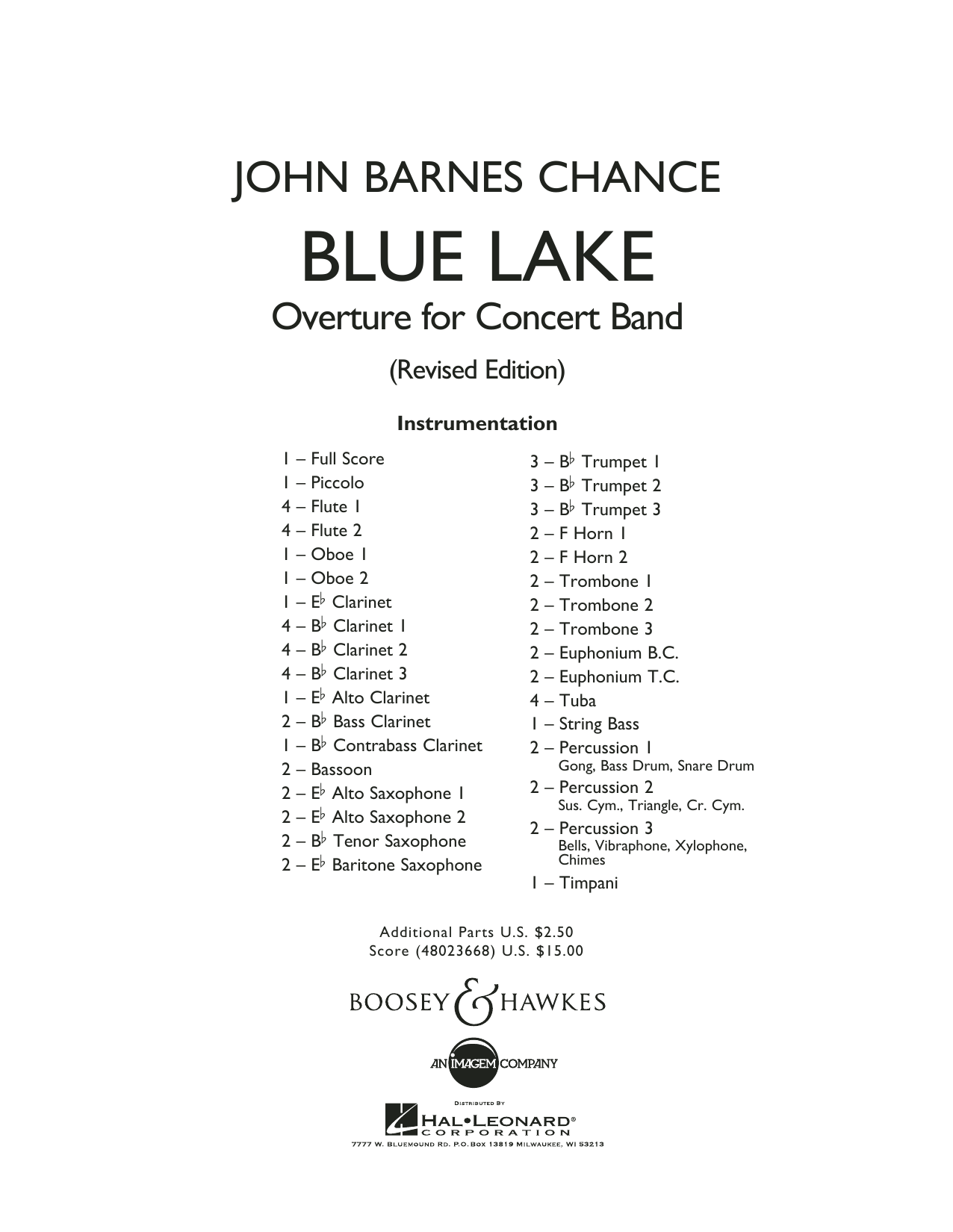

Blue Lake (Overture for Concert Band): Concert Band Conductor Score & Parts
Grade: 4
Item: 35-PK00420738
$115.00
Pickup currently not available
Buy Extra Parts (Digital PDF Download)
Parts Added to Cart!
Description
Commissioned by the Blue Lake Fine Arts Camp in Michigan and premiered in 1971, this dynamic composition by John Barnes Chance has a unique history. The outer sections of the work feature a rhythmic intensity created in part by Chance's free use of eight-note groupings of 2 and 3. However, when first published, the meter was changed to 4/4 resulting in awkward notation of these figures. Through painstaking research by Carl Bjerregaard, Donald Flickinger, and Myron Welch (all connected with Blue Lake) this revised edition restores the asymmetric meters as the composer originally intended. Dur: 5:15


Blue Lake (Overture for Concert Band): Concert Band Conductor Score & Parts isn't in MakeMusic Cloud just yet...but it could be. Let us know you'd like to see it, and you'll help shape what comes next. In the meantime, start a free trial and dive into thousands of interactive titles your students can play along with today.
Request This Title
Tell us you want it.
Start Your Free Trial
Explore everything that's ready to play right now.
Sample Audio
No sample audio found.
Sample Video
No sample videos found.
Additional Details
Publisher:
Hal Leonard
SKU:
35-PK00420738
More about this title
About the Creator: John Barnes Chance
John Barnes Chance (1932–1969) was a trailblazer in concert band composition who elevated the medium through his distinctive harmonic language and rhythmic innovation. His orchestrations combined classical structure with modern sensibilities, earning respect from conductors and composers alike. Though his life was cut short, his legacy shaped how bands approach contemporary classical repertoire.
Chance's work at Greensboro Senior High School and later as a composer gave him deep insight into what bands could achieve. He wrote with genuine affection for the ensemble while never underestimating its capabilities, and his pieces demand musicianship without artifice.
Why we love this
This revised edition restores Chance's original compositional vision after decades of compromised notation, making it a rare opportunity to perform a canonical work exactly as the composer wrote it. The restoration itself tells a story worth sharing with your band about textual integrity and the power of dedicated scholarship. Rhythmically and harmonically, Blue Lake stands apart from typical overtures of its grade level; it challenges ensemble precision while remaining deeply musical.
What to expect
Blue Lake pulses with restless energy, driven by layered rhythmic cells that create momentum without settling into predictability. The work feels modern and intelligent without sacrificing accessibility; listeners hear both the complexity and the craft. There's a sense of perpetual motion that energizes the bandstand and the audience alike.
Who it's for
Bands at the Grade 4 level with solid rhythm section fundamentals and enough rehearsal time to absorb asymmetric meters. Advanced Grade 3 ensembles ready to stretch their capabilities will also find this rewarding. Any program seeking a concert opener with real musical substance rather than surface flash.
How to get the most out of it
- Subdivide the asymmetric meters (groupings of 2 and 3 within the outer sections) in rehearsal before conducting them. Have the rhythm section lock in first, then add layers. The notation clarity in this edition makes that process far less painful than it would have been with the old 4/4 version.
- Balance the brass during the rhythmic intensity passages; the overlapping eight-note figures create a thick texture that can blur if any section dominates. Clarity serves the music better than power.
- Shape the transitions between the driving outer sections and any contrasting material. Let the momentum breathe rather than treating the whole work as relentless; the architecture depends on contrast.
- Schedule extra rehearsal time for the ensemble to internalize the meter shifts. Once players understand the logic, the piece clicks into place quickly and becomes genuinely fun to perform.
How to use it
Place this at the top of a concert where you want to announce artistic ambition. It works beautifully as a showcase for what your ensemble has learned about contemporary repertoire and can serve as a conversation starter about musical restoration and authenticity. Consider pairing it with other Chance works or with pieces that share his harmonic language to build a thematic programming thread.
Skills your students will build
- Reading and performing asymmetric meters (groupings of 2 and 3 eighth notes within larger metric structures)
- Ensemble precision under complex rhythmic textures
- Understanding textual editing and composer intent through the restoration narrative
- Balancing multiple independent rhythmic lines within a full ensemble
- Stylistic clarity in contemporary concert band writing