
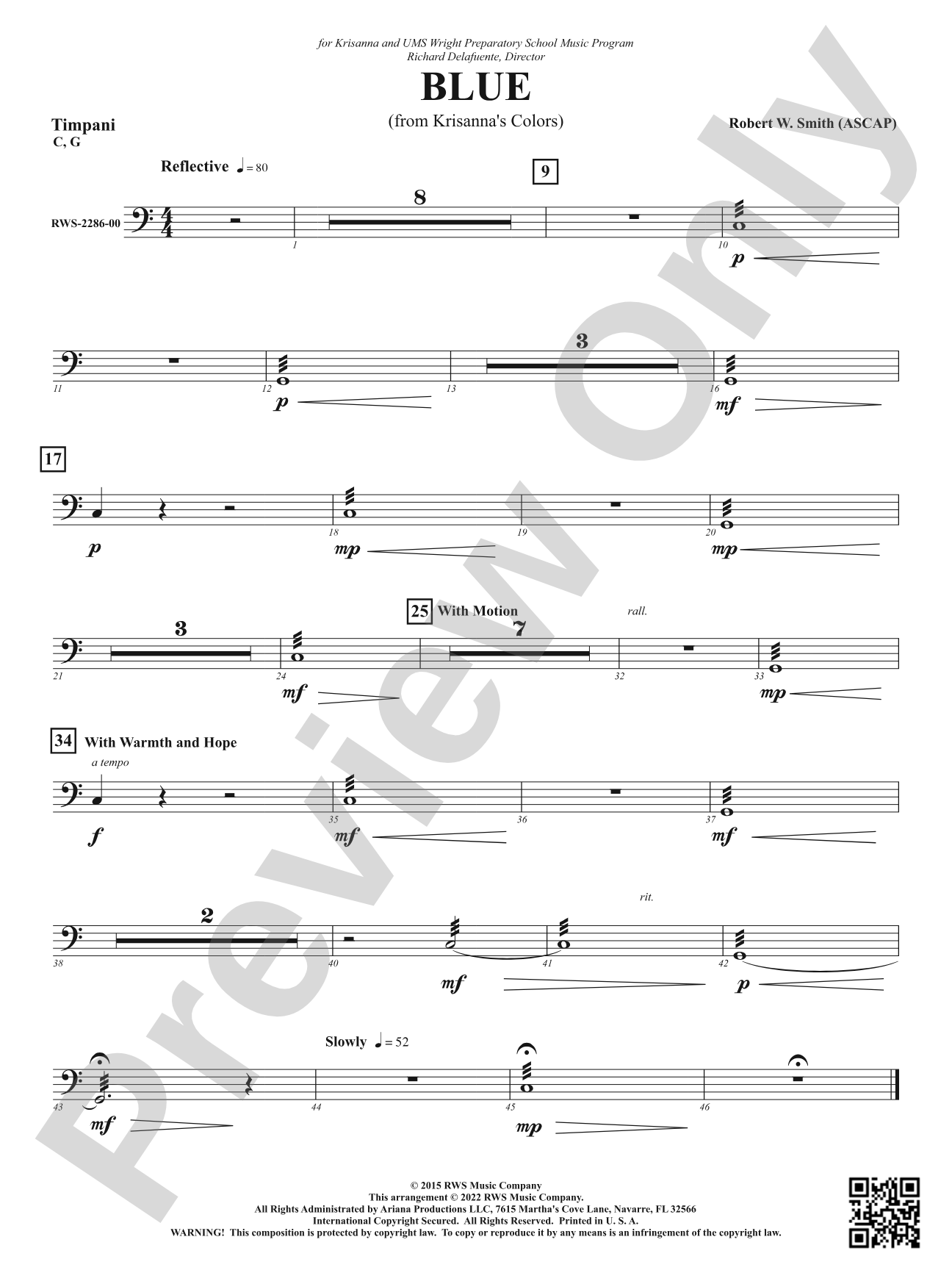

Blue - From Krisanna's Colors: Timpani
From Krisanna's Colors
By Robert W. Smith
Grade: 3
Item: 98-PC-RWS2286_TMP
$3.99
Pickup currently not available
Description
Simple, yet elegant and graceful, "Blue" is a lyrical work by Robert W. Smith scored for the full orchestra. Beautiful harmonic changes rooted in the language of American jazz make "Blue" a rich educational experience on many levels. With its poignant melody and beautiful chordal setting, Blue is appropriate for any concert or festival performance. Highly recommended!
Original Item#: RWS-2286-00


Original Item#: RWS-2286-00
Blue - From Krisanna's Colors: Timpani isn't in MakeMusic Cloud just yet...but it could be. Let us know you'd like to see it, and you'll help shape what comes next. In the meantime, start a free trial and dive into thousands of interactive titles your students can play along with today.
Request This Title
Tell us you want it.
Start Your Free Trial
Explore everything that's ready to play right now.
Sample Audio
1
Audio File
--:--
0:00
0:00
Sample Video
No sample videos found.
Additional Details
Series:
RWS - Concert Orchestra
Publisher:
RWS Music Company
SKU:
98-PC-RWS2286_TMP
More about this title
About the Composer: Robert W. Smith

Robert W. Smith stands among America's most recorded and performed composers for concert band and orchestra. With over 400 published works to his credit, the majority issued through Alfred Music, Smith has established himself as a cornerstone voice in American instrumental music. His education in music at Troy State University and the University of Miami provided the foundation for a career that has taken him across the globe as both composer and clinician, from Japan and Australia to venues across Europe and North America.
Smith's symphonic works, including The Divine Comedy and The Odyssey, have resonated with musicians and audiences worldwide. Beyond the concert hall, his music has appeared in television broadcasts, Olympic ceremonies, and iconic American events ranging from the Macy's Thanksgiving Day Parade to Opening Day at Dodger Stadium. His gift for accessible yet substantive orchestration makes his work equally valued in schools and professional ensembles.
Why we love this
Smith crafts a work that feels substantial without overwhelming your ensemble. The jazz-inflected harmonic language keeps listeners engaged while remaining within Grade 3 technical reach, and the lyrical character rewards careful phrasing and dynamic control from your musicians. This is the kind of piece that sounds polished at festival and brings genuine musical satisfaction to players who haven't yet mastered technical virtuosity.
What to expect
Blue settles over the ensemble and audience like quiet reflection. Smith's melody unfolds with graceful simplicity, while the jazz-informed harmonies beneath it create unexpected warmth and harmonic sophistication. The piece never demands virtuosity, yet it feels entirely complete and genuinely beautiful.
Who it's for
Conductors working with orchestras at the intermediate level who want a concert work with genuine musical substance and accessible orchestration. This piece rewards ensembles ready to move beyond technical etudes and into expressive, harmonically interesting literature while remaining within Grade 3 scope.
How to get the most out of it
- Shape the melody with warm, singing tone throughout; Smith's poignancy depends on the conductor and concertmaster drawing the orchestra's ears to the primary line rather than allowing accompaniment texture to dominate.
- Explore the harmonic colors deliberately. The jazz-rooted chord changes are the pedagogical heart of the piece, so let orchestral sections hear and feel how each voicing shifts underneath the melody.
- Balance transparency with fullness in sections marked tutti. The orchestration is economical by design; clarity of individual lines will reveal Smith's harmonic writing more effectively than densely blended sound.
- Allow time for the ensemble to internalize the piece's reflective mood. A slightly spacious tempo will give brass and woodwind players room to breathe and help the lyricism emerge naturally.
How to use it
Program this as the centerpiece of a concert focused on American composers or as a compassionate moment between more dramatic works. Its lyrical character and elegant restraint provide ideal contrast to energetic or virtuosic pieces, and it works particularly well as a closing selection that leaves audiences contemplative rather than exhilarated.
Skills your students will build
- Listening to and balancing jazz-influenced harmonic progressions
- Sustaining expressive phrasing across full orchestra without technical display
- Following and responding to conducting nuance in a lyrical, non-metric context
- Blending diverse orchestral colors while maintaining melodic clarity