Blue And Grey (from Lincoln) Sheet Music Preview

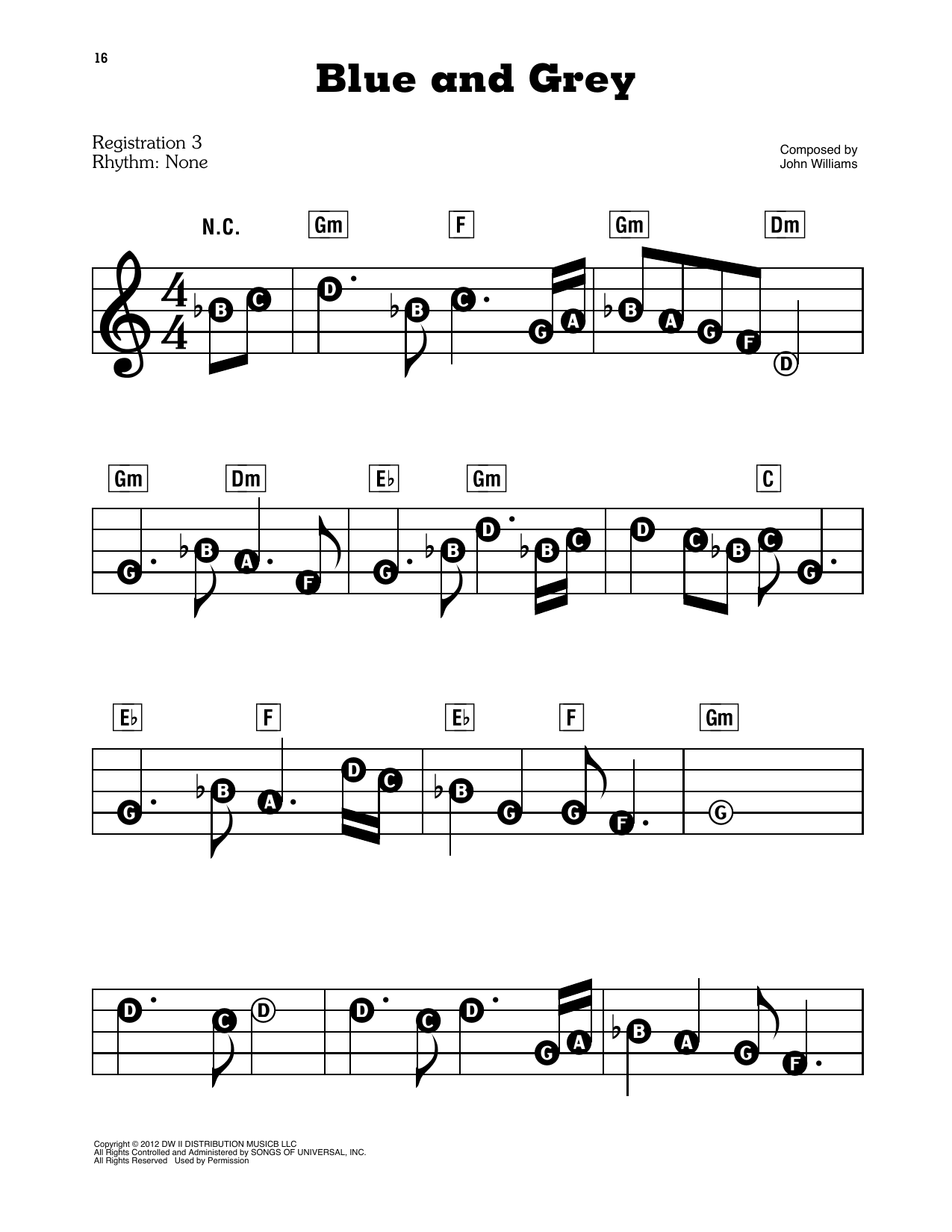
Blue And Grey (from Lincoln): E-Z Play Today

By John Williams

Item: 35-DS01885873

Digital Download
$4.99
Description

Blue And Grey (from Lincoln): E-Z Play Today isn't in MakeMusic Cloud just yet...but it could be. Let us know you'd like to see it, and you'll help shape what comes next. In the meantime, start a free trial and dive into thousands of interactive titles your students can play along with today.

Sample Audio
No sample audio found.
Sample Video
Additional Details
Publisher: Hal Leonard
Page Count: 2
SKU: 35-DS01885873

More about this title

About the Composer: John Williams

John Williams stands as one of the most prolific and celebrated film composers in history, crafting iconic scores for Star Wars, Jaws, E.T., Indiana Jones, and countless other landmark films across five decades. His mastery of orchestral writing, melodic invention, and emotional storytelling through music has earned him five Academy Awards and a place among the most performed composers of the modern era. Williams' work demonstrates that film music can achieve the same artistic depth and durability as concert hall repertoire, making his scores invaluable for music education.

In the classroom and rehearsal room, Williams' compositions serve as essential teaching tools. His clear orchestration, memorable themes, and structural clarity make complex musical ideas accessible to students of all levels, while his sophisticated harmonic language and dramatic sense inspire musicians to think beyond the page.

Why we love this

Williams composed the Lincoln score to underscore quiet moments of reflection and moral weight, and this piano arrangement captures that intimate, contemplative quality perfectly. Students and teachers respond to film music because it sits at the intersection of accessibility and artistic legitimacy, and Williams' thematic approach makes this an especially rewarding piece to rehearse and perform.

What to expect

Restrained and searching, with a quality of quiet introspection. The harmonic language carries a sense of historical weight and moral reflection, moving with deliberation rather than urgency. This is music built for listening closely rather than filling a room.

Who it's for

Pianists preparing for recitals or auditions who want repertoire that demonstrates musicality beyond technical fireworks. Teachers seeking material that engages students with contemporary film music while maintaining artistic credibility.

How to get the most out of it

  • Resist rushing the pacing. Williams writes with space and silence as compositional elements, so allow the harmonic progressions to breathe rather than pushing forward.
  • Shape the melodic line with a singing approach even on keyboard, treating sustained notes with the same care a cellist would show.
  • Listen closely to how the piece sits beneath the film; watching the relevant scene beforehand anchors the emotional intent and prevents the arrangement from feeling abstract.

How to use it

Include this as part of a contemporary music recital or a thematic concert exploring music from prestige film scores. At two pages, it works well alongside other short character pieces or as a quieter interlude between more dramatic selections.

Skills your students will build

  • Pedal control and resonance management in sparse textures
  • Phrasing in sustained, non-rhythmic material
  • Reading and interpreting minimalist-influenced harmonic progressions
  • Balancing technical simplicity with emotional depth

You May Also Like