
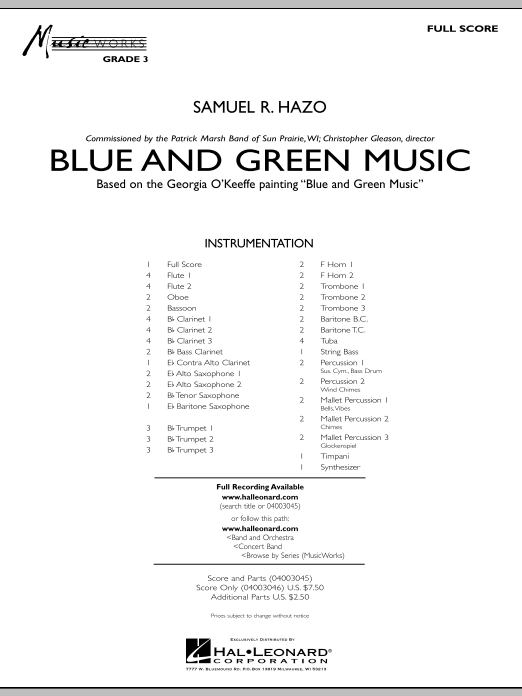

Blue And Green Music: Concert Band Conductor Score & Parts
By Samuel R. Hazo
Grade: 3
Item: 35-PK00181418
$75.00
Pickup currently not available
Buy Extra Parts (Digital PDF Download)
Parts Added to Cart!
Description
The stunning artwork of Georgia O'Keeffe is no more apparent than in her famous 1921 painting entitled "Blue and Green Music". Fittingly commissioned by the Patrick Marsh Middle School in Sun Prairie, Wisconsin (O'Keeffe's birthplace), Samuel Hazo does an amazing job of portraying subtle as well as bold colors into musical terms. Based on a single theme that is manipulated and varied throughout, the piece progresses from delicate mallet percussion effects up to climactic impact points for the entire ensemble. O'Keeffe explained her idea that "music could be translated into something for the eye." And Mr. Hazo succeeds wonderfully in translating it back into something for the ear! Dur: 4:45


Discover MakeMusic Cloud: thousands of interactive titles your students can play along with today.
Sample Audio
No sample audio found.
Sample Video
Additional Details
Publisher:
Hal Leonard
SKU:
35-PK00181418
More about this title
About the Composer: Samuel R. Hazo
Samuel R. Hazo is a composer whose work consistently bridges visual art and musical expression. His commissions from school ensembles across the country reflect a gift for writing music that speaks directly to young musicians while maintaining artistic sophistication.
Hazo's approach to composition emphasizes clarity of intent and accessibility without sacrificing musical substance. His ability to translate conceptual ideas into orchestration that works for developing ensembles has made him a valued voice in the band repertoire.
Why we love this
Hazo captures the essence of O'Keeffe's abstract vision without resorting to program music clichés. The piece earns its four and a half minutes by letting a single theme reveal new colors and dimensions through orchestration, dynamics, and texture rather than melodic repetition. For Grade 3 ensembles, this represents exactly the kind of conceptual writing that stretches young musicians musically while remaining within their technical reach.
What to expect
The piece unfolds like studying a painting under changing light. Delicate, shimmering passages give way to moments of bold assertion, then recede again into contemplation. Colors shift subtly at first, then with increasing drama, creating a journey from introspection to confident climax.
Who it's for
Grade 3 concert bands seeking repertoire that connects music to visual art and rewards careful listening. Directors looking for a substantial standalone piece that develops musicianship through textural awareness rather than technical display.
How to get the most out of it
- Shape the mallet percussion passages with rubato in the opening sections; these delicate moments establish the work's painterly foundation and benefit from flexible phrasing rather than strict metronomic playing.
- Balance the ensemble carefully as the texture thickens, ensuring that inner voices and harmonic color remain audible even as the dynamic builds toward climax.
- Treat the transition points between subtle and bold sections as intentional shifts in artistic vision rather than abrupt changes; let the orchestra settle briefly at each new dynamic level before progressing.
- Invest rehearsal time in the final climactic passage to achieve clarity and control at full volume; this moment justifies the entire arc of the piece.
How to use it
Feature this as a centerpiece in a concert exploring connections between art and music, pairing it with visual projections of O'Keeffe's work. The piece also serves well as a standalone festival entry that demonstrates your ensemble's musicality and maturity beyond technical prowess.
Skills your students will build
- Listening for and executing dynamic gradations within sustained passages
- Blending mallet percussion effects with the full ensemble
- Sustaining phrasing and musicality across a work without repetitive melodic material
- Responding to textural changes as structural markers
- Building toward climactic moments through disciplined ensemble control