Blow the Man Down Sheet Music Preview

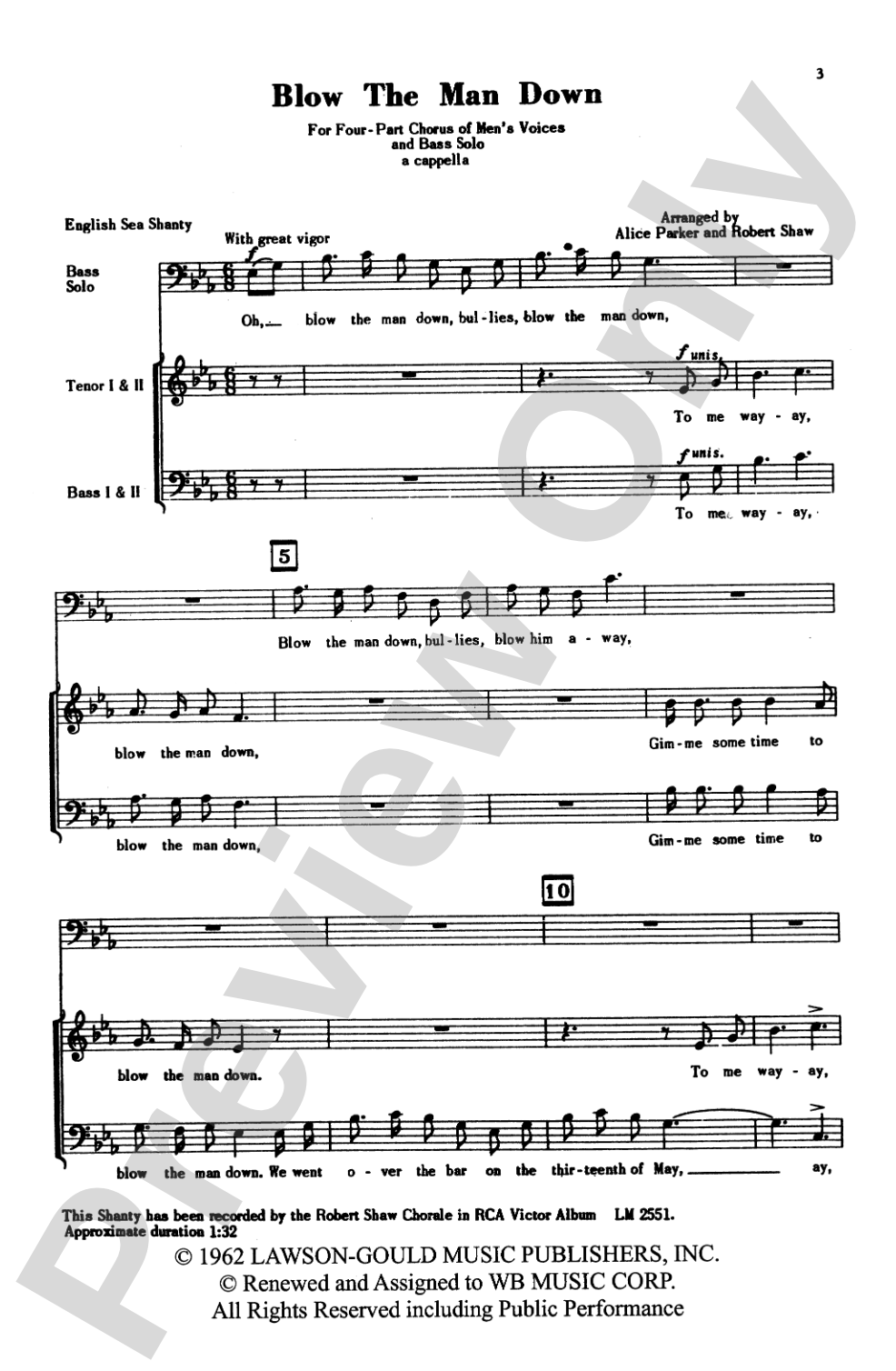
Blow the Man Down: TTBB Choral Octavo

English Sea Shanty

Arr. Robert Shaw and Alice Parker

Item: 00-PO-0004966

Digital Download
$2.25

Minimum order quantity: 20 copies

Description

Blow the Man Down: TTBB Choral Octavo isn't in MakeMusic Cloud just yet...but it could be. Let us know you'd like to see it, and you'll help shape what comes next. In the meantime, start a free trial and dive into thousands of interactive titles your students can play along with today.

Sample Audio
No sample audio found.
Sample Video
Additional Details
Series: Alfred Archive Edition: Lawson-Gould Music Publishers
Publisher: Alfred Music
Page Count: 8
SKU: 00-PO-0004966

More about this title

About the Arranger: Robert Shaw

Robert Shaw was a conductor, arranger, and educator whose work shaped American choral music in the 20th century. His arrangements are known for their attention to voice leading, clarity of texture, and respect for the original material. Shaw's decades leading the Robert Shaw Chorale and his teaching at Emory University established him as a central figure in choral pedagogy and performance.

Why we love this

Shaw and Parker's treatment of this sea shanty honors its narrative drive while opening it up for TTBB voices with genuine musicality. The flexible voicing options (TB, TTB, TBB, TTBB) mean you can perform it with the exact voice distribution you have on any given season. It's a piece that directors reach for when they need something that's both accessible and genuinely rewarding to sing.

What to expect

Salty and spirited. The melody carries the energy of working sailors, and the harmonies Shaw and Parker provide feel honest rather than fussy. There's a quality of camaraderie in the voicing, the kind that makes singers want to dig in together.

Who it's for

Directors working with men's choirs or mixed ensembles who want a folk arrangement with substance. This works equally well for high school, college, and adult singers who appreciate straightforward, singable writing.

How to get the most out of it

  • Keep the rhythm propulsive but not rigid. The maritime swagger of a sea shanty lives in the slight pushes and pulls of the line, not in metronomic precision.
  • Balance the lower voices so the harmonic foundation stays audible without overshadowing the melody. This is especially important if you're using the TB or TBB voicing.
  • Shape the text with intention. Sea shanties tell stories, and your singers should deliver the narrative with the same clarity they'd use in speech.

How to use it

Program this in a folk or American music set where it can anchor a thematic concert. It pairs naturally with other traditional repertoire and serves as a perfect palette cleanser between more complex works. It's also the kind of piece that builds ensemble confidence because singers feel the song working from the first rehearsal.

Skills your students will build

  • Managing dynamic contrast within a single melodic line
  • Balancing independent voice parts while maintaining textural cohesion
  • Interpreting rhythmic freedom in folk-derived material
  • Collaborating as section singers to support a narrative

You May Also Like