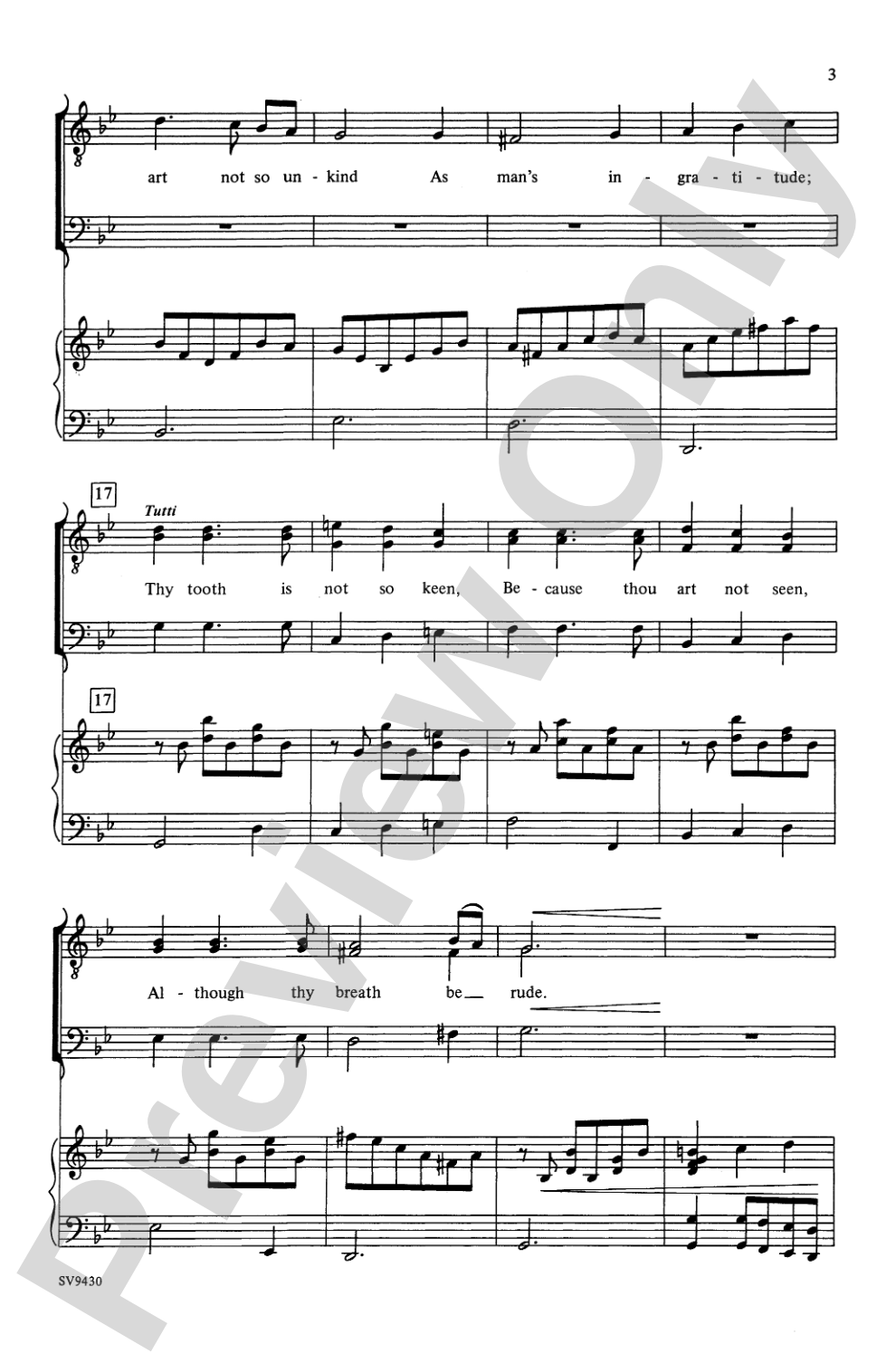
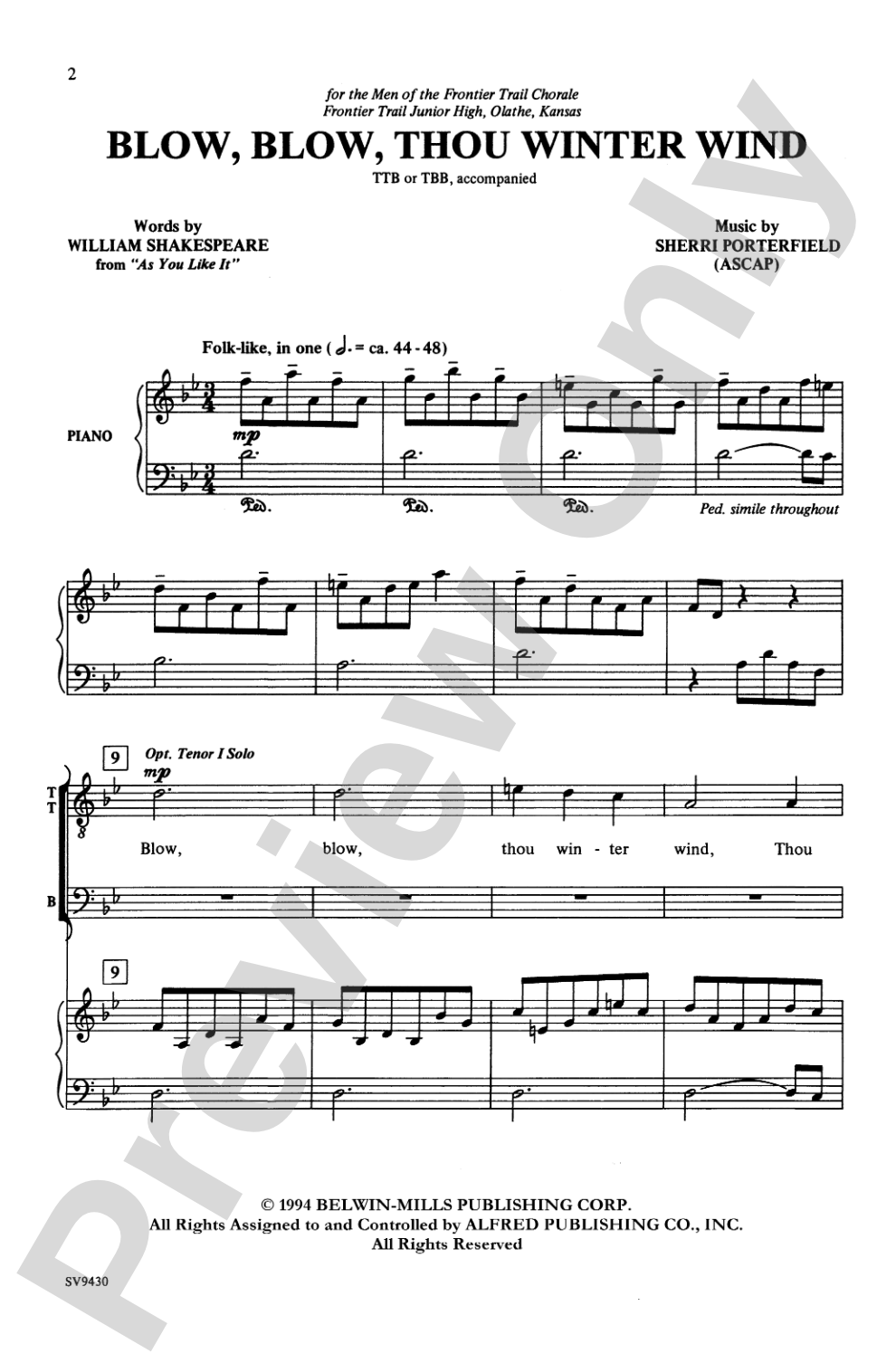
Blow, Blow, Thou Winter Wind Sheet Music Preview

Blow, Blow, Thou Winter Wind: TTB or TBB Choral Octavo

By Sherri Porterfield

Level: Moderate

Item: 00-PO-0005233

Digital Download
$2.25

Minimum order quantity: 20 copies

Description
Using Shakespeare's well-known text from As You Like It, Sherri has created a sonorous, energetic work for the male chorus. Her accompaniment is supportive, yet allows for vocal independence. A superb concert or festival piece.

Blow, Blow, Thou Winter Wind: TTB or TBB Choral Octavo isn't in MakeMusic Cloud just yet...but it could be. Let us know you'd like to see it, and you'll help shape what comes next. In the meantime, start a free trial and dive into thousands of interactive titles your students can play along with today.

Sample Audio
No sample audio found.
Sample Video
Additional Details
Series: Alfred Archive Edition: Studio PR Catalog
Publisher: Alfred Music
Page Count: 8
SKU: 00-PO-0005233

More about this title

About the Composer: Sherri Porterfield

Sherri Porterfield

Sherri Porterfield directs choirs at Cedar Park Middle School in Cedar Park, Texas, and has previously taught in Missouri and Kansas. Her ensembles have earned numerous first-place and sweepstakes awards at competitions and performed at several state music educators conventions. She has also served as an adjunct assistant professor of music education at the University of Missouri-Kansas City Conservatory of Music.

With over 175 choral compositions published through Alfred Music and other major publishers, Porterfield has maintained an active composing career since earning her B.S.E. in music education from the University of Memphis and her Master of Music in choral conducting from the University of Missouri-Kansas City. She has received yearly ASCAP awards since 1997, worked extensively as a clinician and guest conductor throughout the United States, and been recognized four times in Who's Who Among America's Teachers. She is active in the Texas Music Educators Association, Texas Choral Directors Association, American Choral Directors Association, and ASCAP.

Why we love this

Porterfield sets Shakespeare's bracing text with genuine vigor, avoiding sentimentality while honoring the poetry's bite. The accompaniment sits back intelligently, giving your men room to project and blend without fighting a dense harmonic texture, making this an excellent festival choice where clarity matters.

What to expect

Bracing and alive. Porterfield's setting captures the defiant energy of Shakespeare's winter song without sounding harsh; the voices move with purposeful momentum while the accompaniment provides harmonic color that feels fresh rather than heavy. There's a sonorous warmth beneath the outer vigor, giving the piece both teeth and heart.

Who it's for

Male choirs and mixed choirs with strong tenor and baritone sections looking for repertoire with both substance and accessibility. The moderate difficulty level makes it suitable for high school and college men's ensembles, community choirs, and advanced middle school groups seeking a festival-ready piece.

How to get the most out of it

  • Balance the voices horizontally by having singers think of the melodic line as a single musical phrase rather than blocking by part; this prevents the TB/TBB voicing from sounding sectional.
  • Let the winter imagery inform your tempo choices; the text's rhythm will naturally suggest briskness without rushing, so trust the word-painting to guide your pulse.
  • Highlight the independence Porterfield built into the accompaniment by rehearsing it thoroughly; a confident pianist makes the singers' job easier and prevents them from over-relying on harmonic support.

How to use it

Program this in a winter concert or season-themed recital, where its festive defiance plays well against more introspective material. It also functions superbly as a contest selection in the moderate division, where clean voicing and strong text delivery stand out in adjudication.

Skills your students will build

  • Singing through the vowels while maintaining the rhythmic drive of Shakespeare's text
  • Balancing independent voice lines while preserving blend in TB/TBB voicing
  • Responding to accompaniment nuance without losing independence as soloists
  • Singing with character and dramatic intention within a moderate harmonic vocabulary

You May Also Like