Bliss Sheet Music Preview

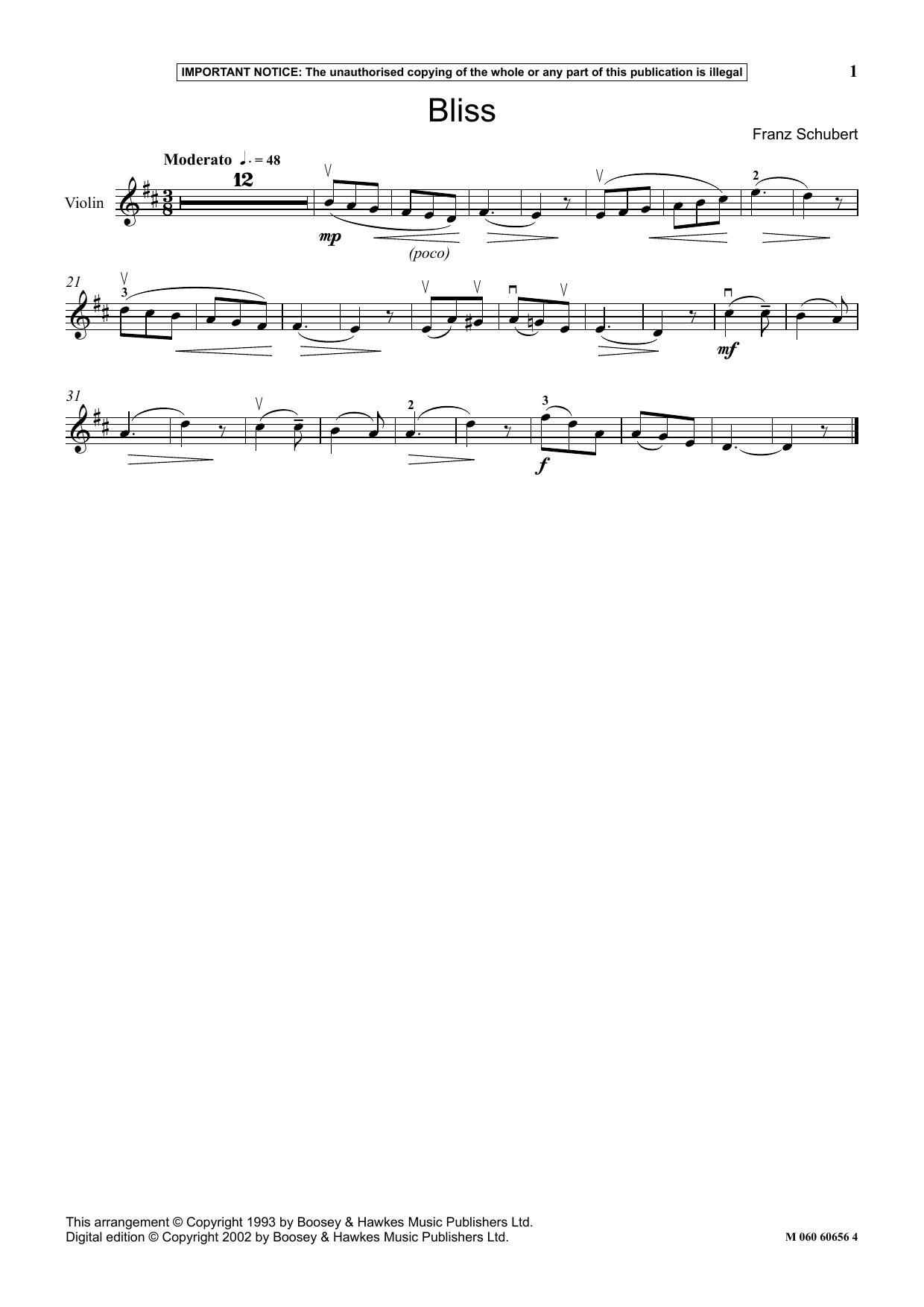
Bliss: Instrumental Solo

As performed by Franz Schubert

Item: 35-DS00239062

Digital Download
$3.99
One moment…
Description

Discover MakeMusic Cloud: thousands of interactive titles your students can play along with today.

Sample Audio
No sample audio found.
Sample Video
Additional Details
Publisher: Hal Leonard
Page Count: 2
SKU: 35-DS00239062

More about this title

About the Artist: Franz Schubert

Franz Schubert (1797-1828) composed prolifically across every major genre despite his short life, leaving behind nearly 1,000 works that shaped the course of Romantic music. His gift for melody was unmatched; he could spin out unforgettable themes that feel both intimate and expansive, often within deceptively simple formal structures. Schubert's piano works and lieder remain central to music education because they model how to achieve profound emotional depth without technical excess.

For ensemble directors and piano teachers, Schubert's accessibility masks real compositional sophistication. His works teach students about harmonic color, phrase architecture, and the power of repetition with variation. Whether adapting his chamber works or exploring his original keyboard music, performers encounter a composer equally concerned with singability and architectural integrity.

Why we love this

Schubert's instrumental writing consistently rewards student players with material that sits naturally under the fingers while demanding genuine musicality. This piece shows his knack for creating memorable phrases that anchor themselves in students' ears, making rehearsal time focused and efficient rather than frustrating.

What to expect

Schubert creates an atmosphere of gentle contentment here, the kind that emerges from a well-crafted tune and clear harmonic foundation. The music settles into you like a favorite passage from a familiar song, familiar without feeling obvious.

Who it's for

Piano students and soloists working at late elementary to early intermediate levels will find this accessible yet rewarding. Teachers seeking repertoire that combines Romantic idiom with manageable technical demands will value this addition to standard collections.

How to get the most out of it

  • Honor the lyrical contour by thinking of each phrase as a complete melodic statement rather than a collection of individual notes. Let the line breathe naturally at structural points without losing forward momentum.
  • Listen carefully to harmonic changes, particularly at cadences. Schubert's harmonic language is direct but colorful, and subtle attention to voice leading makes these moments shimmer.
  • Balance accompaniment figures so they support rather than overwhelm the primary melody. The texture should feel transparent, not heavy.

How to use it

This works well in recital settings where you're pairing Romantic miniatures, or as an encore that leaves audiences with something singable and satisfying. It also serves studio teachers well as a bridging piece between Classical forms and more elaborate Romantic expression.

Skills your students will build

  • Maintaining consistent phrasing across repeated melodic material
  • Understanding Schubert's approach to harmonic rhythm and tonal movement
  • Balance and texture control in simple accompaniment patterns
  • Interpreting Romantic-era stylistic conventions in piano writing

You May Also Like