

Blessed Legacy: F Educational Pack
Based on the American Folk Tune "Nettleton"
American Folk Tune / arr. Robert Sheldon
Grade: 1.5
Item: 00-PC-0017870_F_EDPAK
$3.00
Pickup currently not available
Description
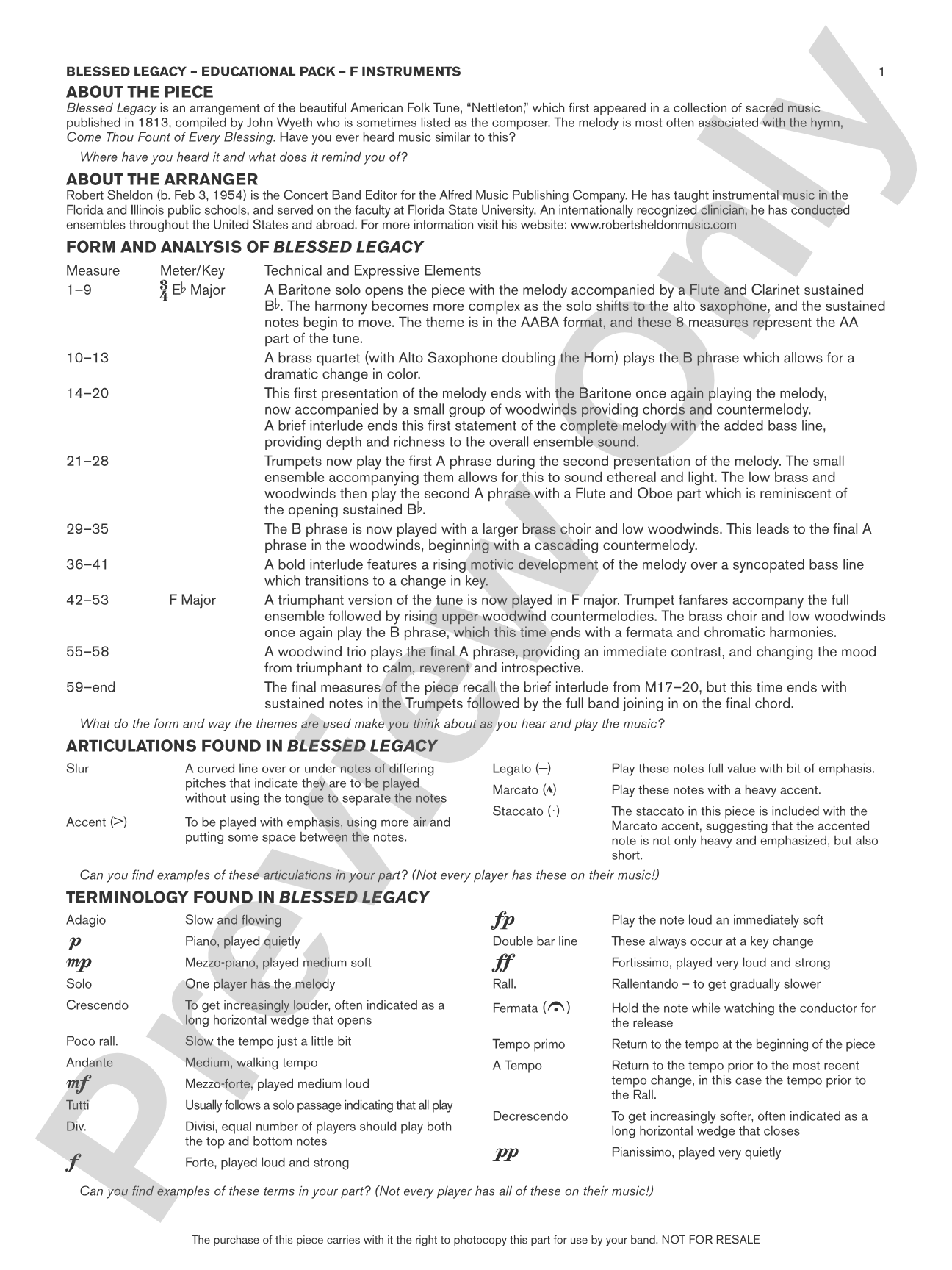
The American folk tune "Nettleton" first appeared in a collection of sacred music published in 1813, compiled by John Wyeth, who is sometimes listed as the composer. The melody is most often associated with the hymn, "Come Thou Fount of Every Blessing." Correlates with Sound Innovations for Concert Band, Book 2, Level 2.


Don't just read it, hear it, play along with it, and watch your students grow with it. In MakeMusic Cloud, Blessed Legacy: F Educational Pack comes alive with professional accompaniment, adjustable tempo, and built-in practice tools that turn solo practice into real progress.
Open in the Player
Jump straight in and assign it today.
Start Your Free Trial
Open this title and explore the full library in minutes.
Sample Audio
1
Audio File
--:--
0:00
0:00
Sample Video
Additional Details
Series:
Sound Innovations for Concert Band
Publisher:
Alfred Music
Page Count:
134
SKU:
00-PC-0017870_F_EDPAK
More about this title
About the Arranger: Robert Sheldon

Robert Sheldon's arrangements and compositions appear on contest and concert programs across the country, and his work as lead author of Sound Innovations has shaped how countless young musicians begin their journey in band. His output is prolific: commissions arrive regularly, new publications flow from his desk throughout each year, and his influence extends far beyond the United States to Australia, Canada, China, Germany, Italy, and Japan, where he conducts regional and all-state ensembles and serves as a clinician.
Sheldon's accolades come from the American School Band Directors Association, Phi Beta Mu, and ASCAP, recognizing both the craftsmanship and expressive depth that define his music. His works have been heard at Carnegie Hall, Boston Symphony Hall, Chicago's Orchestra Hall, the Sydney Opera House, and the Kennedy Center. In 2020, VanderCook College of Music awarded him an honorary doctorate.
Why we love this
Sheldon's arrangement of this beloved hymn tune sits perfectly at the threshold of early concert band literature, giving students their first real taste of a cohesive concert piece without overwhelming them. The 1.5 grade level means every section of your band can contribute meaningfully; there are no abandoned players sitting through page turns. Programming a folk hymn arrangement lets you balance a concert with more contemporary works while honoring the pedagogical logic that Sheldon built into Sound Innovations from the ground up.
What to expect
There is a quiet dignity to "Come Thou Fount of Every Blessing" that this arrangement honors. The familiar melody unfolds with warm harmony, evoking reverence without drama, and students will feel the difference between playing notes and playing music that matters.
Who it's for
Young concert bands working at the early intermediate level will find this accessible yet musically satisfying. It correlates with Sound Innovations Book 2, making it a natural fit for students already progressing through that method, and it works equally well as a standalone concert piece for Grade 1.5 ensembles of any background.
How to get the most out of it
- Let the melody sing through the upper voices but anchor it with clear harmonic support from the lower band. The folk tune deserves reverence without stiffness.
- Balance dynamic control carefully at softer volumes. At this level, students are still learning to voice their parts; use sectionals to ensure inner voices aren't drowning out when the full band plays at mezzo-piano.
- Shape the phrase contours gently. Avoid lethargy in slower passages by encouraging consistent air support and a legit approach to each line, even in held notes.
How to use it
Consider opening a winter or spring concert with this arrangement to establish a reflective mood before moving into brisker fare. Its modest instrumentation and transparent scoring also make it a strong choice for festivals and contests where judges appreciate clarity and musical intent at the Grade 1.5 level.
Skills your students will build
- Sustaining lyrical phrases with consistent intonation and tone quality
- Balancing melody against supporting harmonic parts
- Reading and executing dynamic contrasts in a full score context
- Shaping traditional melodic material with sensitivity to cultural and historical significance