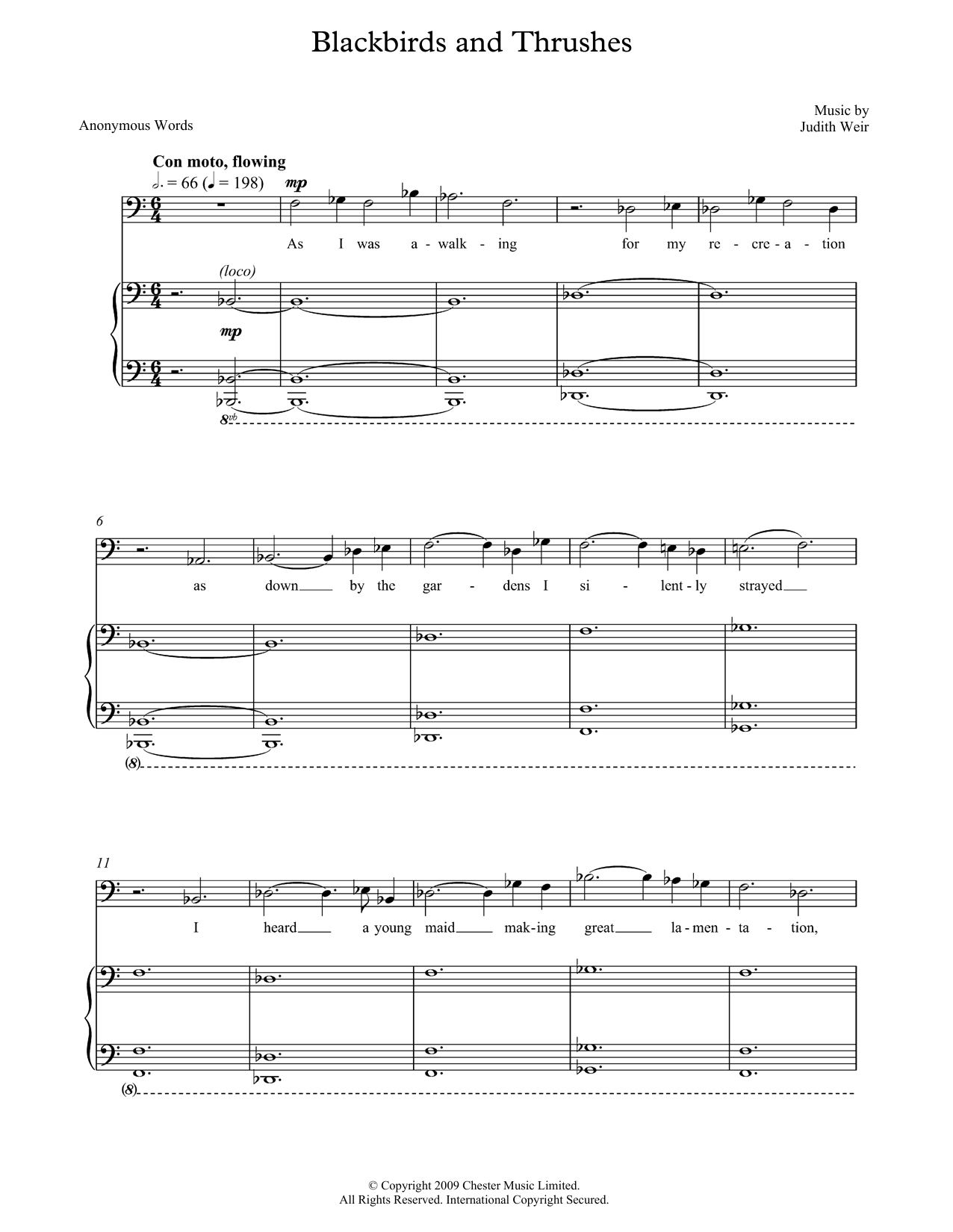
Blackbirds and Thrushes (for bass/baritone and piano) Sheet Music Preview

Blackbirds and Thrushes (for bass/baritone and piano): Piano Vocal

As performed by Judith Weir

Item: 35-DS00365204

Digital Download
$5.99
Description

Blackbirds and Thrushes (for bass/baritone and piano): Piano Vocal isn't in MakeMusic Cloud just yet...but it could be. Let us know you'd like to see it, and you'll help shape what comes next. In the meantime, start a free trial and dive into thousands of interactive titles your students can play along with today.

Sample Audio
No sample audio found.
Sample Video
Additional Details
Publisher: Hal Leonard
Page Count: 6
SKU: 35-DS00365204

More about this title

About the Artist: Judith Weir

Judith Weir is a Scottish composer whose catalogue spans opera, orchestral works, chamber music, and vocal writing. Her music combines lyrical invention with structural clarity, often drawing on literary and folk traditions to create works that are both intellectually rigorous and emotionally direct. As a professor of composition and a former master of the Queen's Music, she has shaped contemporary classical music while maintaining deep connections to song and storytelling.

Why we love this

Weir's setting brings genuine character to the vocal line while keeping the piano writing practical for collaborative rehearsal. The work inhabits that rare space where literary sensitivity and musical craft feel inseparable, making it rewarding for singers who care about text and pianists who enjoy having something substantive to play beneath the voice.

What to expect

The piece carries the quiet observational quality of a folk song viewed through a contemporary lens. There's an intimacy in the writing, with images of birds creating moments of stillness punctuated by small gestures of musical life.

Who it's for

Bass and baritone singers preparing art song repertoire, particularly those interested in contemporary British vocal writing. Pianists working with singers will find the score manageable at a reasonable tempo of learning while offering genuine musical substance.

How to get the most out of it

  • Shape the vocal phrases around the natural cadences of the text rather than forcing regularity; Weir's language flows with speech rhythms that will sound artificial if metered too strictly.
  • Balance the piano's role as both harmonic anchor and independent voice. The accompaniment should breathe with the singer, not push against the line.
  • Attend to dynamic shaping within single phrases. Weir often uses gradual swells and recessions rather than dramatic shifts, which can disappear if you don't commit to the smaller gestures.

How to use it

This works as a standalone recital piece for a singer building a program of art song, or as part of a longer concert exploring contemporary song cycles. Its modest scale makes it suitable for chamber music evenings or vocal master classes where intimate settings allow the details to register.

Skills your students will build

  • Phrasing shaped by textual rhythm and speech patterns
  • Collaborative balance between voice and piano
  • Interpretation of contemporary notation and dynamic subtlety
  • Sustained lyrical singing at modest volume levels

You May Also Like