
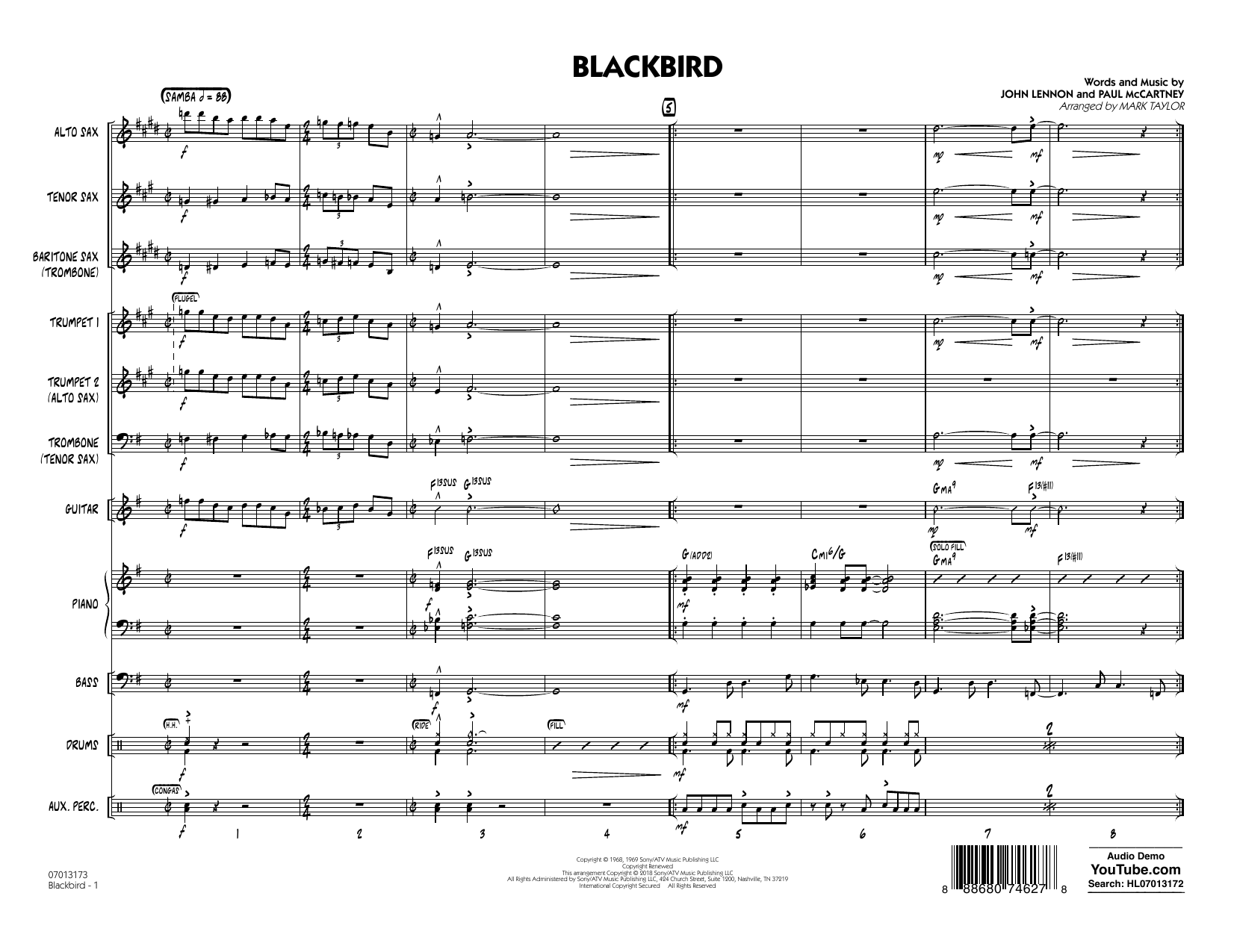

Blackbird: Jazz Ensemble Conductor Score & Parts
As performed by Wings / As performed by The Beatles / Arranged by Mark Taylor
Grade: 4
Item: 35-PK00419872
$45.00
Pickup currently not available
Buy Extra Parts (Digital PDF Download)
| Product | Price | Quantity |
|---|---|---|
| Blackbird - Full Score | $6.00 | |
| Blackbird - Alto Sax | $6.00 | |
| Blackbird - Tenor Sax | $6.00 | |
| Blackbird - Baritone Sax | $6.00 | |
| Blackbird - Trumpet 1 | $6.00 | |
| Blackbird - Trumpet 2 | $6.00 | |
| Blackbird - Trombone | $6.00 | |
| Blackbird - Guitar | $6.00 | |
| Blackbird - Piano | $6.00 | |
| Blackbird - Bass | $6.00 | |
| Blackbird - Drums | $6.00 | |
| Blackbird - Aux Percussion | $6.00 | |
| Blackbird - C Solo Sheet | $6.00 | |
| Blackbird - Bb Solo Sheet | $6.00 | |
| Blackbird - Eb Solo Sheet | $6.00 | |
| Blackbird - Bass Clef Solo Sheet | $6.00 | |
| Blackbird - Alternate Alto Sax | $6.00 | |
| Blackbird - Alternate Tenor Sax | $6.00 | |
| Blackbird - Alternate Trombone | $6.00 | |
| Blackbird - Alto Sax Sample Solo | $6.00 | |
| Blackbird - Trumpet Sample Solo | $6.00 |
Parts Added to Cart!
Description
The haunting and distinctive "Blackbird" (from the Beatles' "White" album) is adapted here in a moderate samba style for the little big band format. Trumpet and alto sax are featured on the melody and for solos.


Blackbird: Jazz Ensemble Conductor Score & Parts isn't in MakeMusic Cloud just yet...but it could be. Let us know you'd like to see it, and you'll help shape what comes next. In the meantime, start a free trial and dive into thousands of interactive titles your students can play along with today.
Request This Title
Tell us you want it.
Start Your Free Trial
Explore everything that's ready to play right now.
Sample Audio
No sample audio found.
Sample Video
No sample videos found.
Additional Details
Publisher:
Hal Leonard
SKU:
35-PK00419872
More about this title
About the Artist: Wings
Wings, Paul McCartney's post-Beatles group, brought a more accessible, groove-oriented sound to popular music in the 1970s. McCartney's songwriting remained sophisticated while becoming more direct and rhythmically adventurous, particularly on the "White" album track that appears here. The band's work has proven remarkably durable for educational arrangements because the melodies are strong, the harmonic language is modern but not opaque, and the grooves naturally translate into jazz ensemble contexts.
Why we love this
This arrangement captures something that the original recording conveys with deceptive simplicity: a haunting melody that sits perfectly in the middle register and invites both soloing and close listening. The samba groove feels fresh in a jazz ensemble setting without overwhelming the piece's introspective character, and having both trumpet and alto sax share the melody creates natural sectional interplay that students actually enjoy executing.
What to expect
Haunting and meditative, with an understated elegance. The samba rhythm gently propels the tune without disrupting its reflective quality, and the melody itself lingers in the ear. It's the kind of arrangement that quiets a room.
Who it's for
Jazz ensembles at the intermediate level who are ready to tackle pop repertoire with musical integrity. Directors looking for material that appeals to students while offering real pedagogical content will find this particularly useful.
How to get the most out of it
- Let the samba feel breathe rather than pushing it into a rigid swing. This piece gains its distinctive quality from rhythmic subtlety, not energy.
- Balance the melody between trumpet and alto sax so the handoff between instruments feels conversational, not mechanical.
- Encourage soloists to honor the piece's introspective mood. The solo space here is for development of the melody's character, not pyrotechnics.
- Use the rhythm section to anchor the samba feel without letting it overwhelm the foreground. Bass and drums should lock in tightly so horn players can phrase with confidence.
How to use it
Pair this with other pop-to-jazz adaptations in a "Great Songwriting" concert set, or use it as a contrast piece in a program that otherwise features swing and bebop standards. It also works well in a student showcase where you want to highlight featured soloists in a setting that remains emotionally grounded.
Skills your students will build
- Phrasing lyrical melodies with maturity in a samba context
- Trading melody lines between sections while maintaining continuity
- Improvising within a modal or blues-inflected harmonic framework
- Supporting a groove without pushing or dragging the tempo