
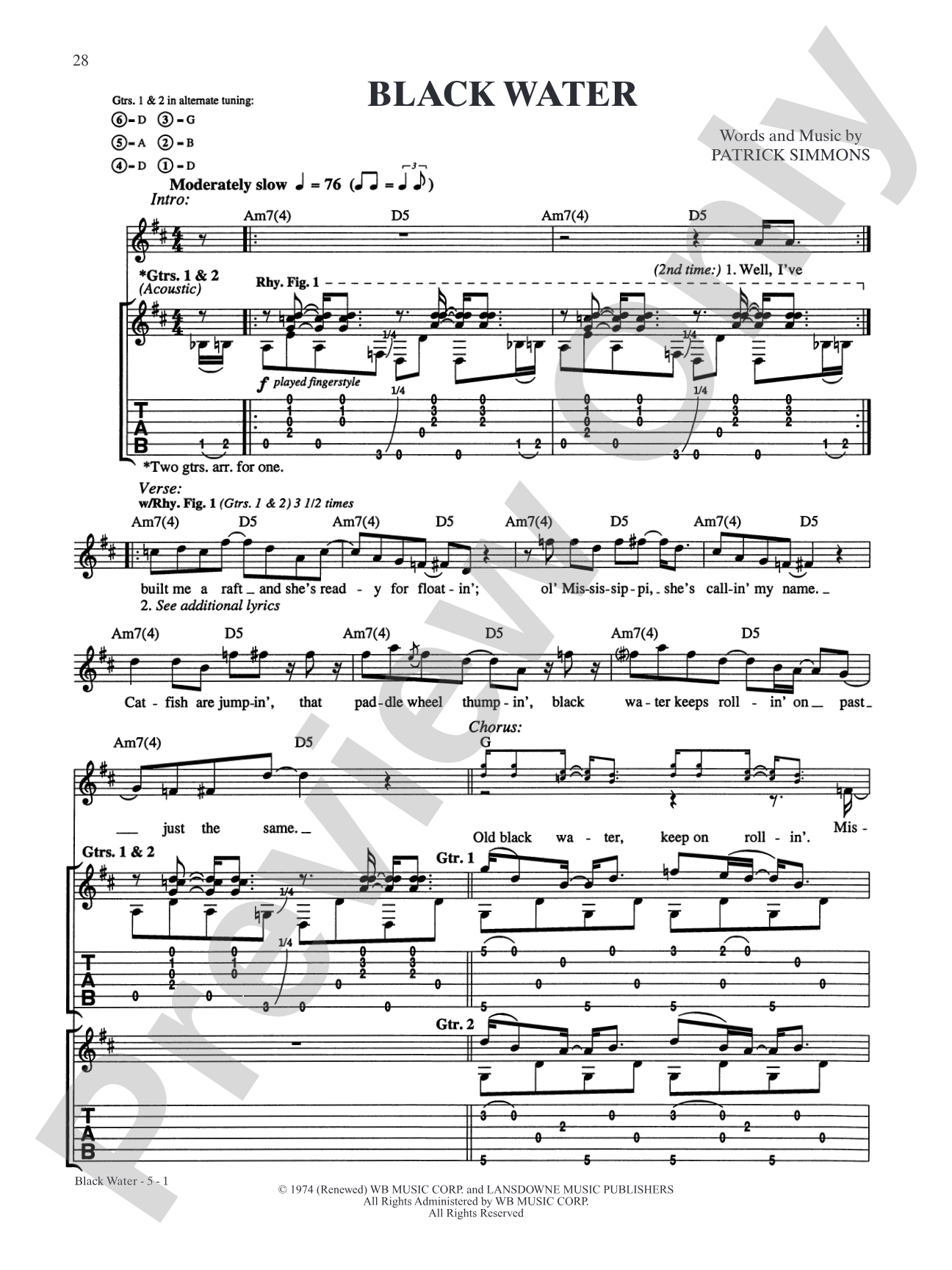

Black Water: Authentic Guitar TAB
37 of the Best Guitar Songs from Your Favorite Artists
Item: 00-PSG-000791
$4.99
One moment…
Description
Album rock evolved in the late 1960s as groups like Cream, Pink Floyd, Blind Faith, Jimi Hendrix, the Beatles, and many more shattered the '50s pop standard of the "three-minute single" and began focusing their attention on producing albums. Radio stations latched on instantly to this Classic Rock era, playing long album tracks and even entire album sides.
Alfred introduces some of the most popular album rock tracks from the '60s, '70s, and '80s. All songs include authentic guitar TAB.
Titles: Bad to the Bone * Hotel California * I've Seen All Good People * Moondance * Old Time Rock & Roll * Speak to Me/Breathe * Us and Them * You Shook Me * and more!


Alfred introduces some of the most popular album rock tracks from the '60s, '70s, and '80s. All songs include authentic guitar TAB.
Titles: Bad to the Bone * Hotel California * I've Seen All Good People * Moondance * Old Time Rock & Roll * Speak to Me/Breathe * Us and Them * You Shook Me * and more!
Black Water: Authentic Guitar TAB isn't in MakeMusic Cloud just yet...but it could be. Let us know you'd like to see it, and you'll help shape what comes next. In the meantime, start a free trial and dive into thousands of interactive titles your students can play along with today.
Request This Title
Tell us you want it.
Start Your Free Trial
Explore everything that's ready to play right now.
Sample Audio
No sample audio found.
Sample Video
No sample videos found.
Additional Details
Publisher:
Alfred Music
Page Count:
264
SKU:
00-PSG-000791
More about this title
About the Artist: The Doobie Brothers
The Doobie Brothers emerged from San Jose, California in the late 1960s and became one of rock's most adaptable bands, shifting seamlessly from country-rock to funk to pop across their catalog. Their tight musicianship and vocal harmonies made them radio staples throughout the '70s and '80s, with hits like "Listen to the Music" and "Long Train Runnin'" demonstrating their ability to craft songs that were both commercially successful and musically substantial.
Why we love this
This collection captures the swagger and precision of classic rock at its commercial peak, offering guitarists concrete models for rhythm playing, lead work, and the dynamics that made album rock distinct. The mix of blues-rooted riffs, intricate fingerpicking passages, and straightforward rock grooves gives players something to sink their teeth into across multiple skill levels within a single collection.
What to expect
Muscular and confident; these are songs built for amplified guitars and recorded in studios where every detail was intentional. The collection carries the weight of albums that defined decades of rock radio.
Who it's for
Guitarists who want to understand the harmonic language and groove sensibility of classic rock through direct study of canonical recordings. High school and adult players seeking repertoire that builds both technical facility and musicianship across rhythm and lead playing.
How to get the most out of it
- Lock in with the rhythm section on the straight-eighth and swing-eighth feels; many of these tracks shift between them, so listen closely to the original recordings to nail the pocket.
- Study the original album versions for dynamics and tone choices; classic rock succeeds through deliberate control of volume and overdrive, not constant intensity.
- Pay attention to the TAB fingering suggestions for chord voicings; these tracks often use specific voicings that define their character, and substituting open chords will flatten the sound.
- Work through the lead passages slowly and focus on phrase phrasing and vibrato; the difference between a technically correct note and a convincing one lives in these details.
How to use it
Feature individual songs in student recitals or ensemble settings where rock instrumentation makes sense. Use selections as summer practice repertoire to keep advanced players engaged between school semesters, or assign tracks from the collection as listening references when teaching rock history and guitar technique.
Skills your students will build
- Reading and executing authentic guitar tablature
- Playing with pocket and feel across multiple rhythmic feels (straight eighths, triplet feels, swing)
- Chord voicing control and the relationship between voicing choice and tone
- Lead guitar phrasing, articulation, and expressive technique (vibrato, bending, dynamics)
- Understanding how rhythm and lead guitar parts interact within a song structure