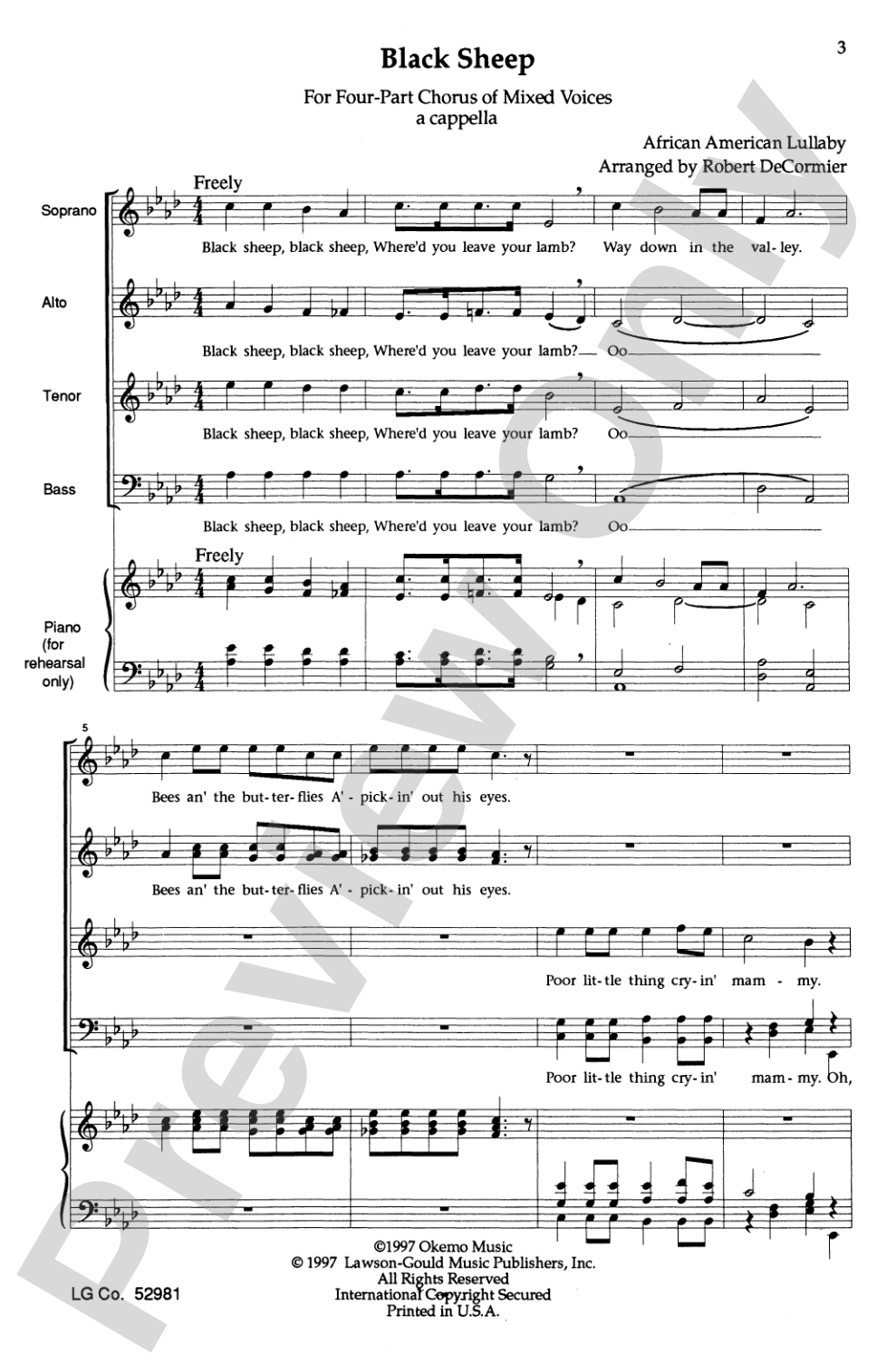
Black Sheep Sheet Music Preview

Black Sheep: SATB Choral Octavo

Arr. Robert DeCormier

Item: 00-PO-0005102

Digital Download
$2.25

Minimum order quantity: 20 copies

Description

Black Sheep: SATB Choral Octavo isn't in MakeMusic Cloud just yet...but it could be. Let us know you'd like to see it, and you'll help shape what comes next. In the meantime, start a free trial and dive into thousands of interactive titles your students can play along with today.

Sample Audio
No sample audio found.
Sample Video
Additional Details
Series: Alfred Archive Edition: Lawson-Gould Music Publishers
Publisher: Alfred Music
Page Count: 8
SKU: 00-PO-0005102

More about this title

About the Arranger: Robert DeCormier

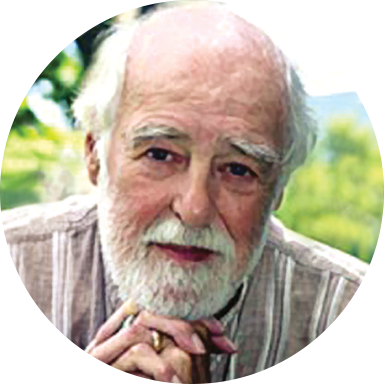
Robert DeCormier

Robert DeCormier studied at the Juilliard School and built a conducting career spanning Broadway, opera, and concert halls throughout the United States and Canada. He served as music director of the New York Choral Society for seventeen years, worked as conductor and arranger for Harry Belafonte, and directed the vocal ensemble for Peter, Paul and Mary from 1978 to 2010. He also taught conducting and ensembles at the Eastman School of Music and founded Counterpoint, a professional vocal ensemble based in Vermont that recorded six albums and conducted workshops with high school choirs across New England.

DeCormier's compositional and arranging work drew from African-American spirituals, American folk songs, and international repertoire. His recordings appear on multiple labels including Arabesque, Vox Turnabout, and Centaur. His television work includes a BBC choral series and Emmy-winning specials, and his contributions to music education and the arts earned him the Vermont Governor's Award for Excellence in the Arts in 2002 and a Lifetime Achievement Award from the New England Choral Arts Foundation in 2006.

Why we love this

DeCormier's arrangement brings the wisdom and playfulness of this traditional tune into a sophisticated four-part setting that works equally well in educational and performance contexts. His ear for voice leading and harmonic color transforms a simple melody into something that sounds both fresh and entirely singable, making it an ideal choice for choirs looking to program something memorable without excessive technical demands.

What to expect

Warm and unpretentious, with the character of a folk song elevated through careful harmonic writing. The arrangement invites singers to connect with the melody's directness while enjoying the richness that four-part writing adds; there is lightness here, not heaviness, even when all voices are engaged.

Who it's for

This octavo suits intermediate to advanced SATB choirs of any age, from high school singers developing secure voice part independence to community and adult choirs seeking accessible secular repertoire with musical substance. It works well in schools, churches, community theaters, and concert settings where the text and melody are familiar enough that singers can focus on blend and interpretation.

How to get the most out of it

  • Balance the melody between soprano and alto in passages where both voices carry the tune; DeCormier's doubling creates richness only if neither part overshadows the other.
  • Shape the text naturally rather than pushing for dramatic effects; the arrangement's charm depends on clear, conversational phrasing that lets the words land.
  • Use dynamic contrast to delineate sections and keep the piece engaging; the eight pages reward subtle attention to light and shade.
  • Ensure rhythm section clarity between all four parts, particularly in any homophonic passages, to maintain the piece's rhythmic integrity.

How to use it

Program this as a palate cleanser between more demanding choral works, or pair it with other folk-song arrangements to create a thematic set. It also serves as an excellent teaching piece for rehearsals focused on blend, balance, and text clarity without requiring extensive preparation from soloists or elaborate staging.

Skills your students will build

  • SATB voice part independence and blend
  • Phrasing folk melody across multiple voice parts
  • Harmonic listening and intonation in four-part writing
  • Text clarity and natural speech rhythm in ensemble singing

You May Also Like